

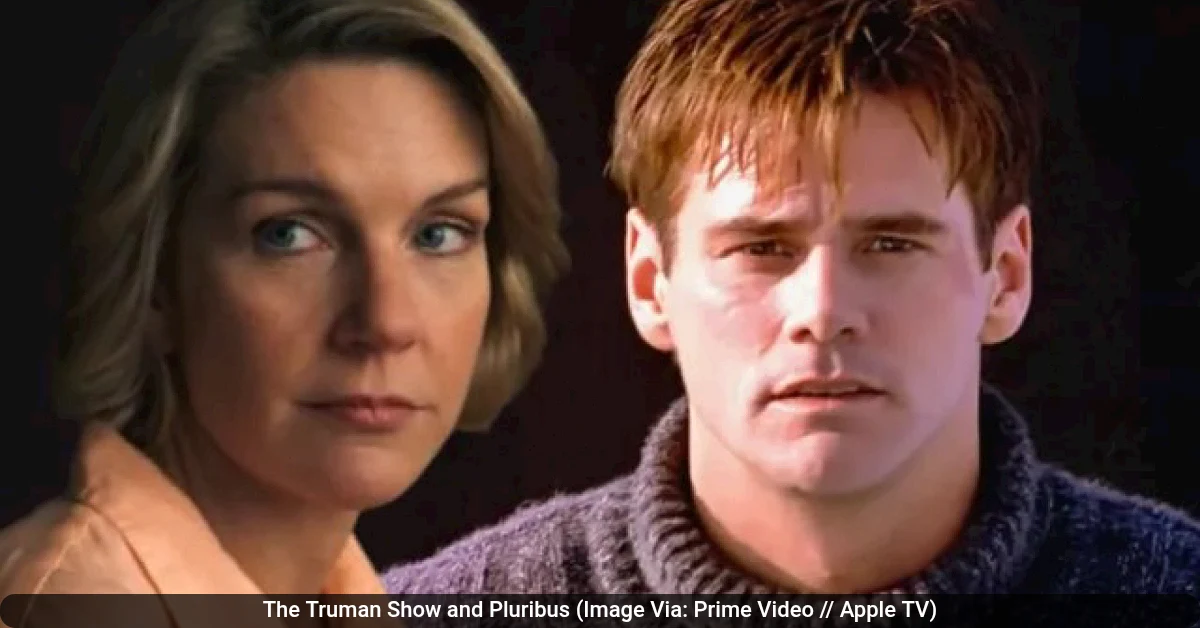
Apple TV’s Pluribus has become a major hit for the streaming service, drawing viewers into a strange new world where nearly everyone is connected to a peaceful hive mind. As the first season moves toward its finale, many are noticing the show’s story shares a powerful connection with a classic film. The series, starring Rhea Seehorn, asks tough questions about freedom, control, and reality that strongly echo the themes of Jim Carrey’s 1998 movie, The Truman Show.
Both stories center on one person living inside a world that is not what it seems. For Truman Burbank, his entire town is a television set. For Carol Sturka in Pluribus, the world has been taken over by an alien force that removes individual thought. While one story is a satirical comedy and the other a sci-fi drama, they both make audiences wonder: what happens when your happy, safe life is built on a lie?
The core similarity between the two stories is their main character’s situation. Jim Carrey’s Truman Burbank lives in the picture-perfect town of Seahaven. Unbeknownst to him, everything from his friends to the weather is controlled by Christof, the director of the 24-hour reality show that is Truman’s life. Truman is the only “real” person in a world of actors.
In Pluribus, Rhea Seehorn’s Carol Sturka is one of the last uninfected humans after a global event called “the Joining.” An alien virus has connected almost all of humanity into a single, placid hive mind. The infected people, or “Others,” are kind, cooperative, and unnervingly happy. They build a calm and orderly reality around Carol, catering to her needs while gently pushing her to join them. Like Truman, Carol is the only authentic person in her immediate world, surrounded by others who are playing a part in a larger design.
In both cases, the environment is not random. It is designed.
Both narratives explore the idea that a life without pain or struggle might also be a life without true freedom. In The Truman Show, Truman has a good job, a loving wife, and a safe community. In Pluribus, the hive mind has eliminated war, conflict, and environmental harm. On the surface, these worlds offer comfort and security.
The cost, however, is individual choice and authenticity. Truman cannot leave Seahaven; the show’s producers use his manufactured fear of water to keep him trapped. Carol is constantly monitored and managed by the Others, who see her independent emotions as a problem to be solved. The shows suggest that control is most effective when it is wrapped in the appearance of kindness and care. The creators of these worlds—Christof in the film and the collective consciousness in Pluribus—genuinely believe they are providing a better way to live.
The dramatic tension in both stories comes from the moment the main character starts to question their reality. For Truman, it begins with small, strange events: a stage light falling from the “sky,” a radio that seems to describe his movements. For Carol, it is the uncanny, uniform happiness of everyone around her and the direct pleas from the hive mind for her to assimilate.
Realizing the truth is only the first step. Both characters face the difficult decision of whether to fight for a difficult freedom or accept a comfortable captivity. Truman nearly abandons his escape attempt before finding the courage to sail to the edge of his world. Carol wrestles with the temptation to give in to the peace offered by the Joining, especially when an outside force pushes her to keep resisting. Their struggle highlights a central question: is it worth risking everything for the right to choose your own path, even if that path is harder?
The Truman Show famously ends with Truman stepping through a door in the studio wall and into the unknown. The film suggests his victory is bittersweet; after a lifetime of being watched and controlled, he will have to navigate a real world that is complex and challenging. His escape is a powerful statement of self-determination, but not a guarantee of future happiness.
Pluribus is building toward a similar dilemma for Carol. Analysis of the show’s recent episodes suggests her story is not headed for a simple, clean victory. If she succeeds in resisting or defeating the hive mind, she may face a world in ruins, grieving the loss of her partner, and bearing the heavy responsibility of being one of the last independent humans. The series, like the film, appears interested in the costly price of true freedom.
You May Also Like:







The reason the comparison between these two works resonates is that they tap into timeless and increasingly relevant anxieties. When The Truman Show was released, it commented on the rise of reality television and media manipulation. Today, Pluribus feels connected to modern fears about technology, artificial intelligence, and the loss of personal identity in a connected world. Both stories serve as powerful allegories, encouraging viewers to examine the influences that shape their own lives and perceptions.
Pluribus is now the most-watched series in Apple TV’s history. Its first season is set to conclude with a finale expected to air around the Christmas holiday.
Also Read: ClaireBell Season 1 Finale: Ending Explained and Key Story Points Recap

