

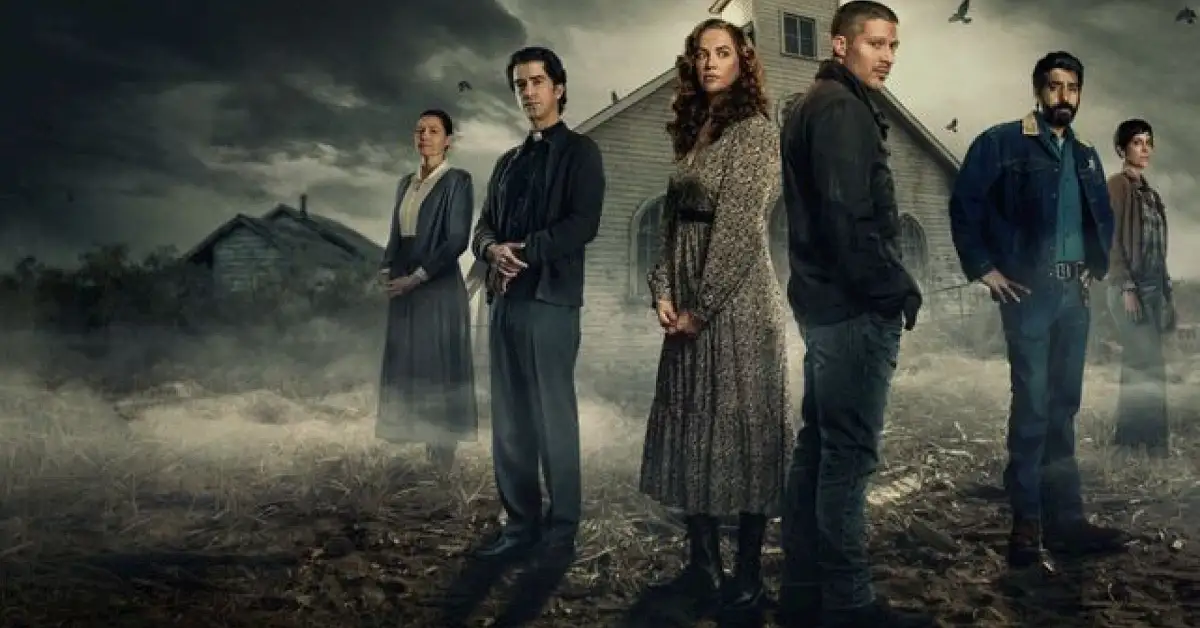

Mike Flanagan, the creator behind some of Netflix’s biggest horror hits, recently opened up about his most personal project, Midnight Mass, and dropped a truth bomb that might disappoint fans but makes perfect sense given how much the TV industry has changed. The filmmaker admitted that the 2021 series, which many consider his best work, is essentially a one-of-a-kind show that slipped through the cracks at exactly the right moment—and probably wouldn’t stand a chance of getting made in 2026.
During a guest appearance on the Flanagan’s Wake podcast, the director got real about why Midnight Mass remains an anomaly in his filmography and why the current streaming landscape, with its tight budgets and formula-driven approach, would never greenlight something so deeply personal and deliberately paced .
The Show That Almost Wasn’t
For those who haven’t seen it, Midnight Mass tells the story of a small, isolated fishing community called Crockett Island where a mysterious young priest, Father Paul Hill (Hamish Linklater), arrives and begins performing inexplicable miracles. What unfolds is less of a traditional vampire tale and more of a meditation on faith, grief, fanaticism, and community—with vampires quietly lurking in the background as metaphors.
Flanagan didn’t hold back when explaining why the series feels like such a miracle that it got made at all. “There’s nothing about it on paper that makes sense to make,” he said flatly on the podcast. “It’s just not a show you make” .
The series features long monologues about life and death, slow-burn character development, and a structure that Flanagan himself compared to a stage play rather than a typical horror series. It deliberately avoided calling its creature a “vampire,” even though it checks every box of vampire lore, because Flanagan wanted to keep the focus on religious fanaticism rather than horror tropes .
How ‘Hill House’ and ‘Bly Manor’ Made It Possible
So how did such an unpitchable show actually get made? According to Flanagan, it was a combination of timing, leverage, and what he jokingly called “hostage-taking.”
After The Haunting of Hill House became a massive critical and commercial success for Netflix in 2018, Flanagan had serious bargaining power. When the streamer came calling for a follow-up, The Haunting of Bly Manor, Flanagan made a deal .
“‘Hill House’ did so well that they wanted ‘Bly Manor,’ and I said I would do it if they did ‘Midnight Mass.’ So there’s a little bit of hostage-taking involved” .
That strategy worked. Netflix agreed to develop Flanagan’s passion project—one he had been carrying in his head since 2010, long before anyone knew his name . He had first tried to turn the idea into a novel, then a film script that ballooned to 150 pages without reaching the midpoint, before finally realizing it needed the space of a television series .
For years, networks rejected the concept. Flanagan recalled pitching a 45-minute presentation to over a dozen different places, only to be turned down by every single one . It wasn’t until he proved his commercial viability with Hill House that Midnight Mass finally found a home.
The Netflix ‘Regime Change’ That Changed Everything
Here’s where the story gets even more complicated. By the time Midnight Mass finished production, the executives who had approved it were no longer working at Netflix .
“There’d been a huge executive regime change at Netflix that occurred during production on ‘Midnight Mass,’” Flanagan explained .
The show was made during the COVID-19 pandemic, which actually worked in its favor. The production operated in its own bubble with minimal oversight. But when filming wrapped and the new leadership team sat down to watch the finished product, they were confused .
“There was a whole new team who had just gotten acclimated and said, ‘Okay, let’s see this show.’ And I was like, ‘Here is the show!’ And they said, ‘Where are the vampires?’ And I said, ‘They’ll get there eventually, but the real vampire is fanaticism!’ They didn’t think that was terribly funny” .
The new executives pushed for major reshoots to turn it into a more straightforward vampire series that would be easier to market. But Flanagan explained that the sets had already been destroyed, making expensive reshoots impossible . With no other option, Netflix released the series as-is in September 2021.
Against All Odds, It Worked
Despite the behind-the-scenes uncertainty, Midnight Mass found its audience. During its first full week of release, it ranked second across all major streaming platforms in minutes watched—trailing only the global phenomenon Squid Game season 1 . Critics praised its ambition, its performances (particularly Linklater’s transformative turn as Father Paul), and its willingness to ask big questions without providing easy answers.
The series currently holds an impressive 87% on Rotten Tomatoes, and fans regularly rank it as Flanagan’s most emotionally resonant work . For Flanagan personally, it remains the favorite of all the series he’s made .
“It’s my favorite of the series that I’ve gotten to do,” he said on the podcast .
Why It Would Never Happen Today
Flanagan was blunt about the chances of Midnight Mass getting made in the current entertainment industry. “I don’t think the show would be made today, anywhere,” he stated .
He pointed to how much the streaming landscape has shifted. “It happened at the perfect time when Netflix was saying yes to so many things. The industry’s just not like that anymore” .
Today’s streaming services are cutting budgets, canceling shows faster than ever, and playing it safe with established intellectual property. A slow, talky, seven-episode miniseries about faith and grief that happens to have a vampire in it—but refuses to call it a vampire—simply doesn’t fit the current algorithm-friendly model.
Flanagan also explained that the show’s refusal to provide clear answers made it a tough sell. “It had struck me that it was a show about internal dialogue and homilies, and ultimately a show that didn’t have the answers to the questions it asked, because we don’t. And that was kind of baked into its identity, and it was really just a song at the end of the day, about faith, and life, and how we treat each other, and it’s hard to sell that” .
The Original Plan for a Very Different Season 2
Fans who’ve wondered about a second season might be surprised to learn that Flanagan originally had very different plans for the story—plans that would have completely changed the ending audiences eventually got .
In early versions of the script, Riley Flynn (Zach Gilford) was supposed to survive and become the antagonist of a potential second season. Flanagan envisioned Riley fighting the “angel” at the end of season 1, getting his throat torn open but not dying on screen. He would then return as a traveling preacher with a Southern Baptist revival tent, with Warren (Igby Rigney) and Leeza (Annarah Cymone) chasing him across America to stop him .
“It took years for me to realize that [Riley] had to get out of the way,” Flanagan admitted. Once he made the decision to shift focus to Erin Greene (Kate Siegel) as the true hero, everything clicked into place .
That change allowed for the devastating finale where the island burns, the characters sing “Nearer My God to Thee,” and the story finds its emotional resolution. “All of that, and them singing ‘Nearer My God to Thee,’ all of my favorite things about the end, never would have happened with Riley [living to the end],” Flanagan explained .
What the Cast Thinks Now
Hamish Linklater, whose performance as Father Paul earned widespread acclaim, recently addressed the possibility of working with Flanagan again. In an interview promoting Gen V season 2, Linklater made it clear he’d jump at the chance .
“I’ve discussed it, but has he discussed it back to me? No, because look, he’s made a bunch of projects, making projects all the time, not casting old Father Paul much. That’d be nice. He’s the best, he’s absolutely the best. I’d love to work with him again” .
Given Flanagan’s habit of working with the same actors across multiple projects—career-long collaborators like Henry Thomas, Kate Siegel, Rahul Kohli, and Samantha Sloyan all appeared in Midnight Mass—it wouldn’t be surprising to see Linklater pop up in a future Flanagan project. However, with Flanagan now based at Amazon following his move from Netflix, and currently developing a Carrie TV adaptation, schedules may need to align first .
Related Stories
View all articles about
The Show’s Lasting Legacy
What makes Midnight Mass special, according to Flanagan, is precisely what makes it difficult to replicate. It came from a deeply personal place—his own experiences as an altar boy, his journey with faith, his questions about how we should live and what happens when we die .
Flanagan intentionally avoided calling the creature a vampire because he didn’t want audiences bringing centuries of vampire expectations to the story . “I think Midnight Mass is not a vampire story in the traditional sense because the vampire in our story is really representing fanaticism and fundamentalism,” he explained.
Also Read: The Pitt Season 2 Episode 7: Shawn Hatosy Opens Up About Dr. Abbott ‘Checking In on’ Dr. Robby
The show remains available on Netflix for anyone who wants to experience what Flanagan calls “a song at the end of the day, about faith, and life, and how we treat each other” . And while the industry may have changed, the series stands as proof that sometimes the most unpitchable ideas become the most unforgettable.
For more entertainment news and exclusive interviews, keep checking back with VvipTimes for the latest updates from the world of streaming and horror.






Leave a Reply