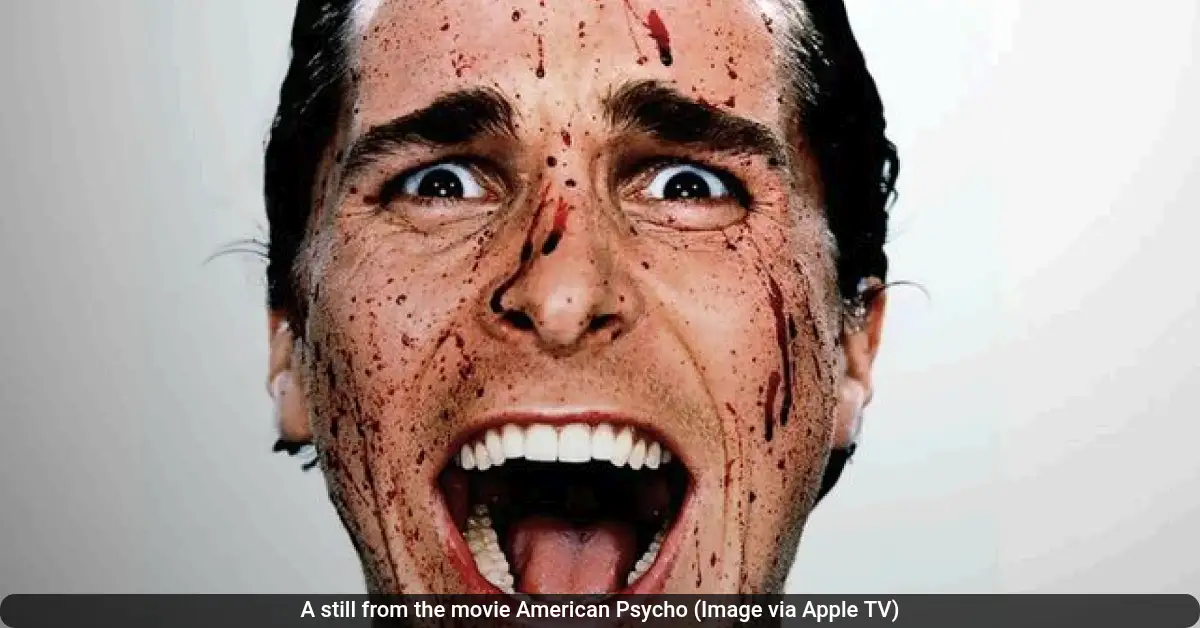
More than two decades after its release, the ending of American Psycho still puzzles audiences. The story of Patrick Bateman, a wealthy investment banker who is also a serial killer, wraps up with events that seem to erase his crimes. Did he imagine everything? Did he get away with it? The answer lies in understanding the film’s core message.
The final scene leaves Bateman stuck at dinner with his colleagues, listening to their empty talk about restaurant reservations. As he looks directly at the viewer, he delivers a famous final thought: “This confession has meant nothing”. No one around him acknowledges his violence, and all evidence of it has vanished. This leads to the central debate over what is real and what is not.
What Happens at the End of American Psycho?
In the final act, after a chaotic and surreal shooting spree, Patrick Bateman makes a tearful phone call to his lawyer, Harold Carnes. He confesses to murdering numerous people, including his colleague Paul Allen. The next day, he visits the apartment where he committed the murders, only to find it perfectly clean and up for sale. The building manager tells him Paul Allen never lived there.
Bateman then meets his lawyer at a bar. Carnes laughs off the confession as a joke. He even tells Bateman he couldn’t possibly be a killer and claims he recently had dinner with Paul Allen in London. Back with his friends, Bateman listens to them debate superficial topics and realizes his admission has no impact. He is trapped in his wealthy, hollow life with no chance of escape or punishment.
The Two Main Interpretations of the Ending
For years, viewers have debated two main explanations for these confusing events.
Interpretation One: The Murders Were Real
In this view, Bateman did commit every murder. The clean apartment and the lawyer’s claims are not proof the killings were fake. Instead, they show how the system protects wealthy, powerful men like Bateman. The apartment’s owner likely had it cleaned to avoid a scandal and protect property values. The lawyer either lied about seeing Paul Allen or mistook someone else for him, a common error in a world where all the bankers look and dress the same. The film’s co-writer, Guinevere Turner, supported this idea, stating she and director Mary Harron wanted the crimes to feel real, not like a dream.
Interpretation Two: The Murders Were a Fantasy
The other popular reading is that Bateman’s violent spree was all in his head. Supporters point to the absurd, cartoonish violence of the final shootout, where police cars explode with a single gunshot. The moment an ATM machine tells him to “Feed Me a Stray Cat” is seen as the point where the movie clearly enters fantasy. His notebook, filled with disturbing drawings of murder and torture, could be seen as evidence of dark fantasies, not real events.
What the Film’s Creators Say About the Ambiguity
Director Mary Harron has deliberately refused to give a definitive answer. She once quoted Quentin Tarantino, saying, “If I tell you that, I take this movie away from you”. However, she has expressed that she never intended for the entire film to be seen as a dream.
She indicated the ATM scene is a key turning point. “I will say there’s a moment where it becomes less realistic, and that’s the moment when the ATM says ‘Feed Me a Stray Cat’”. This suggests that while Bateman’s earlier actions may have happened, his perception of reality fractures as the film goes on.
Co-writer Guinevere Turner offered a similar insight. She explained that they wanted to leave things open-ended, as the novel did, but actively disliked the “it was all a dream” trope. She stated, “We just said we’re going to make a really conscious effort to have it be real, and then at some point… he’s sort of perceiving things differently, but they’re really happening”.
The Real Meaning: A Satire of Privilege and Identity
For many, arguing over what was real misses the film’s main point. American Psycho is a sharp satire of 1980s consumerism, toxic masculinity, and white-collar privilege.
The film constantly shows that Bateman and his colleagues have no real identity. They wear the same suits, eat at the same restaurants, and obsess over the same status symbols, like business cards. They frequently mistake each other’s names because they are all interchangeable. In this world, Bateman’s desperate need to be seen as powerful and unique leads to violence, but even that fails to make him stand out.
The ending’s power comes from showing that in Bateman’s world, whether he killed people or just fantasized about it doesn’t matter. His society is so self-absorbed and morally empty that it would ignore actual murder. His confession means nothing because the people around him are incapable of seeing him as anything but another rich, white banker. The system is designed to protect people like him from consequences.
Christian Bale, who played Bateman, discovered this uncomfortable truth while researching the role. When he visited a real trading floor, some brokers told him they loved the character Patrick Bateman. Bale assumed they were being ironic, but they were serious. This proved how the film’s critique of toxic masculinity could be misunderstood by the very people it was satirizing.
Ultimately, the film suggests Bateman’s greatest punishment is not jail, but being trapped forever in a life of meaningless luxury, completely invisible and without any real self. The famous final shot of a sign that reads “THIS IS NOT AN EXIT” drives this home. For Patrick Bateman, there is no way out of the empty world he helped create.
Also Read: Robin Hood Episode 9 Release Date and Where to Watch the Penultimate Drama