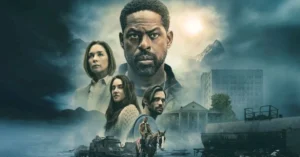

The crime thriller City of Shadows wrapped up its intense six-episode story with a finale that went beyond catching a killer. The series, which follows detectives Milo Malart and Rebeca Garrido, concluded by revealing how a brutal case of serial killings exposed deep-seated corruption within the police force and the tragic history that created the perpetrators. The ending ties together personal revenge, institutional failure, and a last-minute rescue, leaving viewers with a complex look at justice in a broken system.
The story centers on a mysterious killer known as Gaudí’s Shadow, who targets Barcelona’s elite in dramatic, public ways. What begins as a high-pressure investigation spirals into something deeply personal for the detectives, especially when Judge Susana, a key figure in Milo’s life, becomes a target. The finale reveals the killers’ identities, their shocking motive, and how their plan ultimately falls apart at the city’s most famous landmark.
Who Were the Killers and What Was Their Plan?
The investigation led by Milo and Rebeca uncovered that Gaudí’s Shadow was not one person, but a brother and sister: Hector and Helena Guitart. Their killing spree was a calculated act of revenge against individuals they held responsible for destroying their childhood.
Their final plan was their most audacious. It centered on the Pope’s visit to consecrate the Sagrada Familia as a basilica, an event drawing global attention. Hector, who worked at the church, smuggled gasoline inside. His target was not the Pope, but the government ministers who had approved urban development plans that harmed people like him. Meanwhile, Helena intended to destroy the office of Felix Torrens. Their goal was to create a fiery, unforgettable spectacle that would force the city to confront the corruption they had suffered.
“Their murders are designed to be loud. Public. Impossible to ignore.”
The Tragic Past That Created Monsters
To understand the ending, you must understand Hector and Helena’s beginning. They were not born violent. Their story is one of repeated trauma and systemic failure.
Their mother died in a car accident when they were young. Their father, devastated, turned to drugs. The final blow came when a redevelopment project, led by businessman Eduardo Pinto, forcibly cleared their slum neighborhood. Their father collapsed and died in front of them, leaving the children orphaned. Sent to the La Ferradura orphanage run by the Torrens Foundation, they entered a new nightmare.
At La Ferradura, Felix Torrens repeatedly abused Helena. Hector, who had a fascination with fire, was punished by being locked in a basement for days without food or water. The institution that was meant to protect them became a place of torture. As adults, when their new neighborhood was again marked for demolition, the old wounds reopened. They saw the men who ruined their lives—Pinto and Torrens—still thriving, wealthy, and respected. Their murders were a direct response to this unaddressed pain.
How the Finale Unfolded: Fire and a Final Hint
The climax of the series saw the police scrambling to stop the attack at the Sagrada Familia. Jordi’s team located Hector at the ceremony. When he tried to flee, they shot him in the shoulder. Rather than be captured, Hector doused himself in gasoline and set himself on fire. He was taken to a hospital, but his chances of survival were very low.
Milo and Rebeca raced to Torrens’s office at Palau Güell, believing Helena was there. They found her on the roof, traumatized by a painting of a Gaudí building that reminded her of her abuse. Milo pleaded with her, but Helena, stating she had let her brother down, also set herself alight and jumped from the building.
However, in her final moments, Helena gave a cryptic clue about Judge Susana’s location. She said Susana’s air was being taken away. Rebeca pieced together that this meant the Guitart family mausoleum at Montjuic Cemetery. They arrived just in time to save Susana, who had been left there to suffocate.
The Police Corruption That Nearly Buried the Case
A major revelation in the finale was the corruption festering within the police department itself. The investigation was sabotaged from the inside by two officers:
- Bachs: This officer was leaking confidential case information to a celebrity journalist, Mauricio, in exchange for money. His motives were personal, related to financial pressures like alimony.
- Bastos: A higher-ranking officer, Bastos actively worked to derail Milo’s investigation. He lied to have Milo fired and created obstacles because he was protecting his patron, Felix Torrens. Bastos’s career was tied to the Torrens Foundation, and he aimed to keep the abuse hidden.
When Jordi discovered Bachs’s betrayal, he was promptly suspended. Bastos faced a disciplinary investigation, but the series leaves his ultimate punishment unclear, suggesting that such deep-rooted corruption is not easily wiped clean.
What the Ending Means for Milo and Rebeca
After the chaos, the ending finds the two detectives in a quiet moment of resilience. Milo makes the difficult decision to admit his brother, Hugo, who struggles with schizophrenia, into a mental health institution. This act represents Milo accepting that he cannot fix everything himself and is a step toward managing his own guilt.
Rebeca, who has faced her own personal struggles, decides to be more selective about her future cases. She stays with Milo in the hospital waiting room, solidifying their partnership. The series does not end with a perfect victory, but with a sense of survival and the hard-earned possibility of moving forward.
Also Read: The Garrison Pub’s Real Story: From Peaky Blinders’ Tavern to Kitchen Showroom