
The final episode of Dispatches from Elsewhere did something many TV shows never dare to try. Instead of giving easy answers to its season-long puzzles, it broke its own story wide open to reveal the real person at its center. Titled “The Boy,” the episode that aired on April 27, 2020, pulled off a major switch, turning a quirky mystery into a deeply personal confession from its creator and star, Jason Segel.
Fans who followed four strangers through a strange game in Philadelphia were in for a shock. The show’s creator, Jason Segel, stepped out from behind his character, Peter, to play a version of himself on screen. The episode reveals that the entire series is a show Segel’s character is writing while dealing with his own career regrets and personal struggles. This move takes the audience from a fictional story into a real and raw self-examination, changing what the whole series was about.
From a Mysterious Boy to a Real-Life Story
The finale starts not with the four main characters, but with a long black-and-white sequence about the clown-faced boy seen in glimpses all season. This boy lives in a dull world and dreams of being a performer after watching shows like The Muppet Show. He works hard, learns to sing and dance, and wows talent scouts with a performance of “Make ‘Em Laugh” from Singin’ in the Rain.
He finds quick fame, but the joy doesn’t last. The work feels repetitive, and the applause feels hollow. In a heartbreaking scene, the boy has a breakdown before a final show, fails a risky move on stage, and is left alone as the crowd walks away. His manager, who he calls Octavio, drops him off with a bag of money, ending his young career.
This story then makes a sudden and shocking turn. The scene shifts to what looks like Peter at a recovery meeting, talking about feeling lost and empty. The audience soon learns this is not Peter—this is Jason Segel playing himself.
“For the past twenty years what I would do is I would make a bunch of jokes and I would make you all like me. But I don’t think anything is funny right now, and I don’t like myself, and I don’t expect you to like me. I feel done, and I don’t want to be here,” Segel’s character says in the meeting.
This moment shatters the fictional world of the show. The clown boy is revealed to be a young version of Jason Segel, and the man at the meeting is the older, struggling version. The show’s big mystery transforms into a public self-reflection on Segel’s own experiences with fame, the creative industry, and personal battles.
A New Game for a Different Purpose
After the meeting, Jason meets Simone, but not the Simone from the main story. Actress Eve Lindley describes this version as “Simone 2.0”—a more relaxed, wise character who has already learned the lessons the first Simone was figuring out. This Simone connects with Jason and gives him a postcard, inviting him into a new version of the game.
Jason’s journey is strange and symbolic. He goes to a hotel, gives up his phone and wallet, crawls through small spaces, and follows odd clues. He eventually finds an arcade cabinet called Dispatches from Elsewhere. The game asks him pointed questions about his life: “Did you have a view of your future?” and “Did you let it slip away?”
This experience pushes him to start writing. He writes the script for the TV show Dispatches from Elsewhere, the very show the audience has been watching. He shows his first draft to Simone, but she gives him tough feedback: he’s still writing himself as a victim and not taking enough responsibility.
This criticism leads to the episode’s most powerful scene. Jason has a confrontation with the clown boy, his younger self. The boy criticizes him for no longer being bold and creative, for playing it safe in his career, and for his struggles with addiction.
Jason asks his younger self, “So I was a selfish, self-centered, entitled, spoiled guy who lost his way. No victim, no villain, just me and my choices. Is that right?” The Boy replies, “There you go. You’re cured.” When Jason asks if he really is, the Boy says, “No, you’re a goddamn mess. But it’s a start”.
This conversation is the emotional core of the finale. It shows that healing is not about finding a perfect solution, but about starting an honest process and accepting your own role in your life.
Also Read:






The Final Gathering and a Message for Everyone
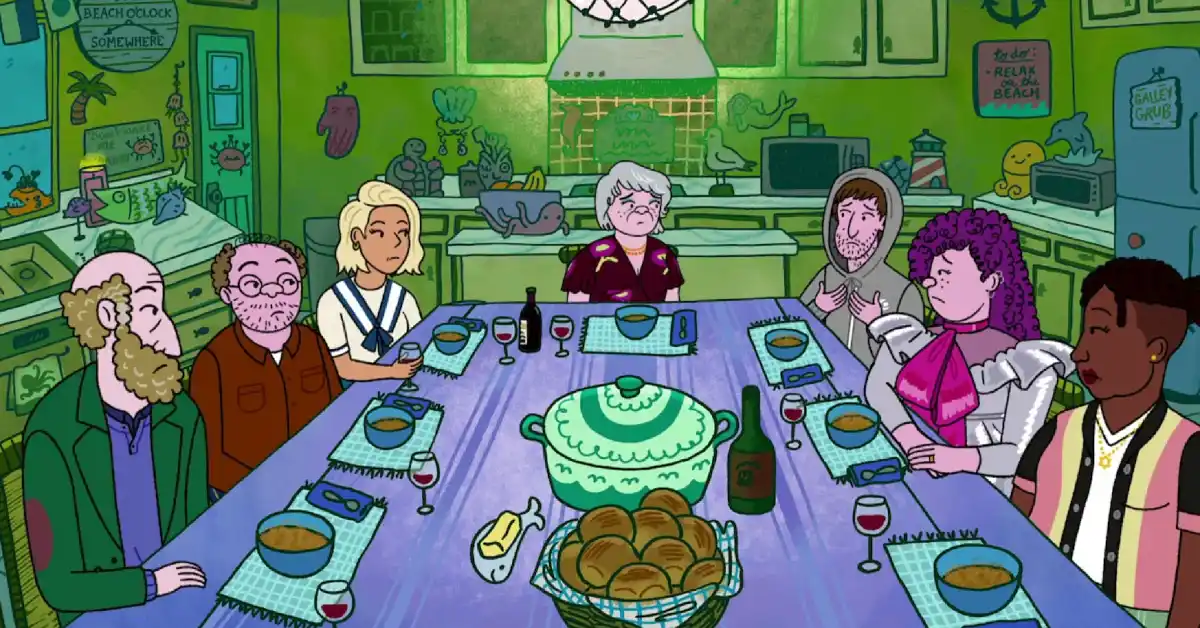
The episode ends with a large gathering in a field. Jason sits surrounded by the show’s main characters—Peter, Simone, Janice, and Fredwynn. They talk about the story as if they’ve just watched it, reflecting different reactions from confusion to emotion.
Then, the show breaks the final wall. Jason looks straight into the camera and speaks to the audience. The camera pulls back to reveal not just the actors, but the entire crew who made the series. This act shows that the story was created by real people working together.
The final narration comes from Octavio, played by Richard E. Grant. He delivers the show’s ultimate message. He explains that real change doesn’t come from a game or a mystery, but when people find each other. The episode then cuts to videos of real people who interacted with the show online, each saying their name and, “I am you”.
Octavio’s final words shift the focus from the individual “you” to the collective “we.” He uses a metaphor of water in a glass inside a fish tank, stating that just as the water is the same, the substance containing it is the same. “There is no You, and there is no Me; there is only We,” he concludes. This reinforces the series’ core theme of shared human experience and community.
Eve Lindley compared the show’s structure to The Wizard of Oz, where the story eventually returns from a colorful adventure to a more real, practical world. “We’re going to Kansas,” she said, explaining the finale’s shift into reality.
Jason Segel explained his bold choice was to prove the show’s own premise. “One of the prevailing things… is that if we open ourselves up to one another, we’re more alike than we are being led to believe,” Segel said. He felt the finale was his chance to lead by example and be the first to be truly honest.
The finale of Dispatches from Elsewhere left viewers with a unique and thought-provoking experience. It traded a neat conclusion for a meaningful insight: that connection and self-acceptance are more valuable than any solved puzzle. The show is available to stream on Netflix, AMC+, Prime Video, and Apple TV.
Also Read: Chicago Fire Season 14 Casts Max Martini as Deputy District Chief