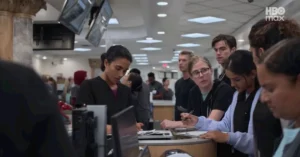

Two major streaming series have told the same shocking true story. In 1980, Texas housewife Candy Montgomery was accused of killing her friend, Betty Gore, with an axe. Her claim of self-defense led to a trial that captured the nation. Within a year, audiences saw two different versions of this case. Hulu released “Candy” starring Jessica Biel in May 2022. Max (formerly HBO Max) released “Love & Death” starring Elizabeth Olsen in April 2023. Both shows cover the same core facts—the affair between Candy and Betty’s husband, the violent killing, and the dramatic trial. But they use very different styles to explore one central question: what really drives a person to commit such an act?
The Source of the Story: How Faithful Are They to the Facts?
The foundation for both series is the same real-life tragedy in Wylie, Texas. “Love & Death” makes its approach clear from the start. Each episode begins with the title card: “This is a true story”. The show closely follows the 1984 book Evidence of Love and the Texas Monthly articles titled “Love and Death in Silicon Prairie”. Critics note it sticks to a checklist of known events, dates, and incidents from these sources. The show’s writer, David E. Kelley, even uses direct lines from the Texas Monthly article, like Candy’s proposition to Allan: “Would you be interested in having an affair?”.
“Candy” takes more creative freedom with smaller details to build a specific mood. The series changes some elements, such as compressing the timeline of events and altering certain details about Betty’s family life and home. One writer for the show, Robin Veith, said they felt no pressure to copy the facts exactly. “The thing about this story is there’s like 100 ways to tell this story,” Veith stated. Her goal was to explore the “feminine rage” she saw at the story’s core, even if that meant adjusting some facts for dramatic effect.
On strict factual accuracy regarding the sequence of major events, “Love & Death” is generally considered the more faithful adaptation. However, both shows keep the central pillars of the case intact: the affair, the violent confrontation on June 13, 1980, and the legal battle that followed.
A Clash of Style: Horror vs. True-Crime Drama
The most striking difference between the two series is their tone and visual style. “Candy” is crafted as a psychological horror story. Its opening credits set this tone immediately, using eerie, distorted images from old cookbooks and homemaking guides to suggest a sinister edge beneath suburban normalcy. The show builds a slow sense of dread, focusing on the quiet despair and building rage within its characters. The score by Ariel Marx adds to this feeling with a haunting, music-box quality. The show saves the most graphic depiction of the axe attack for the final episode, presenting it as a fractured, terrifying memory.
“There was something about this story, about a woman’s explosive rage at 10 o’clock in the morning, seemingly over very little,” said “Candy” writer Robin Veith. “It felt apropos of the #MeToo moment of like, ‘Hey, we can actually talk about this feminine rage.’”
In contrast, “Love & Death” feels like a traditional true-crime drama or a detailed podcast. Its opening uses a montage of 1970s decor and Texas life set to Nina Simone’s “Don’t Let Me Be Misunderstood,” creating a more familiar, almost nostalgic atmosphere. The storytelling is more linear, showing the affair, the murder, and the trial in a straightforward sequence. It uses popular radio hits from the era to keep viewers anchored in the time period. The violence is presented more directly as a chaotic, brutal crime of passion.
Different Portraits of Key Characters
The shows also diverge in how they present the people involved, which shapes how viewers understand their motives.
Candy Montgomery is played very differently by Jessica Biel and Elizabeth Olsen. Biel’s portrayal emphasizes a restless energy simmering beneath a perfect homemaker’s surface. Her Candy is deeply bored and unfulfilled, seeking an affair as a way to feel alive again. Olsen’s Candy is often described as more calm, methodical, and in control, a woman who expertly compartmentalizes her life. One reviewer noted Olsen plays her as “the most normal person on the planet,” which makes her actions even more unsettling.
The portrayal of Betty Gore is another major point of difference. In “Candy,” Melanie Lynskey plays Betty with a profound sadness and visible depression. The show gives significant time to her struggles as a mother, her loneliness, and her sense of being taken for granted. This builds more sympathy for her character. In “Love & Death,” Lily Rabe’s Betty is more of a mystery. The show focuses less on her inner life, presenting her more through the eyes of Candy and Allan, often as a source of tension and suspicion.
Even the lawyer, Don Crowder, is depicted differently. In “Love & Death,” Tom Pelphrey plays him as a passionate, if sometimes outmatched, attorney fighting aggressively for his client. In “Candy,” Raúl Esparza’s version is slicker and more cynical, portrayed as an agent of chaos who seems to be pursuing his own interests as much as Candy’s.
How the Murder and Trial Are Presented
The shows handle the central act of violence and its aftermath in distinct ways. “Love & Death” frames the axe attack as a sudden, explosive crime of passion. It shows Betty grabbing the weapon first during a heated confrontation, with Candy reacting in what the series suggests was self-defense that spiraled out of control. The trial scenes focus heavily on the gruesome forensic details and the legal strategy.
“Candy” takes a more psychological and fragmented approach. The full brutality of the attack is withheld until the final episode, where it is shown as a bloody, traumatic flashback during Candy’s trial testimony. The show is less concerned with the legal procedure and more interested in the emotional and social fallout of the murder on the community and the families involved.
Audience and Critical Reception
Both series found audiences but were received differently by critics. “Candy” holds a 72% critics score on Rotten Tomatoes. When it was released, it became the 8th most-streamed TV series across all platforms for a week in May 2022. Praise often focused on its unique tone and the strength of its lead performances.
“Love & Death” has a 63% critics score on Rotten Tomatoes. However, it was a major hit for Max, becoming the streaming service’s most-watched original limited series globally after its release. The star power of Elizabeth Olsen, famous for playing Scarlet Witch in the Marvel films, is believed to have drawn a large audience.
Viewers who have seen both often have strong preferences. One Reddit user shared the experience of watching them back-to-back: “I watched ‘Candy’ first, then I watched ‘Love and Death’ right after… By watching the same story play out in two different versions back to back with no break… it really highlights the differences”. Some viewers feel “Candy” is more stylized and captures the late-70s/early-80s era better, while others prefer the star-driven, factual approach of “Love & Death”.
The Real-Life Impact on Betty Gore’s Family
An important and often overlooked part of this story is its effect on the real people involved. The Gore family has had to relive this trauma more than 40 years later due to these series. According to reports, Betty Gore’s family members were not contacted by the producers of either show before production began. One family member told a reporter they did not understand why the painful case was being turned into multiple TV shows now. This highlights a constant tension in the true-crime genre between storytelling and respect for the victims and their loved ones.
Also Read:
Blueface Claims Megan Thee Stallion Visit After 2020 Shooting, Sparks Controversy In New Interview
90 Day Fiance Happily Ever After Tell All: Noga Admits Shame Over Argument with Andrei
TRACKER SEASON 3 EPISODE 7 CAST: WHO ARE THE BENNING FAMILY?
Smiling Friends Season 3 Episode 9: Why Are Fans Convinced Two Secret Episodes Exist?
LOVE (X) Episode Schedule: New Episodes Arrive Each Saturday on WeTV
Dear X Filming Locations: Where Was the K-Drama Shot?
Robin Hood Episode 7 Release Date: Story Details and How to Watch
Kim Taehyung Tops Forbes Korea List, Named Top Male K-Pop Idol For 2025