
The latest episode of Vince Gilligan’s new sci-fi series, Pluribus, has left viewers stunned with a dark revelation. In the episode titled “Got Milk,” protagonist Carol Sturka uncovers the disturbing secret behind the hivemind’s sole food source, leading to one of the most talked-about cliffhangers in recent television.
The Milk Mystery Unfolds
In “Got Milk,” Carol finds herself completely isolated after the hivemind decides it needs “space” from her disruptive behavior. Every person in Albuquerque drives away in a coordinated exodus, leaving Carol alone with a customer service voicemail explaining their departure. This isolation pushes her to investigate what the hivemind does when she’s not watching them.
Her detective work begins when she discovers that recycling bins around town are filled exclusively with empty milk cartons from Duke City Dairy. This confirms the hivemind requires sustenance, contrary to their seemingly ethereal nature. Carol tracks the milk supply to a local dairy warehouse, where she finds not ordinary milk, but a golden, oily liquid being produced from large sacks of white powder.
Carol takes a sample home for testing, recording her findings in a video message to the other immune survivors. She discovers the liquid is odorless, has a neutral pH of 7.1, and doesn’t resemble any conventional dairy product. The barcode on the powder leads her to a dog food manufacturer’s warehouse, where the mystery deepens.
The Horrifying Discovery
The episode builds toward its chilling climax as Carol explores the dog food company’s cold storage facility. She initially finds rows of frozen vegetables, consistent with the hivemind’s claimed vegetarian ethics. Then she notices something hidden under a tarp.
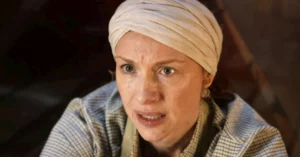
When Carol lifts the tarp, the camera focuses entirely on her face. She processes what she’s seeing for a moment before gasping in visible horror. The episode ends without showing viewers what she found, leaving audiences to speculate for the next week until the next episode arrives.
Fan Theories and Evidence
The most prevalent theory among fans suggests Carol has discovered human remains. The evidence throughout the episode strongly supports this disturbing possibility.
The imagery in “Got Milk” repeatedly connects to death and scavenging. Crows are seen pecking at the sacks of white powder at the dairy warehouse—birds traditionally associated with death. Wild coyotes attempt to dig up the corpse of Carol’s deceased lover, Helen, mirroring the theme of consuming the dead.
Earlier in the season, viewers witnessed the hivemind efficiently collecting human corpses after the initial transformation, loading them onto trucks with dairy logos. This detail gains new significance in light of Carol’s discovery.
The hivemind’s pragmatic approach to resource management further supports the theory. They’ve repeatedly demonstrated they value efficiency over sentimentality. With hundreds of millions dead from the initial transformation and Carol’s subsequent emotional outbursts, the hivemind would view burying all those bodies as wasteful rather than sacred.
As one analysis notes: “The hivemind cleaned up the countless bodies created during the disaster. Their practicality suggests they would repurpose the dead rather than bury them. The show frames them as obsessive recyclers rather than killers.”
Specific theories about the milk’s composition include ground bone meal, powdered corpses, blood plasma, or spinal fluid. Blood plasma stored for transfusion has a pH level around 7.1, matching exactly what Carol measured in the liquid. Plasma also shares the amber color she described.
The episode’s title, “Got Milk,” adds a layer of dark comedy, twisting the familiar childhood association of milk with health and purity into something sinister. The timing of the episode’s early release just before Thanksgiving in the United States added another uncomfortable layer to the consumption theme.
Also Read:




The Bigger Picture
This revelation recontextualizes the hivemind’s stated principles. While they claim to be peaceful vegetarians who won’t harm living creatures, processing already-dead humans for food would technically not violate this code. It represents the ultimate form of recycling in their utilitarian worldview.
The discovery also creates a moral dilemma for Carol and the audience. If the hivemind is sustainably using available resources without killing, is their system actually more logical than traditional burial practices? Carol’s horror stems from her human perspective, which views human remains as sacred rather than as reusable nutrients.
This development continues Pluribus‘ exploration of philosophical questions about consciousness, identity, and morality. The series has been praised for creating a post-apocalyptic scenario that makes viewers question whether the new world order is actually better than the old one.
The mystery will likely be addressed in episode 6, scheduled for release on December 5 on Apple TV+. Until then, fans continue to analyze every clue from “Got Milk,” speculating about what exactly Carol saw under that tarp and how this discovery will change her struggle against the hivemind.
Also Read: Stranger Things Season 5 Volume 1: Which Main Characters Survived the Onslaught?