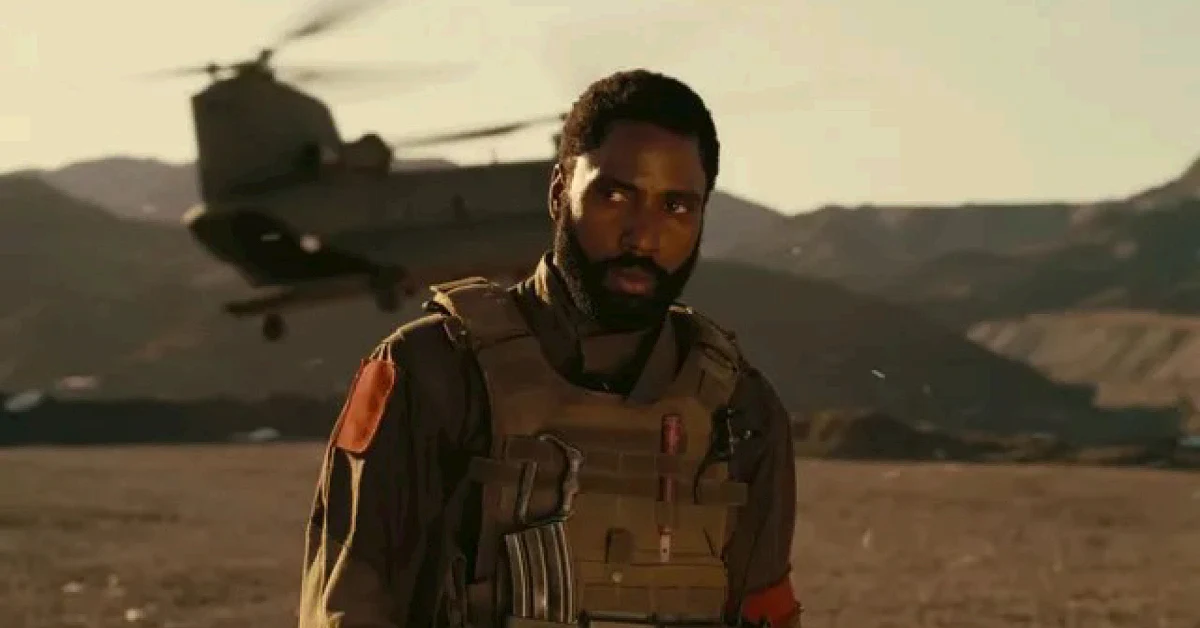
The big fight at the end of Christopher Nolan‘s 2020 film Tenet is famous for its complex time mechanics. The ‘temporal pincer movement’ shows two teams fighting on the same battlefield, but one is moving forward in time while the other moves backward. However, many viewers are now looking at this sequence differently. Analysis suggests this complicated battle served a single, simple purpose: to create a major distraction. While all eyes were on the massive clash at Stalsk-12, the real mission was a quiet, secret operation happening at the same time.
The goal was always to stop Andrei Sator, a wealthy Russian played by Kenneth Branagh, from destroying the world. Sator had a device called the Algorithm which, if activated, would reverse time itself and end all life. His plan was to kill himself, triggering the device, while enjoying one last happy moment on his yacht in Vietnam. To stop him, the heroes had to do two things at once: retrieve the Algorithm from a heavily guarded bunker and ensure Sator died without sending a signal to the future.
The Purpose of the “Temporal Pincer”
In the film, the temporal pincer movement is explained as a military tactic where one team attacks moving forward in time, and a second, inverted team attacks moving backward from the future. This allows the second team to use knowledge of how the battle ends to guide the first team. The heroes split into a Red Team moving forward and a Blue Team moving backward.
Yet, the true value of this flashy two-front war was not tactical superiority. Its real job was to act as the ultimate decoy. The massive, chaotic battle drew all of Sator’s forces and attention to the surface. Meanwhile, a small, critical mission was taking place underground. The Protagonist, played by John David Washington, and the soldier Ives used the cover of the fight to sneak into the underground vault, called the Hypocenter, to find and grab the Algorithm. The complex time maneuver kept the enemy busy so the small team could complete their vital task unseen.
The Hidden Mission and Neil’s True Role
While the Red and Blue Teams fought above, The Protagonist and Ives faced their own problem below. They found the Algorithm in a locked chamber, guarded by one of Sator’s soldiers. A dead body with a red string on its backpack was also in the room. At the crucial moment, that soldier appeared to come back to life, unlocked the gate for them, and was shot.
This mysterious soldier was later revealed to be Neil, played by Robert Pattinson. In the film’s final moments, Neil explains everything to The Protagonist. He was not just a fellow agent, but a close friend recruited by The Protagonist himself in the future. Neil’s entire journey in the movie was leading to this point. After the battle, he inverted himself to travel back in time, enter the chamber, and sacrifice his life to unlock the door and save his friend. As he tells The Protagonist:
“For me, I think this is the end of a beautiful friendship. But for you, it’s just the beginning.”
This reveal changes how we see Neil’s character. His knowledge of the Protagonist’s habits, his calmness in dangerous situations, and his willingness to follow the mission all make sense. He was always working toward this fixed point in time.
The Protagonist’s Shocking Realization
After securing the Algorithm, the story has one last twist. The Protagonist realizes he is not just a recruit in the Tenet organization. He is its founder. In his personal future, he will travel back in time to create the very organization that recruited his past self. This means every event in the film, including his own recruitment and his friendship with Neil, was set in motion by his own future actions.
This creates a perfect, closed loop. There is no beginning or end. The Protagonist’s final act in the movie is to protect Kat, Sator’s wife played by Elizabeth Debicki, from another Tenet agent. This act solidifies his understanding of his own destiny. He now knows his path is to go into the past, build Tenet, and set the entire plot into motion to save the world.
Also Read:




Understanding the Film’s Core Ideas
The movie operates on a fixed timeline, meaning events cannot be changed. A key phrase repeated is “What’s happened, happened.”. This philosophy resolves potential time travel paradoxes. Characters like Neil are not changing the past; they are fulfilling actions that have always occurred. His sacrifice was always part of the timeline, just as the Protagonist was always the founder of Tenet.
The title Tenet itself is a clue. It is a palindrome, reading the same forwards and backwards, reflecting the film’s structure. The story is also built around the ancient Sator Square, a five-word Latin palindrome where every word appears in the film, like SATOR (the villain), AREPO (the art forger), and TENET (the organization).
The final battle, for all its visual spectacle and inverted physics, was a masterful distraction. Its noise and chaos were a cover for a silent, surgical strike at the heart of Sator’s plan. The real victory was won not by the armies clashing above, but by the small team below and a friend willing to complete a loop that saved the future.
Also Read: Heated Rivalry Season 1 Finale to Air December 26, Concluding Shane and Ilya’s First Chapter