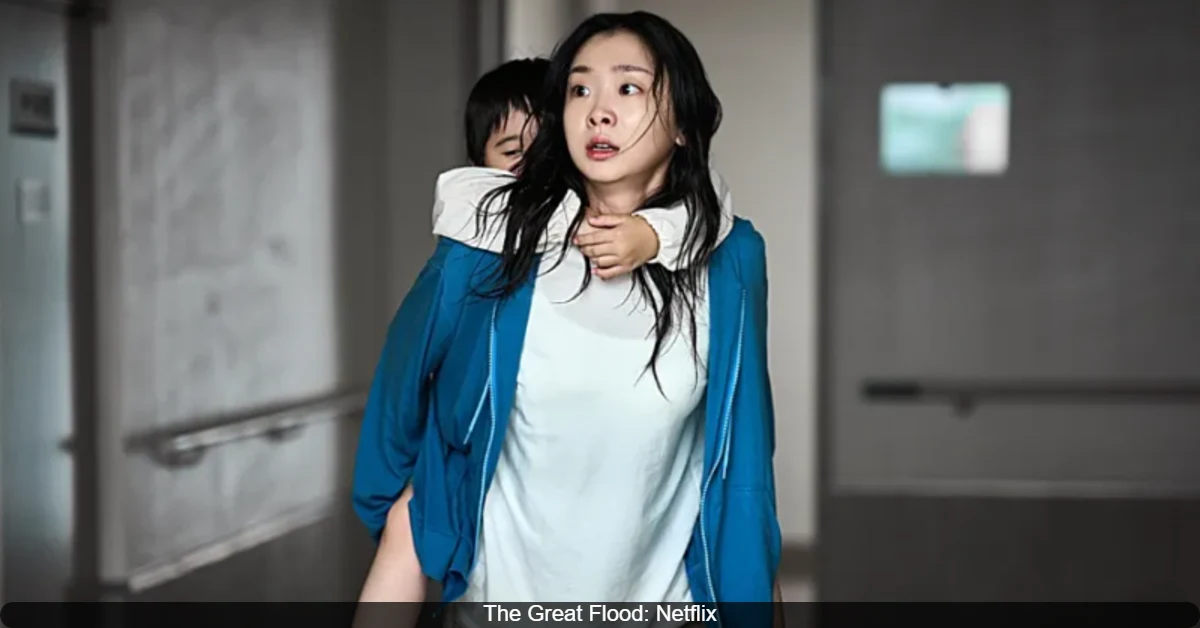
The Great Flood, a new South Korean science fiction disaster movie on Netflix, starts with water rising fast in a Seoul apartment building. A mother must fight to save her son. By the end, it asks a bigger question: can an artificial intelligence learn what it means to be human? This shift has left viewers and critics split on whether the film is a clever surprise or a confusing mess.
The film stars Kim Da-mi as Gu An-na, an AI researcher, and Park Hae-soo as Son Hee-jo, a mysterious security agent. It was released for global streaming on December 19, 2025.
What Is ‘The Great Flood’ Really About?
The story begins like a classic disaster film. An asteroid hits Antarctica, melting the ice caps and causing a global flood that submerges cities. In Seoul, An-na is trapped in her high-rise apartment with her young son, Ja-in (played by Kwon Eun-seong). As water pours into their home, their only escape is to go up, fighting through panicked neighbors and crumbling stairwells to reach the roof.
Their struggle takes a turn when Son Hee-jo finds them. He tells An-na she is not just another survivor. She is a scientist crucial to a project aimed at saving humanity. Her work on an “Emotion Engine” – an AI designed to replicate human feelings – is now the key to creating a new human race. Hee-jo’s mission is to get her to a rescue helicopter, but his motives seem complex, and the safety of her son may not be part of the plan.
The Major Sci-Fi Twist That Divides Audiences
About halfway through its 108-minute runtime, the film reveals its true nature. The catastrophic flood is not real. It is a sophisticated simulation.
An-na and the child are not fleeing a natural disaster. They are inside a test run by the Emotion Engine. An-na’s consciousness has been placed into a virtual world to see if she, as a mother, will successfully rescue her son against all odds. The goal is to teach the AI the depth of a mother’s love and sacrifice. Each attempt is marked by a number on An-na’s t-shirt, showing she has lived through this day countless times.
The film reveals that the flood scenario is just a virtual simulation designed to test whether a mother would successfully rescue her child. This tests the viability of the current version of the Emotion Engine.
This twist changes the entire film. It transforms from a tense survival thriller into a high-concept science fiction story about AI, consciousness, and what defines humanity.
Strengths: A Strong Start and Impressive Scale
Most reviewers agree the film begins very well. The first 30 to 45 minutes deliver gripping, edge-of-your-seat tension. Director Kim Byung-woo, known for The Terror Live, creates a real sense of claustrophobia and urgency as water fills the apartment building. The special effects are generally praised for making the disaster feel visceral and terrifying.
Kim Da-mi’s performance as a determined mother anchors the film. She portrays fear, resolve, and desperation in a way that makes the early emotional stakes feel genuine. The core concept of the twist is also seen as ambitious and thought-provoking. One review called it “the perfect survival movie” for subverting expectations so dramatically.
Weaknesses: A Confusing and Overstretched Second Half
The major criticism of The Great Flood is that its ambitious ideas become tangled and confusing. Many found the plot overly complicated after the twist is revealed. What starts as a straightforward fight for survival shifts into a cerebral puzzle that struggles to explain its own rules clearly.
Some viewers felt the narrative lost its emotional drive. The adrenaline from the first half fades, replaced by exposition and conceptual sci-fi that can be hard to follow. One critic noted the film tries to glue “two movies together into one big movie,” and the connection between the halves feels weak. Elements like flashbacks to An-na’s past are mentioned as feeling underdeveloped or unnecessary to the main plot.
The film’s tone also shifts. Some described parts of the third act as becoming “silly” or “ridiculous,” which undermined the initial serious tension.
Verdict: Stream It or Skip It?
This is where opinions split sharply, offering a clear guide for what kind of viewer might enjoy it.
Consider streaming it if:
- You enjoy big, ambitious sci-fi concepts and unpredictable narrative twists.
- You are a fan of Korean cinema and want to see a new blend of disaster action and philosophical ideas.
- You appreciate strong central performances, particularly from Kim Da-mi.
- You don’t mind if a film becomes conceptually complex, even at the cost of some clarity and pacing.
Consider skipping it if:
- You prefer straightforward, consistently tense disaster thrillers from start to finish.
- You get frustrated when a movie’s second half drastically changes tone and genre.
- You value narrative clarity and get annoyed by plots that feel convoluted or under-explained.
- The idea of a major mid-film twist that recontextualizes everything is unappealing to you.
Also Read:





In summary, The Great Flood is not your typical disaster movie. It is a film of two distinct parts: a well-executed survival thriller and a risky, brainy sci-fi experiment. Its success for you will depend entirely on how well you connect with its ambitious, if messy, second act. It is now available to stream globally on Netflix.
Also Read: Can This Love Be Translated? K-Drama: Complete Release Schedule, Cast, and Global Streaming Details