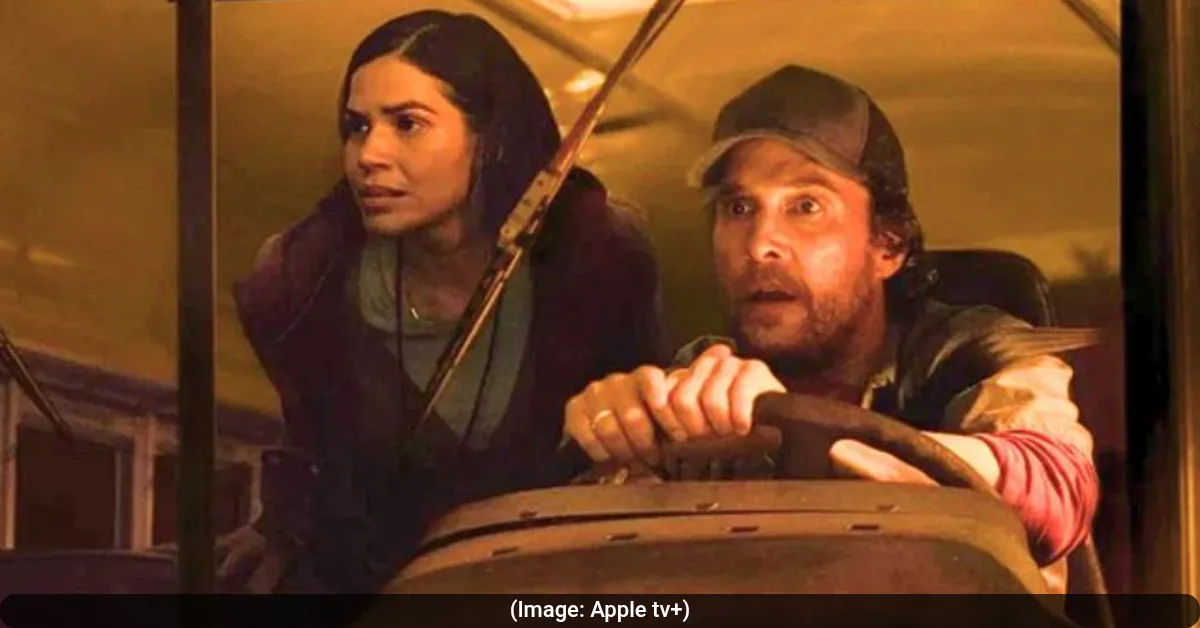
A school bus driver’s quick thinking during a deadly wildfire has become one of the most gripping survival stories in recent memory. The Lost Bus, the new film starring Matthew McConaughey and America Ferrera, brings this real-life tale of heroism to the screen. The movie is based on the extraordinary true events of November 8, 2018, when bus driver Kevin McKay and teacher Mary Ludwig saved 22 children from the most destructive wildfire in California’s history.
The True Story of the 2018 Camp Fire
The Camp Fire began on the morning of November 8, 2018, in Butte County, California. A failure on a transmission line owned by the utility company PG&E sparked the blaze, which rapidly grew out of control due to high winds. The fire ultimately killed 85 people, displaced more than 50,000 residents, and burned over 150,000 acres. The town of Paradise was almost completely destroyed.
It was in the middle of this catastrophe that bus driver Kevin McKay received an emergency call. Ponderosa Elementary School needed help evacuating 22 children who were unable to be picked up by their parents. Despite the danger, McKay answered the call. With the help of school teacher Mary Ludwig and kindergarten teacher Abbie Davis, they began a harrowing journey to safety.
The Harrowing Five-Hour Journey
McKay, Ludwig, and Davis faced impossible conditions as they navigated the school bus through the inferno. Their escape route was blocked by thick smoke and raging flames. The five-hour, 30-mile drive was filled with terrifying moments. At one point, smoke filled the bus, and the teachers had to rip pieces of McKay’s shirt, douse them in water, and use them to help everyone breathe.
“We were both trying to keep each other from crying,” Ludwig said about how she and Davis were feeling during the ordeal. “And we just kind of held hands and… we just said a prayer.”
They relied on just one water bottle and a single fire extinguisher. Through sheer determination, McKay drove the bus to safety, and every child was successfully reunited with their families.
From Book to Hollywood Film
The story of the lost bus was first documented in the 2021 book Paradise: One Town’s Struggle to Survive an American Wildfire by San Francisco Chronicle writer Lizzie Johnson. The book provides a comprehensive account of the Camp Fire, with the story of Kevin McKay’s bus comprising just a handful of pages.
Producer Jamie Lee Curtis discovered the story while reading a review of Johnson’s book. She immediately knew it had the makings of a powerful film.
“I said out loud to my husband, well, that’s the movie,” Curtis recalled. “That’s how you make the movie. And I called Jason Blum, who’s my partner, and I said, ‘I want to make a movie, and I believe it’ll be the most important thing either one of us does in the movie business.’ And that’s how the movie began.”
Director Paul Greengrass, known for films like Captain Phillips and United 93, was drawn to the project for its kinetic energy and human resilience. He co-wrote the screenplay with Brad Ingelsby.
What’s Real and What’s Different in the Movie
While The Lost Bus is firmly based on true events, the filmmakers took some creative liberties to shape the story for the screen. The film focuses on the characters of Kevin McKay (Matthew McConaughey) and Mary Ludwig (America Ferrera), while the real-life third teacher, Abbie Davis, is not depicted, as she chose not to be involved with the movie.
Some details were also changed to increase dramatic tension. In the film, McKay is unsure of his family’s safety during the rescue. In reality, Kevin McKay had already ensured his family was safe at a nearby hotel before answering the emergency call. He noted that this “freed me up to focus completely on this terrifying situation.”
The real Kevin McKay has been supportive of the film, acknowledging that while some moments were exaggerated, the core of the story remains authentic.
“I felt very included, I got to share my perspective and a lot of that perspective made it into the film,” McKay shared. “The authenticity that Apple was looking to come up with, the filmmaker, Paul Greengrass, he wanted this to be real and authentic and true to the story.”
Where Are the Real Heroes Now?
Following the Camp Fire, Kevin McKay continued his studies at California State University-Chico, earning a degree in history and his teaching credentials. The 47-year-old now works as an educator at Fair View High School in Chico, fulfilling his goal of making a greater impact. He lives with his long-time girlfriend, Cari Green.
Mary Ludwig continues her work in education. Both McKay and Ludwig met with the actors portraying them to help build a foundation for their characters. America Ferrera spoke about the experience of portraying a real person.
“I think of Mary, the person who’s remarkable and was so generous and lovely and spoke to me and answered every question I had for her,” Ferrera said. “And the Mary who ended up on screen is different.”
The Making of a Disaster Film
To recreate the Camp Fire with terrifying authenticity, director Greengrass and his team faced significant challenges. They decided not to film in California, feeling it would be insensitive to the Paradise community. Instead, they shot in Ruidoso, New Mexico, a town uncannily similar to Paradise.
The production secured an abandoned arts college where they could safely control the environment. They used gas lines to create real fire plumes without releasing particles that could start an actual forest fire. Achieving the strange, occluded light of a forest fire required meticulous planning—the team shot driving scenes during the “magic hour” each day, giving them only one-hour time slots to work with.
Greengrass was committed to handling the subject matter with care and respect for the real people involved. The filmmakers did not contact any of the children who were on the bus, as they were minors at the time of the event.
A Story of Human Resilience
The Lost Bus is ultimately a story about everyday people rising to meet extraordinary circumstances. While the film features one moment where a character notes that wildfires are worsening, it primarily focuses on the human experience of the disaster rather than making overt political statements.
For director Greengrass, the story represents a microcosm of a larger global issue.
“I’m always interested in what’s driving our world today,” Greengrass said. “For example in Captain Phillips, this tiny encounter on the high seas dramatized what globalization meant.”
The film had its world premiere at the 2025 Toronto International Film Festival and began playing in select theaters on September 19, 2025. It becomes available for streaming on Apple TV+ starting October 3, 2025.
Also Read: Red Alert: New Paramount+ Series on 2023 Israel Attacks Coming October 7