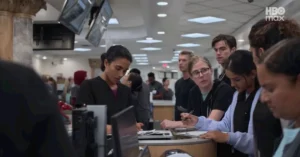

Noah Wyle’s return to television in the medical drama The Pitt feels like a homecoming, but his character is facing a completely different world. Playing Dr. Michael “Robby” Robinavitch, a seasoned attending physician battling a broken system, Wyle says he understood the core of the man immediately. The show, which airs on Max, has become a major hit by presenting a raw, real-time look at a single 15-hour shift in a hospital emergency room. Its success has earned 13 Emmy nominations, marking Wyle’s first nomination in 26 years.
The Core of Dr. Robbie Was Clear From Day One
When asked about finding his character, Noah Wyle explained that Dr. Robbie’s essence was apparent to him at the very beginning. “This has been a wonderful sort of psychological examination of one guy having one of the worst days of his life,” Wyle said. The entire season is designed as a mounting pressure cooker, with each episode representing one hour of a grueling shift. Wyle’s focus was on portraying the accumulating fatigue and the struggle to manage overwhelming stress. This intense structure meant Wyle didn’t have to search for the character; he simply had to live through the relentless day with him.
“This is building a pressure cooker hour by hour, degree by degree… The presence required in just that exercise, I haven’t even thought about similarities or differences [to ER].”
The format of the show, which rarely leaves the emergency room floor, was key to this process. Wyle described it as an intimate, immersive experience similar to a ride-along. “You can turn your head, but you can’t really leave. And you’re going to be sort of stuck witnessing everything in real time,” he said. This creates a powerful connection for the audience and a unique challenge for the actors, who must build their character’s journey sequentially without the usual breaks in filming time.
A Different World from the E.R. of the 1990s
While Wyle is famous for playing the idealistic Dr. John Carter on NBC’s ER, he is clear that The Pitt is a product of a changed era. The new show films on a stage just 100 feet away from the old ER set at Warner Bros., but Wyle notes it feels “like a million miles and a million years” apart. The medicine, the challenges, and the societal pressures are all different. The Pitt actively tackles contemporary issues like staffing shortages, the impact of gun violence, fentanyl overdoses, and the lasting effects of the COVID-19 pandemic on healthcare workers.
Wyle admits the show would not exist without the pandemic. It was during that time, feeling a lack of purpose while not working, that he decided to tell a new story about modern healthcare. He was inspired by letters from real medical professionals who said his old work inspired them. “I thought maybe there’s another story to tell here that’s more contemporary that reflects what these guys are going through now,” Wyle explained. The goal is to spotlight the fragile state of the healthcare system and the immense toll it takes on frontline workers.
An Unflinching Look at a Modern Healthcare Crisis
The show’s commitment to realism is extreme. There is no musical score to tell viewers how to feel; the only sounds are the beeps of machines, rolling gurneys, and urgent dialogue. The writers and producers conduct extensive interviews with healthcare experts from all fields, ending each conversation with a crucial question: “What isn’t on TV that should be?”. This research leads to storylines that often mirror real-world events. An episode about a measles outbreak debuted the same week cases surged in the United States.
To ensure medical accuracy, the entire cast underwent a rigorous two-week medical bootcamp before filming. They learned procedures like suturing and intubation and have real doctors and nurses on set at all times to choreograph trauma scenes and correct details. This foundation allows the actors to focus on their performances within the chaotic, authentic environment.
Also Read:






The Breaking Point and the Role Model
The entire first season builds toward a pivotal moment in Episode 13, where Dr. Robbie suffers a panic attack on the ER floor. For Wyle, this scene was the emotional climax he had been working toward. “I was so looking forward to that release both for myself and the character,” he said. “The whole season has been building to that point.” He even stayed emotionally immersed in the character’s stressful headspace during the final weeks of filming, requiring patience from his own family until he could fully step away after production ended.
Wyle sees Dr. Robbie as an important figure on television today. In contrast to the charismatic anti-heroes that have dominated dramas, Robbie is a different kind of male role model. “He’s just trying to do the best he can and not let his demons get in the way,” Wyle stated. “I think there are a lot more guys like Robby out there… So it’s not a bad example to put back on TV.” The character represents the quiet, dedicated heroes struggling within a system that often seems designed to break them.
Production on Season 2 of The Pitt is currently underway and is scheduled to debut in January. The new season will jump forward ten months from the events of the first season. Wyle, who also serves as an executive producer, plans to take on even more responsibility by writing and directing some episodes of the upcoming season.
Also Read: Down Cemetery Road Season 1 Episode 7 Recap: A Major Death and a Cliffhanger Ending