

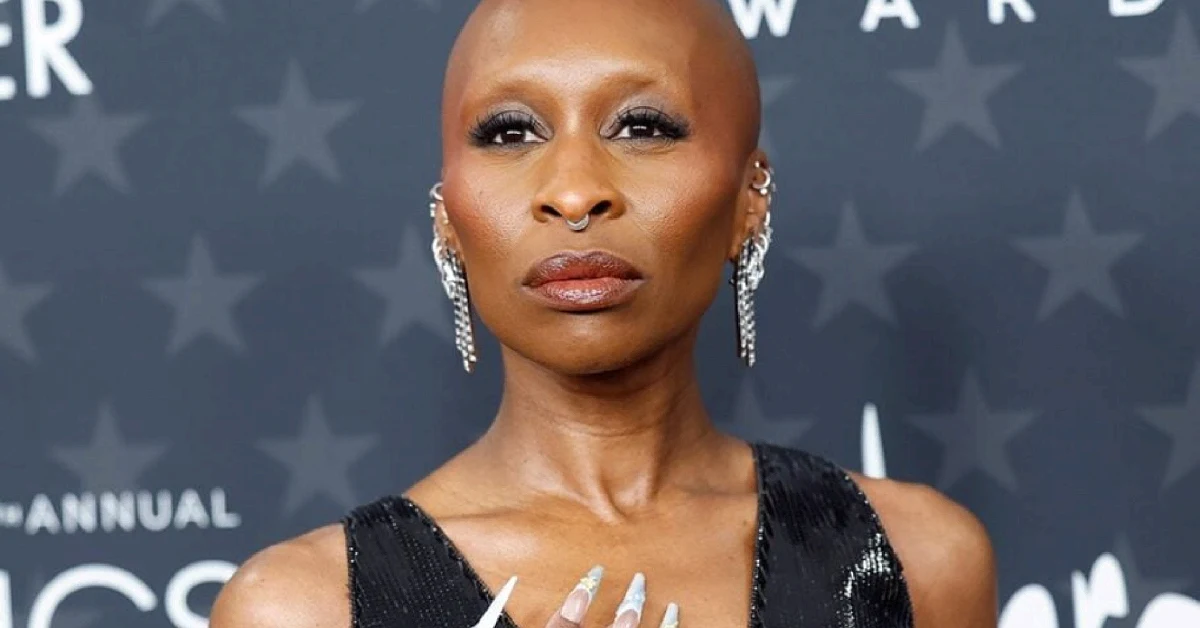

Cynthia Erivo has directly addressed the public scrutiny that followed her friendship with Ariana Grande during the long promotional campaign for Universal Pictures’ two-part Wicked adaptation, describing the reaction as a “weird” form of “annoyance” that two women could genuinely be close.
In an interview with The Guardian published October 27, 2026, conducted while she was promoting her upcoming courtroom drama Prima Facie, Erivo said the online commentary had turned ordinary human behavior into a spectacle, and she questioned why visible emotion from two female co-stars provoked such irritation . The comments mark her most pointed public response yet to a controversy that has shadowed the franchise since the first film’s release in November 2024, and they land as the awards narrative around Wicked: For Good has already collapsed.
Cynthia Erivo’s Guardian Interview: The Exact Words Behind the “Annoyance” Quote
Erivo framed the public reaction as a form of armchair psychoanalysis. “It was interesting that there were many people who had become psychologists from their couches,” she told The Guardian. “There was this weird sort of, what’s the word I’m looking for … annoyance … at the fact that two women could actually be friends. Like, why are they friends? Why are they connected? There must be something wrong with them” .
She then sharpened the point with a series of rhetorical questions that echoed the cross-examination style of her Prima Facie character, Tessa, a barrister who defends men accused of sexual violence. “Why are they showing emotion? How dare they cry? And how dare they laugh? And how dare they be emotive and alive?” she said. “It’s a double-edged sword. Because if we were dead behind the eyes and showing no emotion, there would have been something else to say about it” .
The actor also rejected the idea that there is a correct, publicly approved amount of feeling for a celebrity to display. She told the paper she wished someone could have handed her a precise standard: “Right, this is the proper balance of emotion that you should show. Don’t show this. Don’t show that. Just this amount” .
How the Wicked Press Tour Became a Meme Factory
The Wicked campaign was unusually long and unusually exposed. Filming began in December 2022, and the two films were released in November 2024 and November 2025 respectively, meaning Erivo and Grande were paired in interviews, premieres and junkets across roughly three years . Every hug, every tearful exchange and every hand gesture was clipped, captioned and recirculated.
The most durable artifact was “holding space.” During an Out magazine junket interview in November 2024, journalist Tracy E. Gilchrist told the pair that fans were “taking the lyrics of ‘Defying Gravity’ and really holding space with that and feeling power in that.” Grande sympathetically held Erivo’s pointer finger, and the clip became one of the defining viral moments of the season .
The volume of clips created a secondary problem: the more the pair were seen being affectionate, the more the internet demanded a hidden explanation. The Guardian noted that commentators began asking whether the closeness was “faked as part of a Hollywood psyop” and what was “really going on” between Erivo, who is queer, and Grande . IndiaTimes reported that what began as fans enjoying gifs of the two women hugging and supporting each other gradually shifted into something more invasive, with some insisting the bond was romantic and others claiming it was manufactured for cameras .
The Singapore Ambush and the “Bodyguard” Problem
The scrutiny intensified after a red-carpet incident in Singapore on November 13, 2025, during the Wicked: For Good premiere. An Australian prankster, Johnson Wen, known online as “Pyjama Man,” jumped a security barrier and grabbed Grande while attempting to get a selfie. Erivo immediately stepped between them and confronted him .
Wen pleaded guilty to one charge of public nuisance, was sentenced to nine days in jail and was later deported from Singapore and barred from re-entering the country . The internet’s response, however, recast Erivo as Grande’s “bodyguard,” a label she said reduced a human act of protection to a caricature.
Erivo told The Guardian the reaction was “cloaked in a mix of misogyny and misogynoir,” with people taking pleasure in mocking “a queer, muscular, bald, Black woman looking out for her friend” . She recalled a journalist asking her on another red carpet whether she was a “protector,” a question that still rankles. “I was like: ‘Oh, you think because I look like this that you could talk to me this way about something that was a human thing that I would have done for any friend, and hopefully a friend would have done for me,’” she said. “But I must be a bodyguard” .
Misogyny, Misogynoir and the Policing of Female Emotion
Erivo’s remarks connect two separate patterns that media researchers have tracked for years: the suspicion directed at intense female friendships, and the specific racialized scrutiny applied to Black women who display protectiveness or anger. The Guardian interview places both dynamics in the same frame, arguing that the “bodyguard” joke was not neutral humor but a way of stripping agency and humanity from a Black woman’s instinctive response .
Erivo has made a version of this argument before. In a prior interview with Stylist, she said people struggled to understand “how it was possible for two women to be friends — close — and not lovers,” and she pointed to a broader cultural gap: “There’s such little conversation around platonic female friendship that is deep and real, even though it exists everywhere. We’re not used to seeing it on camera, in front of people” .
That gap has commercial consequences. Female-led press tours are now judged as content, and the emotional register of the stars becomes part of the marketing mix. When the register is warm and demonstrative, it generates engagement; when the engagement turns skeptical, the same footage is re-edited as evidence of performance.
The Oscar Snub That Proved Erivo’s Point
The backlash did not stay inside social media. On January 22, 2026, Wicked: For Good was completely shut out of the 98th Academy Awards nominations, a sharp reversal from the first film’s ten nominations, including Best Picture. Erivo was omitted from the lead actress field, and Grande was omitted from supporting actress .
The snub followed a rocky critical reception for the sequel despite a 30% larger domestic opening than its predecessor, and it came after the pair had earned Golden Globe nominations but gone home empty-handed . An anonymous Oscar voter later told NewsNation that the duo’s promotional appearances had “creeped a lot of people out” and that in their “rush to feel authentic,” they “came off as cosplaying” .
That voter’s quote is the clearest evidence that the “annoyance” Erivo describes had migrated from comment sections into the awards-voting class. The same emotional displays that drove billions of impressions were framed by some industry voters as a liability.
Wicked’s Box Office vs. Its Awards Narrative
The financial picture complicates any narrative of failure. The 2024 Wicked earned $758 million globally, including $474 million in North America and $283 million overseas, becoming the highest-grossing Broadway musical adaptation in box office history at the time . Wicked: For Good opened to $226 million worldwide, the highest-ever opening for a Broadway musical adaptation, with $150 million domestic and $76 million international . By its fourth weekend, the sequel was projected to reach a cumulative global total of $467 million . The two films together represent nearly $1.3 billion in worldwide gross for Universal .
The divergence between commercial performance and awards reception is the real business story. Universal built a two-part tentpole that delivered reliably at the box office but became culturally overexposed. [Insert verified update from Universal Pictures here] on how the studio plans to manage the franchise’s next life cycle, including home entertainment, licensing and potential stage or streaming extensions.
Feud Rumors, the Dazed Interview and the Friendship’s Real Status
In January 2026, rumors emerged that Erivo and Grande were never close outside work and that the friendship had faded after Wicked: For Good was released . A source told The Sun that the press tour “became way bigger than anyone expected” and “turned into this massive online obsession,” creating an expectation of inseparability that neither actor could sustain .
Erivo pushed back in July 2026. During a Dazed interview at Paris Fashion Week, she said she planned to attend Grande’s Eternal Sunshine Tour stop in London in August and that Grande already knew she was coming. She also named “Hampstead Heath” as her favorite song from Grande’s previous album . The remarks were widely read as a soft confirmation that the relationship survived the noise, even if it no longer operates as a round-the-clock public double act.
The Parasocial Economy of Celebrity Friendships
The Wicked cycle is a case study in how parasocial attention works in the short-video era. A four-minute junket interview can generate years of remixed content. Fans who invest in the bond feel entitled to adjudicate its authenticity. Critics who suspect performance feel entitled to demand proof. Both groups produce the same outcome: the relationship becomes a text to be decoded rather than a private fact.
Erivo’s Guardian comments push back against that decoding industry. By asking “how dare they be emotive and alive,” she reframes the debate from “is the friendship real?” to “why does the public require a verdict at all?” That reframing has implications beyond one franchise. Studios increasingly rely on cast chemistry as a marketing asset, but the same asset can turn into a reputational risk when the audience decides the chemistry is a performance.
What Comes Next for Erivo and Grande
Erivo’s immediate promotional focus is Prima Facie, Susie Miller’s legal drama about a barrister who is sexually assaulted by a colleague, which The Guardian describes as a searing film about consent and the limits of the justice system . She has also been announced as a guest host on SNL UK, and she continues to perform live, including a recent concert in Phoenix, Arizona.
You May Also Like:
Grande, meanwhile, is on the Eternal Sunshine Tour and preparing the release of a new album, petal, according to Cosmopolitan . Whether the two appear together publicly again is less important than what their experience reveals about the conditions under which famous women are allowed to be friends on camera. The Wicked press tour turned affection into content, content into suspicion, and suspicion into an awards-season liability. Erivo’s response is a refusal to accept that conversion as normal.
Also Read: SNL UK Season 2: Danny Dyer, James Norton and Cynthia Erivo Set to Host October Episodes
For VVIPTimes, the lesson is blunt: the internet does not punish celebrities for showing emotion. It punishes them for showing the wrong amount, and then charges admission to the debate.










Leave a Reply