

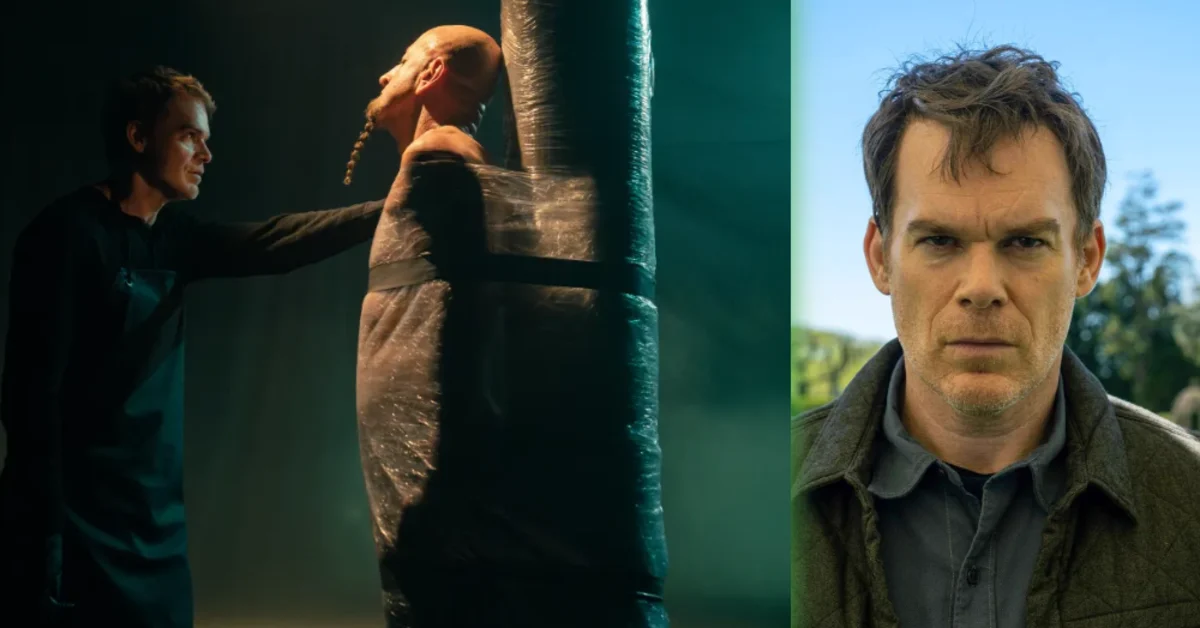

Dexter Morgan has spent twenty years putting killers on his table and making sure they never leave. Eric Stonestreet’s Al Walker—the man Dexter knew as Rapunzel—is the sole exception. When Dexter: Resurrection Season 2 Episode 1 arrives on Paramount+ with Showtime on Friday, October 30, 2026, at 12:00 AM PT / 3:00 AM ET, that exception becomes the premiere’s defining problem.
The episode, titled “Risky Business,” picks up after a multi-year time jump and forces Michael C. Hall’s aging vigilante to confront the one target who walked out of his kill room alive—while two entirely new predators carve up New York City in the background.
The premiere lands roughly one night before Halloween and opens a ten-episode season that Showtime and Paramount+ are positioning as the most consequential chapter in the franchise’s two-decade history. The first season shattered Showtime streaming records with 3.1 million global cross-platform viewers in its first three days—a 46% jump over the Dexter: Original Sin prequel launch—and the network confirmed the premiere became the most-streamed debut in Showtime’s history on Paramount+ alone. Season 2 does not have the luxury of a quiet build. It arrives with a stacked ensemble, an explicit midlife-crisis thesis, and a loose end that has been festering since the Season 1 finale.
What the Episode 1 Sneak Peek Reveals About the Rapunzel Reunion
Entertainment Tonight released the first official clip from the premiere in late October, and the scene is built on a lie that has not yet collapsed. Al Walker appears to be on a family vacation, standing in front of an RV surrounded by ordinary families somewhere outside New York City. Dexter approaches him from a distance and waves. Al still knows him only as “Red,” the alias Dexter used inside Leon Prater’s circle of killers. The exchange is almost warm—two middle-aged men making small talk—until Dexter says, “I saw your latest work and I wanted to connect.”
That line carries the entire architecture of the scene. Dexter has been tracking Al. He knows Rapunzel has continued killing. And Al, who has no idea that “Red” is the Bay Harbor Butcher, agrees to meet again later. The preview ends with plans for a second meeting, which means the premiere is structured around a countdown: Dexter has one conversation to close the gap before Al either disappears again or figures out who he is actually talking to.
The clip also answers a question that hung over the off-season. Al was the only member of Prater’s killer club to survive besides Dexter, and he fled New York after growing suspicious of Dexter’s behavior. Bringing Stonestreet back rather than writing the character out signals that the writers view Rapunzel as unfinished business, not a discarded Season 1 thread. Stonestreet’s return was confirmed at New York Comic Con on October 8, where he made a surprise appearance during the show’s panel alongside Hall, Uma Thurman, James Remar, Jack Alcott, Bokeem Woodbine, Krysten Ritter, showrunner Clyde Phillips, and executive producers Scott Reynolds and Marcos Siega.
Two New Serial Killers and a Midlife Crisis: The Season 2 Premise
The official Season 2 logline, distributed by Paramount+ and Showtime, places Dexter “caught between two killers—one with decades of notoriety and a lifetime of kills behind him, and the other a fresh young face terrorizing New York in ways no one has ever seen.” It then adds the twist that has driven most of the pre-season coverage: “Meanwhile, Dexter battles a new and unexpected enemy: a mid-life crisis. Harrison continues his own pursuit of justice as father and son face their darkest chapter yet.”
Brian Cox plays Don Framt, the New York Ripper—an inactive serial killer whose reputation was built decades ago and who now operates through taunts and psychological pressure rather than direct violence. Dan Stevens plays Owen Stark, the Five Borough Killer, a younger and more erratic threat who calls the police to announce his crimes. The pairing is deliberate. Cox’s Ripper represents the kind of killer Dexter used to hunt with confidence: established, methodical, and arrogant. Stevens’ Five Borough Killer represents the opposite—a predator who does not follow the old rules and whose unpredictability exposes how much Dexter’s physical edge has eroded.
Gabriel Luna guest-stars as Ray Ballard, a third killer known as the Sleepy-Eyed Stranger, whose presence makes the “two killers” framing look almost modest. Krysten Ritter returns as Mia LaPierre, also known as Lady Vengeance, though the trailer deliberately leaves her status unresolved. The ensemble is not background noise. It is a structural choice: Season 1 loaded the board with new talent; Season 2 settles into a groove and lets the stacked call sheet interact.
Why the Time Jump Matters for Harrison, Quinn, and the NYPD
Season 2 opens after a multi-year time jump, and the show uses that gap to resolve the most awkward piece of Season 1’s aftermath. Harrison Morgan, played by Jack Alcott, is now twenty-one, has graduated from the NYPD academy, and is working as a police officer in the city his father is secretly hunting. The father-son friction that drove much of Season 1 has matured into something more dangerous: Harrison has institutional legitimacy, and Dexter has none. Every kill Dexter performs now carries the risk of putting his own son on the trail of the Bay Harbor Butcher.
Desmond Harrington’s Joey Quinn has been promoted to a series regular, and the expanded role gives the revival a direct tether to the original series’ Miami Metro era. Quinn’s presence also raises a continuity question the show has not fully answered in marketing materials: how much does Quinn know, and how much has he chosen not to ask? The death of Angel Batista in Season 1 removed one of the last moral anchors from Dexter’s past. Quinn remains, and his promotion suggests the show intends to use him as a bridge between the old life and the new one.
The Midlife Crisis Is Not a Gag—It Is the Season’s Central Threat
The trailer leans into the comedy of Dexter getting glasses, but the first two episodes reviewed by critics treat aging as a genuine tactical vulnerability. CBR’s review notes that the season is “framed by the notion that despite his best efforts, Dexter is no longer as physically able as he once was,” which is “especially problematic in his line of work where he needs to be faster, stronger, and smarter than his potential victims.” The midlife crisis is not about sports cars or younger women. It is about a killer who has spent his adult life avoiding recognition suddenly wanting to be seen—a desire that is, as the review points out, “precisely what could take Dexter down.”
That psychological shift gives the premiere a second layer of tension beyond the Rapunzel reunion. Dexter’s control has always been his defining trait: the plastic sheeting, the slides, the ritual, the certainty that nobody leaves the table. Season 1 broke that certainty with Al’s escape. Season 2 compounds it with a body that no longer cooperates and a son who now carries a badge. The premiere’s title, “Risky Business,” reads less like a Tom Cruise reference and more like a warning about a man whose margins for error have collapsed.
Release Schedule, Streaming Tiers, and the Business Stakes
Season 2 consists of ten episodes, released weekly on Fridays on Paramount+ with Showtime. The premiere requires the Paramount+ Premium tier, which includes Showtime access and costs $13.99 per month; the ad-supported Essential tier at $8.99 does not carry the series at launch. That tier distinction matters for the ratings conversation. Season 1’s 3.1 million three-day figure was a global cross-platform number that combined Paramount+ streaming with Showtime’s linear broadcast. The seven-day tally climbed to 4.4 million cross-platform viewers, a 25% increase over Original Sin and a 41% gain over the first three days. If Season 2 holds that pattern, the weekly release structure will stretch the audience conversation across ten weeks rather than concentrating it into a premiere weekend.
The franchise’s corporate architecture has also shifted. Dexter: Resurrection is produced by Paramount Television Studios and Counterpart Studios, with Clyde Phillips serving as showrunner and executive producer. Hall executive produces in addition to starring, alongside Reynolds, Siega, Tony Hernandez, Lilly Burns, John Goldwyn, Sara Colleton, Veronica West, Kirsa Rein, and Tanner Bean and Katrina Mathewson. The renewal for Season 2 came with an important footnote: Dexter: Original Sin, the prequel series that preceded Resurrection, was not renewed after one season. The franchise is now consolidated around Hall’s present-day Dexter, and the creative resources are following that consolidation.
What Critics Are Saying Before the Premiere
Reviews of the first two episodes have been largely positive, with a consistent caveat about the show’s crowded antagonist roster. MovieWeb’s spoiler-free review calls the double-episode premiere a journey that “sets the journey in motion brilliantly,” and notes that the time jump, which initially looked like a way to skip past unresolved Season 1 drama, is handled with enough immediate fallout that the decision becomes understandable. JoBlo describes the season as “just as fun to watch as some of the best seasons that have come before,” and confirms that Rapunzel, the Sleepy-Eyed Stranger, and Brian Cox’s New York Ripper all receive proper introductions in the early episodes.
The more skeptical read comes from Absolute Geeks, which points out that the show “has historically been strongest when it focuses on one antagonist per season,” and that Season 2’s board—Rapunzel, the Ripper, the Five Borough Killer, the Sleepy-Eyed Stranger, and whatever Krysten Ritter’s Mia LaPierre is doing—is unusually crowded. That criticism is not a prediction of failure. It is a description of the season’s structural gamble: the premiere has to establish Rapunzel as the emotional through-line while introducing enough new threats to sustain ten episodes, and it has to do both without letting any single antagonist get lost in the shuffle.
The Unfinished Business That Defines the Premiere
The most revealing detail in the Episode 1 preview is not the RV, the families, or even the line about Al’s “latest work.” It is the fact that Al still calls Dexter “Red.” That alias is the only thing keeping Dexter alive in this relationship. The moment Al connects “Red” to the man who killed the rest of Prater’s club, the reunion becomes a different kind of scene entirely. The premiere is built on the audience’s awareness that this second meeting is either a kill-room setup or a trap—and the show is in no hurry to clarify which.
For a franchise that has now attempted a perfect ending twice—first with the lumberjack finale, then with New Blood—Season 2 carries an unusual weight. MovieWeb’s review notes that the revival “will more than likely be his last,” and that the season “seems to be gradually, tastefully, setting up several ways that Dexter Morgan’s story could come to a satisfying conclusion.”
Related Stories


The premiere does not resolve that question. It sharpens it. Dexter is older, slower, and more exposed than he has ever been. Rapunzel is back, and this time Dexter knows exactly where to find him. The only question is whether the man who has spent twenty years controlling every variable can still control this one.
VVIPTimes will continue tracking Dexter: Resurrection Season 2 across its ten-episode run, with weekly episode analysis, ratings updates, and cast tracking as the season continues.


























Leave a Reply