
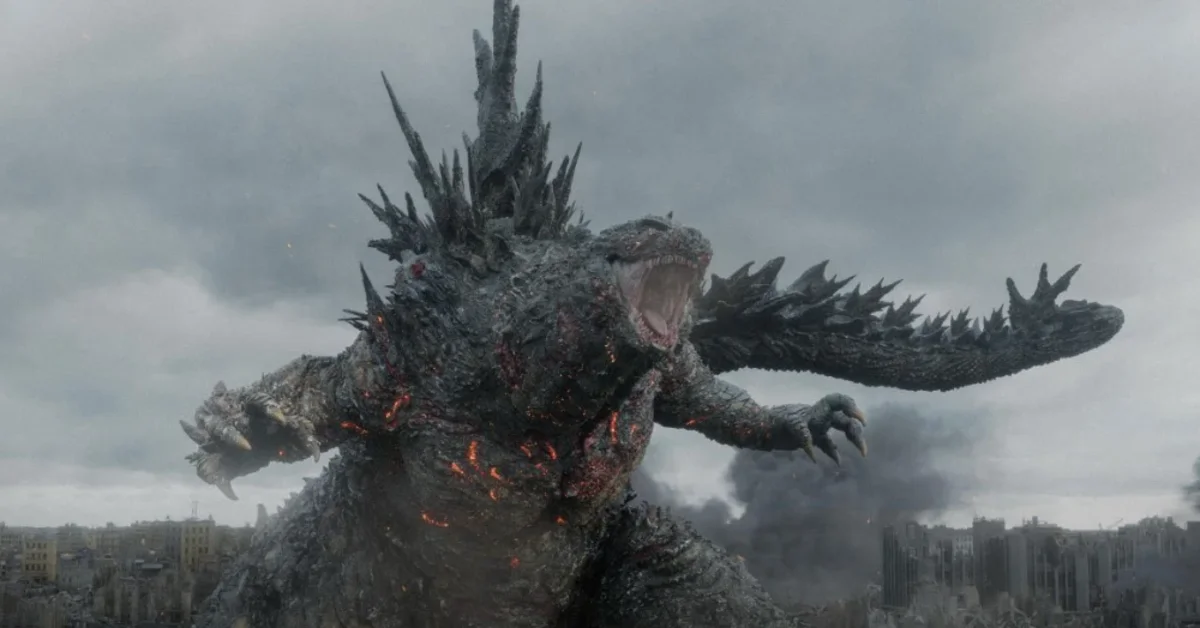

Godzilla Minus Zero has arrived in cinemas, and the sequel does something rare for this 72-year-old franchise: it picks up the same characters, in the same decade, and continues their story. Directed, written and visually supervised by Takashi Yamazaki, the film opened in Japan on November 3, 2026 and reaches North American theatres on November 6, 2026 through GKIDS. It runs 135 minutes, carries the franchise’s first-ever R rating, and is the first Japanese production shot under the Filmed for IMAX programme.
Here is a full, spoiler-heavy breakdown of the story, the characters, the monsters and the ending.
Where the story picks up
The film opens in 1949, two years after the events of Godzilla Minus One. Japan is rebuilding, and Koichi Shikishima (Ryunosuke Kamiki) is living quietly with Noriko (Minami Hamabe) and the orphaned girl they are raising, Akiko (Sae Nagatani).
Godzilla is believed dead in Sagami Bay after the climactic Operation Wada. That peace does not last. A new creature attacks Matsumoto in Nagano Prefecture, levelling the city. The government’s newly formed Large-Scale Disaster Response Bureau, led by Kenji Noda (Hidetaka Yoshioka), is handed the problem.
Noda brings in Makoto Aoyama (Masami Nagasawa), a meteorologist who believes monster activity and weather patterns are linked. He also brings in Kanji Murakami (Min Tanaka), a biologist who survived the atomic bombing of Hiroshima and carries the loss of his wife, daughter and grandson.
Ghidorah is not a normal monster
The film’s new threat is Ghidorah, and Yamazaki gives it a fresh origin. The creature begins as a mysterious white substance that crash-lands in Japan between the two films. It absorbs DNA and physical traits from nearby wildlife, which is why scientists combine “chimera” and “hydra” to name it.
It first appears as a single-headed, bat-winged dragon. When humanity tries to kill it with an American fuel-air bomb, it survives. A second plan attaches a lightning rod to its back to ground it with strikes; instead, Ghidorah absorbs the electricity and evolves into a golden, three-headed beast with two tails and a gravity beam.
Ghidorah’s link to weather is deliberate. Yamazaki explained the idea in an interview:
“The way in which [Ghidorah] interacts with or affects the weather is a metaphor for a natural disaster… There were a lot of disastrous typhoons that we had to survive through in our postwar era, which is also a reason that our postwar recovery was a bit delayed as well.”
Koichi Shikishima: from kamikaze guilt to a father on the run
The first film ended with Shikishima choosing to live, ejecting from his explosive-laden fighter instead of dying in Godzilla’s mouth. Minus Zero tests that choice.
Shikishima is now a husband and a father, and he initially refuses Noda’s request to rejoin the fight. He agrees to advise younger pilots rather than fly, then ignores that role and joins the mission anyway. The first operation against Ghidorah fails badly, and Shikishima watches a fellow plane get torn in half.
His instinct is to run. He takes Noriko and Akiko and tries to start a new life away from the danger, partly because he knows Noriko’s body is now valuable and partly because he cannot bear to lose her again. The film’s emotional argument is that running is understandable but not the same as protecting anyone.
Noriko: the survivor whose body became a weapon
Noriko’s return is the film’s biggest piece of continuity. The closing shot of Godzilla Minus One showed a black mark on her neck; Minus Zero explains it. Exposure to Godzilla’s cells, known as G-cells, saved her life after the Ginza attack. Other infected people grew horns and scales and died. Noriko’s body accepted the mutation.
Now she wears a patch over a damaged eye, and her eye colour has changed. Dr. Ogata (Jun Kunimura) states plainly:
“I can say for certain. That patient…she had no business surviving.”
That survival makes her the key to Murakami’s Resonance Wave device, which uses the shared biology between Noriko and Godzilla to mimic a Godzilla bio-signature and pull the creature in a chosen direction. Noriko is the only person who can operate it, and she volunteers for the job while Shikishima wants her nowhere near it.
Akiko and the real meaning of “Have a safe trip”
The six-year-old is not a side character. Before the final battle, Shikishima and Noriko leave Akiko at a local orphanage run by Sumiko Ota (Sakura Ando). The other children tell Akiko her parents are never coming back. She insists they are different, and she is right.
Later, knowing the United States will hunt Noriko for her G-cells, the couple plans to leave Akiko behind permanently for her own safety. At the orphanage, the girl sobs one phrase over and over: “Have a safe trip.” Noriko had told her it was a magic spell that guarantees the person travelling will come home.
That scene is the hinge of the whole film. The family cannot go through with the goodbye, and the final shot shows the three of them riding away on Shikishima’s motorcycle together.
Kenji Noda pays the highest price
Noda is the film’s engine. He builds the plan, recruits the team, manages the politics and argues Murakami out of his revenge scheme. During the Ginza battle, he tries to repair damaged fuel lines meant to help bring Ghidorah down and is killed when the monster strikes his vehicle.
His death lands as the cost of the strategy. It also completes his arc from the first film, where he was the engineer who insisted Japan could solve its own problem without waiting for other countries.
Kanji Murakami: the most dangerous man in the film
Min Tanaka’s Murakami is the film’s most complicated figure. He reported Ghidorah’s first attack, he builds the Resonance Wave, and he has a private plan. He wants to use Noriko and the device to send Godzilla to New York City, so that American civilians experience what Hiroshima experienced.
Noda confronts him and asks him to break the cycle rather than continue it. Murakami listens. He abandons the revenge plan, destroys his research and lets the Shikishimas escape. American forces then arrest him, which leaves his knowledge intact inside his head and his fate unresolved.
Makoto Aoyama: the weather expert who inherits the fight
Masami Nagasawa’s Aoyama is the new scientific lead, and the film quietly hands her Noda’s role. She maps Ghidorah’s storm-following behaviour, pushes the lightning strategy and carries guilt from a tsunami she failed to predict.
Nagasawa is a familiar face to Godzilla fans; she played the Mothra fairies in 2003’s Godzilla: Tokyo S.O.S. Her casting gives the sequel a direct line back to the franchise’s earlier era.
The Ginza battle, step by step
The plan is to make the two monsters fight and then kill the survivor.
- Godzilla, regenerated and resurfaced, is drawn to Ginza using the Resonance Wave and Noriko.
- Ghidorah is drawn to the same spot by electrical generators and the storms it follows.
- Godzilla severs one of Ghidorah’s heads. The detached head latches onto Godzilla’s arm and tears it off. Both monsters regenerate.
- Noda and his team spring a liquid nitrogen and gas trap, weakening Ghidorah through extreme temperature change.
- Ghidorah reattaches its head, but that head has absorbed G-cells and now carries Godzilla’s scales, dorsal spines and heat ray.
- Ghidorah cannot control its new abilities. Godzilla lands a full atomic heat ray blast and kills it.
The American military arrives after the battle, allows Godzilla to return to the sea and reveals its real interest: seizing the Resonance Wave technology and Noriko herself.
What the ending actually leaves open
Godzilla Minus Zero ends without a post-credits scene. Viewers who stay through the credits will hear Godzilla’s roar, but no extra footage follows.
The final stretch: Murakami destroys his machine, is taken into American custody, and the Shikishimas go on the run. Godzilla swims back into the ocean, alive and uncontrolled. The American and Japanese governments now know a weapon exists that can steer him.
That is the political point the film builds toward. Godzilla is not a hero here. He is the atomic bomb with legs, and everyone who survives the battle immediately starts thinking about how to point him at someone else.
What critics are saying
Reviews are strong but not unanimous. The film sits around 90% on Rotten Tomatoes across more than 75 reviews, with a Metacritic score of 77.
Variety’s chief film critic Owen Gleiberman called it an “even grander follow-up to ‘Godzilla Minus One.’” The Guardian gave it 4 out of 5 stars and praised its social commentary alongside the effects work. The Seattle Times called it a “roaring good sequel” that asks viewers to break cycles rather than simply survive them.
Not everyone is convinced. The New York Times described it as visually stunning but narratively undisciplined, and The Baltimore Sun said the formula feels less fresh the second time, with the melodrama running long.
Release details, rating and box office
Japan opened the film on November 3, Godzilla Day, the 72nd anniversary of the original 1954 release. Toho reported ¥910 million ($5.75 million) and 590,000 admissions on day one, a record opening day for a live-action film in Japan, beating Harry Potter and the Chamber of Secrets (¥840 million). Three-day takings reached ¥1.38 billion ($8.7 million).
North America gets the film on November 6 in 3,254 theatres, with tracking pointing to a $30 million opening weekend. GKIDS is distributing.
You May Also Like:

United Kingdom and Ireland screenings began in IMAX on November 3, with general cinemas from November 6. Australia opens November 5, along with Brazil, Italy, Mexico and Germany. France opened November 4.
India was originally set for November 6, but the release moved because Ramayana: Part One holds IMAX exclusivity. PVR INOX Pictures has confirmed a November release, and trade reports point to November 20 as the likely date, though an exact date has not been formally locked.
The R rating comes from the Motion Picture Association for “some violent content/bloody images,” the first time in the franchise’s history that a Godzilla film has received it. It is also the 39th Godzilla film.
Yamazaki has said he would return for another entry if Toho asked:
“If Toho came to me with another offer to explore this world even further, I’d probably say yes.”
Also Read: Godzilla Fans Should Know This Health Warning Before Seeing Minus One in Theaters: Full Recap, Characters, and Release Info
For more film breakdowns, release guides and box office coverage, keep checking VvipTimes, where every monster-sized story gets the full picture.













Leave a Reply