
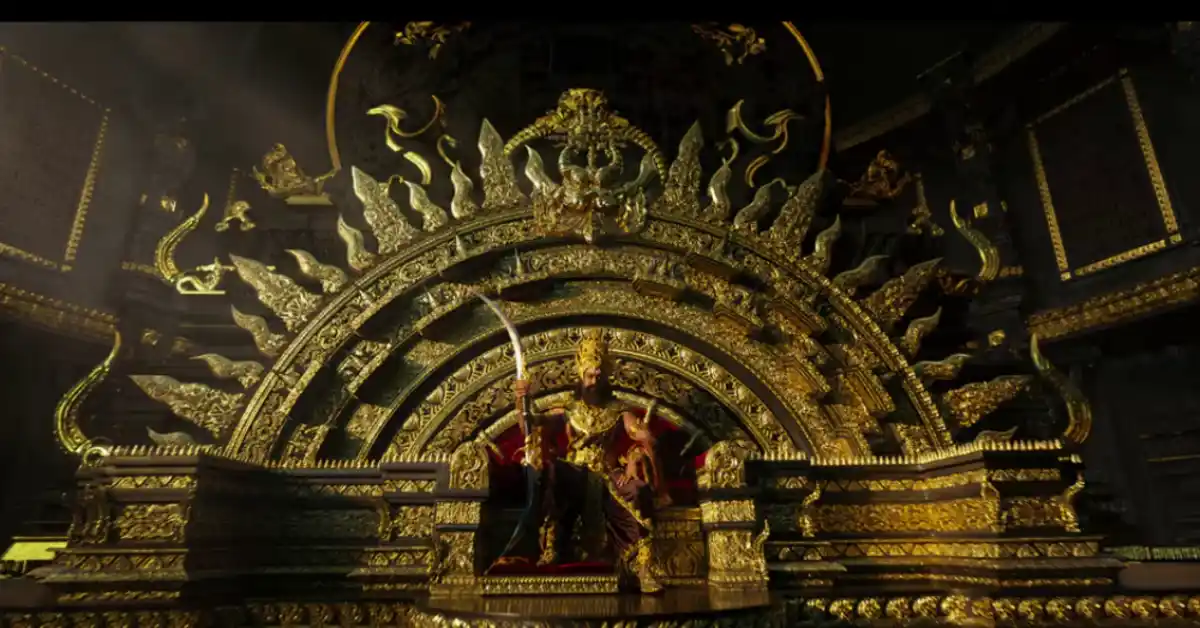

Ramesh Andhale, one of the art directors of Nitesh Tiwari’s Ramayana: Rise of a Legend, has shared the real cost of building the film’s grandest props and sets. In an interview with Prabhat Khabar, Andhale confirmed that Ravana’s throne was made for approximately ₹1 crore and used 24-karat gold leafing, while Surpanakha’s chariot cost around ₹1.5 crore despite appearing in only one scene. The film, starring Ranbir Kapoor, Yash, and Sai Pallavi, released in theatres on November 5, 2026, and has already earned ₹127.50 crore on its first day in India, according to trade tracker Sacnilk. The combined budget of the two Ramayana films is over ₹4,000 crore, producer Namit Malhotra revealed earlier.
The Throne That Cost ₹1 Crore
Building Ravana’s throne was not a quick task. Andhale told Prabhat Khabar that the art department spent four months on the piece. The process started with a clay model based on approved designs, after which the team constructed the final structure using fibre. What made the throne stand out on screen was the finish: real 24-karat gold leafing was applied to its surface. The final cost came to around ₹1 crore.
“No set is ever finalised on the first attempt. It takes 10-15 different versions and variations to achieve what is ultimately seen on screen. Construction of the sets began after about three months of preparation.” – Ramesh Andhale, art director
The throne is part of a key sequence in the film where Ravana takes over the rule of Lanka from Kuber and sits on the golden seat as the new king. Yash plays Ravana in the film, and the throne was designed to reflect the character’s larger-than-life presence as the demon king.
Surpanakha’s Chariot: ₹1.5 Crore for One Scene
Surpanakha’s chariot, carried by Rakul Preet Singh’s character, appears in only one sequence: when she visits Lord Rama and Lakshman in the Panchavati forest. Even so, the production team invested three months into building it. The challenge was not just visual. The chariot had to be functional and able to move during filming, which meant balancing mechanics with the grand look required for the screen. The final cost was ₹1.5 crore.
Over 150 Sets Built by Hand
The art team joined the project in February 2024, and construction began in April 2024 at Prime Focus Studios in Mumbai’s Film City. More than 150 sets were created for the film. Each major structure went through 10 to 15 design changes before being approved. Instead of depending only on green screens, the team built physical floors, wall textures, and gold decorations so actors could interact with real surroundings. Andhale said the team creates “10-15 versions of whatever you see on screen”.
Jatayu Model and Pushpak Vimana
Two more large-scale builds stand out. A 24-foot-tall skeleton model of Jatayu was constructed so actors could maintain accurate eye-lines while delivering dialogue. The model allowed the cast to know exactly where to look during a scene instead of performing against an empty space. Ravana’s Pushpak Vimana, the flying vehicle, was too large for the studio. It was built in four separate parts over 40 to 50 days, with a diameter of around 50 feet.
A Workforce of Hundreds
The Lanka set alone kept 500 to 600 workers busy at the same time. Big crowd scenes used up to 1,000 dancers and junior artists. Andhale also noted that director Nitesh Tiwari personally checked every set a day before shooting, after reviewing storyboards and concept art four days earlier.
Jewellery and the Gold Look
The film’s jewellery added another layer of detail. Tarang Arora, Creative Head of House of Amrapali, told NDTV that Lanka was believed to have been built of gold, so the team had to show opulence through the characters’ ornaments. One of the most difficult pieces was Ravana’s chest plate.
“That entire chest plate was handcrafted by our artisans, and it took a long time to complete. We had to be very practical. We wanted to show opulence but also ensure that if the actor wore it for six hours, he wouldn’t feel uncomfortable.” – Tarang Arora, Creative Head, House of Amrapali
The designers used snake motifs in Ravana’s jewellery to show him as a devoted follower of Lord Shiva. The colours for his brass and gold-plated ornaments were darker, with shades of blue, black, and green, along with stronger metallic tones. 13 jewellery looks were crafted for Ravana, each with eight to 10 pieces, totalling between 104 and 130 pieces. Each look weighed approximately 6-7 kg.
Related Stories
Release Details and Box Office Start
Ramayana: Rise of a Legend released worldwide on November 5, 2026, in Hindi, Tamil, Kannada, Telugu, and Malayalam, across 2D, 3D, IMAX 3D, 4DX 3D, and 3D Screen X formats. The film is produced by Namit Malhotra’s Prime Focus Studios in collaboration with DNEG and Yash’s Monster Mind Creations. The cast includes Ranbir Kapoor as Lord Rama, Sai Pallavi as Sita, Ravie Dubey as Lakshman, and Sunny Deol as Lord Hanuman. The first part has earned ₹127.50 crore in India on its opening day. The second part is set for a Diwali 2028 release.
For more detailed breakdowns of how your favourite films are made, stay with VvipTimes.





















Leave a Reply