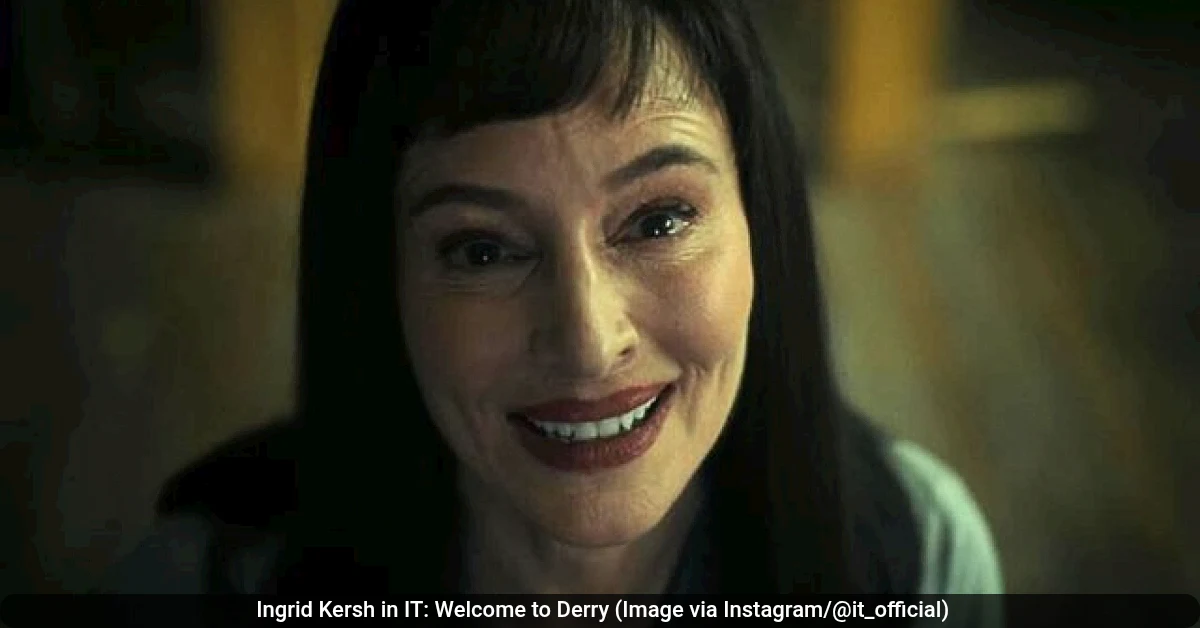
If you have been watching IT: Welcome to Derry and the character of Ingrid Kersh seems eerily familiar, you are right on two counts. The face of the actress is known from decades of film and television, and the character herself is a direct link to Pennywise’s most terrifying tricks. The HBO Max series has revealed that Madeleine Stowe, a star of 90s cinema and the hit series Revenge, is playing a younger version of the creepy Mrs. Kersh from IT: Chapter Two. This deepens the lore of Derry, showing that some of Pennywise’s forms are inspired by real, tragic people connected to the town’s history.
The connection became clear in the show’s fifth episode when the character, who had been known simply as Ingrid, revealed her full name: Ingrid Kersh. This name sent a chill through fans who remembered the elderly Mrs. Kersh from both Stephen King’s novel and the 2019 film. In IT: Chapter Two, a character by that name is the unsettling old woman living in Beverly Marsh’s childhood home, who offers her tea before transforming into a monstrous crone. Welcome to Derry is now exploring the real person behind that nightmarish disguise.
Also Read:
Who Is Ingrid Kersh in the IT Universe?
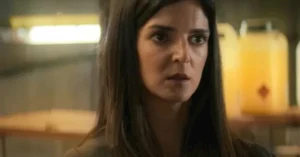
In Welcome to Derry, Ingrid Kersh is a nurse working at the Juniper Hill Asylum in the 1960s. She becomes a confidante to the young protagonist Lilly Bainbridge, but her motives are far from simple. The series reveals that Ingrid is the daughter of Bob Gray, the early 20th-century carnival performer whose identity was taken and used by the ancient entity known as It.
As a child, Ingrid performed alongside her father in the circus; he was Pennywise the Dancing Clown, and she was his assistant, Periwinkle. After her father disappeared, the entity It began using his form. A flashback in the show reveals that a young Ingrid encountered this Pennywise in 1935. Even after seeing it brutally attack a child, she became convinced the creature was her father, somehow changed but still reachable.
“It was him… different, perhaps. Changed by whatever he’d been through, or wherever he’d been… oh, but it was him, all the same. A daughter knows,” Ingrid explains in the series.
This tragic delusion defines her life. She believes that by helping It and luring children to it, she can somehow free her father’s spirit from within the monster. This makes her a complex and dangerous figure—not a monster herself, but a manipulated human whose love has been twisted into becoming an accomplice to evil.
Madeleine Stowe: The Actress Behind the Character
The role of Ingrid Kersh is played by veteran American actress Madeleine Stowe. For many viewers, her face is the source of that “where have I seen her before?” feeling. Stowe’s career spans from the late 1970s to the present, with major roles in iconic films and a defining television performance.
Her breakout role came in the 1987 comedy Stakeout with Richard Dreyfuss. She quickly became a familiar face in 90s cinema, starring in major films such as The Last of the Mohicans (1992) opposite Daniel Day-Lewis, the thriller Unlawful Entry (1992) with Kurt Russell, and the science-fiction classic 12 Monkeys (1995) alongside Bruce Willis. She earned critical praise and awards for her role in Robert Altman’s ensemble film Short Cuts (1993).
To a generation of TV fans, Stowe is best known as Victoria Grayson, the sophisticated and scheming matriarch on ABC’s drama series Revenge, which aired from 2011 to 2015. Her performance earned her a Golden Globe nomination and solidified her status as a commanding screen presence. Her casting in Welcome to Derry brings a weight of experience and recognition to the prequel series, making the reveal of Ingrid Kersh’s true identity even more impactful.
Connecting the Character to IT: Chapter Two
The elderly Mrs. Kersh who terrorizes Beverly Marsh in IT: Chapter Two is played by actress Joan Gregson. In that film, the character is a manifestation created by Pennywise, designed to prey on Beverly’s fears. The executive producers of Welcome to Derry have clarified that the real Ingrid Kersh likely died years before the events of Chapter Two. The monstrous old woman Beverly meets is It wearing a form inspired by Ingrid’s tragic life and memory.
Welcome to Derry is showing us the real human story that the monster later copies. The series explains the origins of specific details from the later film, such as why the cinematic Mrs. Kersh has a particular way of saying “father” and uses the haunting line, “You know what they say about Derry. No one who dies here ever really dies”. These are echoes of the real Ingrid’s trauma, which Pennywise cruelly replicates.
The show also explores Ingrid’s life beyond her connection to Pennywise. She is trapped in a bad marriage and is secretly having an affair with Hank Grogan, the Black man wrongly accused of the theater murders. This relationship adds another layer of danger and secrecy to her life in 1960s Derry.
Why This Reveal Matters for the Story
The unfolding story of Ingrid Kersh does more than solve a fan mystery. It deepens the mythology of Stephen King’s Derry by showing how the town’s human history and tragedies become fuel for the entity It. Pennywise does not just invent its forms; it exploits real people, their losses, and their love.
For the young heroes of Welcome to Derry, particularly Lilly Bainbridge, Ingrid’s betrayal is a devastating lesson. She was seen as a trusted adult, only to be revealed as someone using Lilly as bait to attract the creature she believes is her father. This personal betrayal makes the cosmic horror of Pennywise feel intimately human and cruel.
The series continues to explore how the cycles of fear and violence in Derry ripple through generations, a theme central to King’s original novel. Ingrid Kersh’s story is a key part of that cycle, a poignant and terrifying example of how Pennywise corrupts everything it touches, turning a daughter’s love into a weapon.
Also Read:
Will There Be A Playing Gracie Darling Season 2? Here Is What We Know
Abbott Elementary Season 5 Episode 7: New Club Drama and Release Details
Heated Rivalry Book Ending: What Happens Between Shane and Ilya?
Stranger Things Season 5 Episode 5: “Shock Jock” Details and Fan Theories Explained
God of War TV Series Renewed For Season 2 Ahead Of Premiere: What We Know About The Epic Adaptation
Love & Death Arrives on Netflix as Warner Bros. and Netflix Expand Licensing
Credits: Esquire Australia