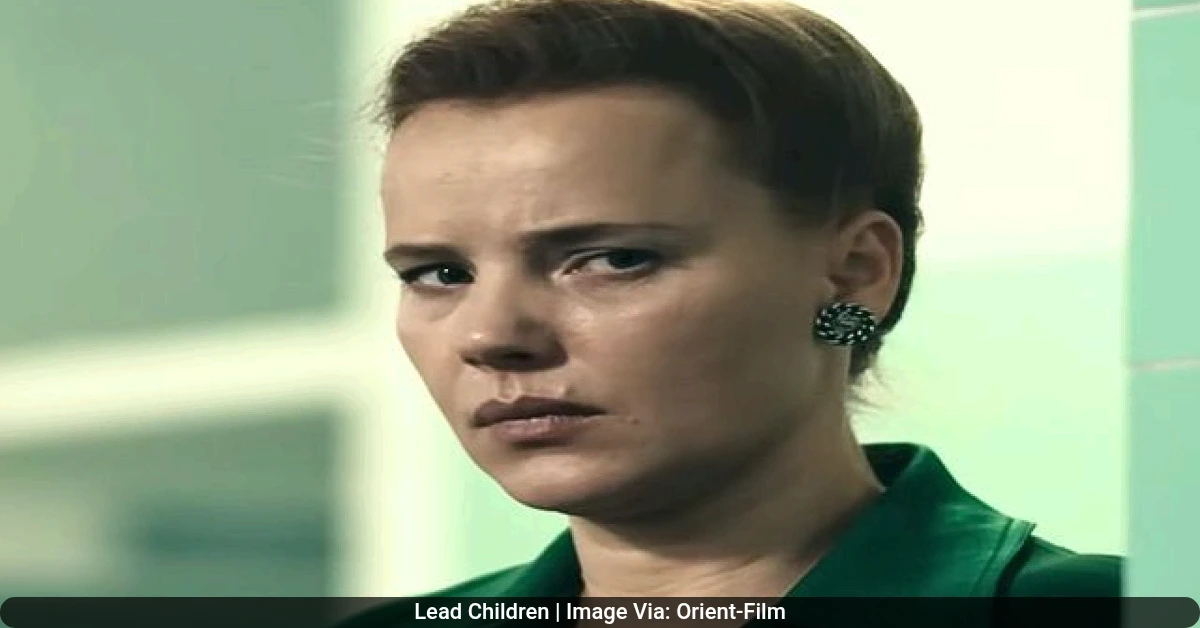
The six-episode Polish Netflix drama Lead Children (Ołowiane dzieci) has arrived on the streaming platform, bringing with it the true story of one woman’s fight against a system that poisoned an entire town. The February 11, 2026 release on Netflix has already sparked conversations among global audiences about the 1970s lead contamination crisis in Szopienice, Poland.
Directed by Maciej Pieprzyca and starring Joanna Kulig as the real-life pediatrician Dr. Jolanta Wadowska-Król, the limited series builds to a finale that balances public protest, deep personal loss, and a turning point that changed Polish industrial history. This article breaks down exactly how the final episode unfolded, what happened to Jolanta, and where the real people are today.
The Protest That Broke the Silence
The finale opens not in a hospital or government office, but on the muddy streets of Szopienice. After five episodes of Jolanta quietly collecting blood samples, documenting sick children, and being dismissed by local authorities, she finally takes her findings public.
Governor Zdzisław Grudzień (played by Zbigniew Zamachowski) spends the first act of the finale trying to contain what he calls “hysteria.” He refuses to shut down the Szopienice smelting plant, insisting that the economic output matters more than the “minor health complaints” of a few families. But Jolanta, backed by mothers who have lost babies and watched their surviving children suffer seizures and developmental delays, organizes a peaceful gathering outside the municipal building.
The protest scene is deliberately not glamorized. There are no dramatic speeches to cheering crowds. Instead, viewers see tired women holding handmade signs, standing in cold rain, and being ignored by passing officials. What breaks the stalemate is not the protest itself, but the arrival of Hubert Niedziela (Michał Żurawski), the SB officer who had earlier threatened Jolanta in a junkyard.
In the finale’s most tense sequence, Niedziela does not arrest Jolanta. Instead, he hands Grudzień a file. The contents are not fully explained in dialogue, but the governor’s face changes completely. Historical context confirms that higher-level provincial authorities—specifically Voivode Jerzy Ziętek (Marian Dziędziel)—had been quietly investigating the plant for months. Niedziela’s file connects Grudzień directly to suppressed medical reports. The governor’s political future collapses in a single minute of silence.
“You’d rather get conned just to keep the peace?”
— Jolanta Wadowska-Król to her husband earlier in the series, a line that defines her final victory.
Jolanta’s Marriage Reaches a Breaking Point
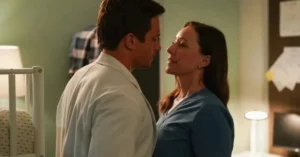
While the public battle moves toward resolution, the private cost becomes fully visible in the finale. Jolanta’s husband, Zbyszek Król (Sebastian Pawlak), works at the same hospital but has always urged caution. He feared retaliation. He worried about their family’s safety. He asked his wife to slow down.
By the final episode, the distance between them is no longer about differing opinions. Zbyszek reveals he has accepted a position in another city. He does not ask Jolanta to come with him. He simply states that he cannot continue living under the shadow of her crusade and the constant threat of violence or professional destruction. There is no shouting match. No infidelity. No villainization of either spouse.
The separation is presented as a mutual, painful understanding. Jolanta loves her husband, but she cannot abandon the children who are already poisoned. Zbyszek loves his wife, but he cannot watch her walk toward danger every single day. They part at their kitchen table, surrounded by the medical books and test results that replaced family dinners long ago.
Heartbreak Hits Closer to Home
Midway through the finale, Jolanta visits a family whose child she had been treating. The little boy, no older than seven, has been declining rapidly. His mother begs Jolanta for new medicine, for anything. But the damage from prolonged lead exposure is irreversible. The child dies off-screen, and the camera stays on Joanna Kulig’s face.
This death is not the first in the series. But it is the one that breaks through Jolanta’s professional armor. She had tested this child months ago. She had filed the paperwork. She had begged for intervention. The system’s slow response cost a life she could not save. The scene is quiet, devastating, and completely devoid of musical manipulation. Viewers only hear the mother’s muffled sobs from the next room.
The Turning Point Ordered by Warsaw
With Grudzień neutralized and regional Voivode Ziętek now directly involved, the finale shows the first real government action. A team of inspectors arrives from Warsaw. They are not locals. They have no personal ties to the plant management. Their testing confirms everything Jolanta had been saying for months—and more.
Soil samples show lead concentrations far above legal limits. Children’s blood tests reveal poisoning levels that explain the seizures, stillbirths, and developmental disabilities documented throughout the series. The plant does not close immediately in the finale. But its directors are ordered to install filtration systems. A formal health screening program is established for all children in the district.
The real Dr. Jolanta Wadowska-Król did not single-handedly shut down Polish industry. But her meticulous record-keeping created an undeniable paper trail. The finale shows the moment her name appears in official documents—not as a troublemaker, but as the lead physician of the new screening program.
Where Jolanta Ends the Series
The final scenes of Lead Children do not show a triumphant hero receiving medals. Instead, Jolanta is back in her examination room. A new mother brings in her toddler for testing. The plant is still running, but the child’s blood levels are normal. The filters are working. The next generation is safer.
Jolanta’s personal life remains unresolved. Her husband has left. She lives alone in the same apartment, surrounded by the same files. But when a young doctor asks her opinion on a new case, she does not hesitate. She grabs her coat and walks toward the examination room.
The series ends not with closure, but with continuation. The fight against industrial pollution did not end in the 1970s. Lead Children makes clear that Jolanta Wadowska-Król kept working, kept testing, and kept advocating for decades. Her legacy is not a single victory—it is every child she tested after the cameras stopped rolling.
How to Watch Lead Children
Lead Children is currently streaming exclusively on Netflix in all regions. The complete six-episode season is available as of February 11, 2026.
Global streaming availability:
- United States, Canada, United Kingdom: Available now on Netflix with English subtitles and dubbed audio options
- Australia, New Zealand: Streaming in 4K HDR on Netflix
- India: Available with Hindi, Tamil, and Telugu subtitle options
- Europe: Full access in all EU territories with local language subtitles
The series runs approximately 60 minutes per episode. All episodes dropped simultaneously; there is no weekly release schedule.
Joanna Kulig delivers a career-defining performance that critics are already calling the best work of her career since Cold War. Maciej Pieprzyca directed the entire series. The production spent months recreating 1970s Katowice, including period-accurate vehicles, clothing, and the iconic red-and-white smelter smokestacks that dominated the Szopienice skyline for decades.
Also Read:


The Real Jolanta Wadowska-Król Today
Dr. Jolanta Wadowska-Król is not a fictional character. Born in 1939, she specialized in pediatrics and internal medicine. Her work in Szopienice during the 1970s directly led to the first official recognition of widespread lead poisoning among Polish children.
She did not seek fame. For years, her contributions were minimized by officials who preferred to credit “collective action.” But in 2007, she was awarded the Order of Polonia Restituta, one of Poland’s highest state honors. In 2018, a documentary about her work introduced her story to a new generation. She continues to live in Poland. She is now in her late eighties.
The Netflix series is the first international dramatization of her work. Her family cooperated with the production to ensure medical accuracy. The real Dr. Wadowska-Król did not attend the premiere due to health reasons, but released a statement thanking the filmmakers for telling the story “without forgetting the children who suffered.”
Stay informed with the latest entertainment news and streaming guides exclusively on VvipTimes, your daily destination for global content worth watching.