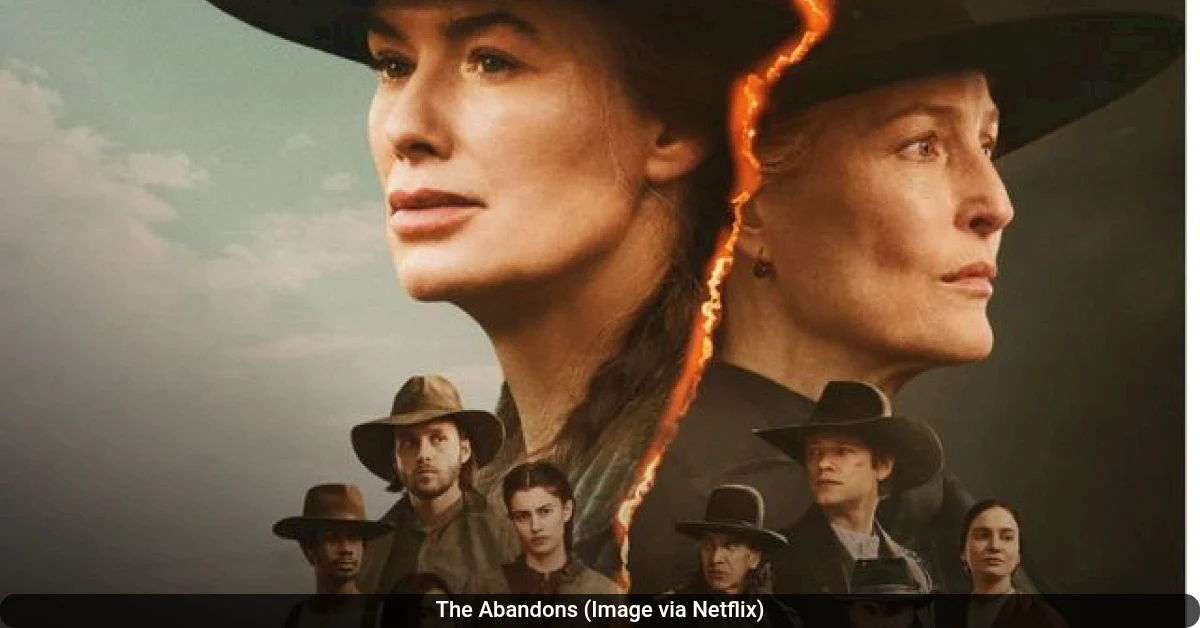
Netflix’s new Western series The Abandons, starring Lena Headey and Gillian Anderson, draws clear inspiration from the Yellowstone franchise but struggles to capture its compelling drama and authenticity.
The series, created by Kurt Sutter of Sons of Anarchy fame, premiered globally on December 4, 2025. Set in the 1850s Washington Territory, it centers on a land conflict between Fiona Nolan (Headey), who runs a ranch with her adopted family, and wealthy industrialist Constance Van Ness (Anderson). Despite a high-profile cast and a proven genre formula, the show has received mixed to negative reviews, with critics and audiences noting it feels like a calculated attempt to replicate Paramount’s success rather than a fully realized drama.
The Core Formula: Land, Power, and Family
The most direct parallel between the two series is their foundational conflict. Like Yellowstone, which is built around John Dutton’s fight to protect his ranch from developers and rivals, The Abandons is a story about land ownership. Fiona Nolan’s claim to her silver-rich property is challenged by Constance Van Ness, a powerful local figure desperate to control the resource for her failing financial empire.
This premise taps into the same archetypes that fueled Yellowstone’s success: the rugged individualist defending their home against voracious capitalist forces. As one analysis noted, Netflix has developed analogs for competitors’ hits, and The Abandons fits as the platform’s answer to the Paramount phenomenon. The show even name-drops a Vanderbilt as a key investor, mirroring the powerful, off-screen corporate threats common in the genre.
A Found Family Versus a Dysfunctional Dynasty
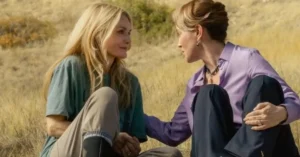
Both narratives are propelled by complex family dynamics, though The Abandons makes a significant change by placing women at the center. Fiona Nolan is a matriarch who has built a “chosen family” of orphans, making her the spiritual counterpart to Yellowstone’s patriarch, John Dutton. Her opponent, Constance Van Ness, rules a biological family with an iron fist, using her children as instruments in her business schemes.
The series attempts to deepen this conflict with a “Romeo and Juliet” subplot between Elias Teller (Nick Robinson) from Fiona’s side and Trisha Van Ness (Aisling Franciosi) from Constance’s clan. However, critics found this storyline “perfunctory and tiresome,” failing to generate the emotional weight of similar tensions in the Dutton universe. The younger characters often feel underdeveloped, serving more as plot devices than compelling figures in their own right.
The Allure of the Western Mythos and Setting
The Abandons fully embraces the aesthetic and thematic hallmarks of the Western genre that Yellowstone helped revitalize for modern television. The show is filled with expansive landscape shots, evocative fiddle music, and the classic iconography of riding, shooting, and frontier scheming. It is set in 1854, placing it closer in timeline to the Yellowstone prequel 1883 than to the modern-day flagship series.
The production also filmed in Calgary, Alberta, a location known for its dramatic vistas and a frequent filming site for Western productions. Despite this, several reviews criticized the show’s visual execution. One major point of contention was the lighting, with many scenes shot so darkly that it was difficult for viewers to discern the action. Others felt the sets looked generic or “flimsy,” lacking the immersive authenticity that helps sell the period setting.
Where The Abandons Stumbled: Writing and Execution
Despite these structural similarities, The Abandons has been widely criticized for failing where Yellowstone succeeded: in creating a believable world with sharp writing and narrative momentum.
A primary complaint focuses on the dialogue. Critics described it as a “clumsy” attempt at stylized frontier speech, mixing anachronisms, awkward phrasing, and overly purple prose. Lines like “Fate is merely a victim of circumstance” or “There’s a mountain of sh-t between us” were cited as examples that pulled viewers out of the story rather than drawing them in. This stands in contrast to Taylor Sheridan’s writing for Yellowstone, which, while sometimes melodramatic, is generally noted for its crisp, character-defining dialogue.
The plotting also faced scrutiny for being both predictable and thinly spread. The seven-episode season introduces multiple underdeveloped subplots involving the local Cayuse tribe, a bandit gang, and neighboring ranchers. These threads often feel like distractions, checking required genre boxes without adding depth or coalescing into meaningful stories. The result is a narrative that one critic called “shallow and silly, full of contrived twists”.
Character Archetypes Versus Realized People
The series features two powerhouse leads in Lena Headey and Gillian Anderson, but even their performances could not fully overcome the limitations of the material.
Headey’s Fiona Nolan is broadly drawn as a fiercely protective, devout, and sometimes ferocious matriarch. Reviewers acknowledged that Headey is “the show’s biggest asset,” bringing coherence and distinct personality to what could have been a stock character. Anderson’s Constance Van Ness, however, was frequently described as a “one-note” villain, portrayed with a “haughty disdain” and “frosty glare” but given no redeeming qualities or nuanced motivations. Their confrontations, meant to be climactic, often fall flat because the characters feel more like archetypes than complex people.
Lena Headey is, indeed, the show’s biggest asset. Brash, righteous, and fiercely protective of her Orphans, Fiona is the standard neo-Western patriarch in braids; it’s the performance that makes her warmth and piety and defiance cohere into a distinct person rather than a stock type.
This lack of depth extends to the supporting cast. Characters like the Native American advisor Jack Cree (Michael Greyeyes) or the neighboring ranchers feel sidelined and underutilized. As one review bluntly stated, “most characters are simply unmemorable”.
A Calculated Product in a Crowded Field
The context of The Abandons‘ release is crucial to understanding its reception. It arrived during a peak in television Westerns, a trend heavily influenced by Yellowstone’s monumental success. In 2025 alone, audiences saw series like American Primeval, Untamed, and Netflix’s own Ransom Canyon announced.
Many critics positioned The Abandons not just as a show, but as a clear business strategy. One review called it “minimum viable product (MVP) TV,” arguing that Netflix assembled just enough attractive features—a famous creator, two beloved franchise leads, a trendy genre—to guarantee initial viewer attention without ensuring high quality. Another labeled it a “shameless attempt” and a “pretender through and through”.
This perception of the show as a cynical, algorithm-driven product made it difficult for it to earn critical goodwill, even from viewers who enjoyed it as a simple genre exercise.
Also Read:
Audience and Critical Reception
The response to The Abandons has been divided but leans negative. On review aggregator sites, it holds a 30% critics’ score on Rotten Tomatoes and a 43 out of 100 on Metacritic, indicating “mixed or average” reviews. Audience scores are similarly low.
Despite this, the show found an audience on Netflix. Shortly after its December 4 release, it trended globally, ranking as high as #2 worldwide and #3 in the United States on the platform. This disconnect between critical appraisal and viewership is common for Netflix originals and suggests that the core Western premise and star power were enough to drive significant sampling.
Fan reactions are a mix. Some viewers on social media and review platforms praised the show as “entertaining,” “a fun watch,” and highlighted the performances of Headey and Anderson. Others echoed critics, calling it “disjointed,” “poorly written,” and criticizing its over-reliance on cliché. The cliffhanger ending of the seven-episode season has left some hoping for a second season to resolve the story, though Netflix has not yet made a renewal decision.
The Shadow of Its Creation
The production of The Abandons was not without public behind-the-scenes drama. Creator Kurt Sutter left the project with a few weeks of filming remaining. Industry reports indicated his departure came after Netflix reviewed early cuts of the series. The feature-length premiere episode was subsequently split into two, requiring additional scenes to be shot. Executive producer Otto Bathurst and co-EP Rob Askins oversaw the completion of production.
While the exact reasons for Sutter’s exit were not officially detailed, this disruption likely impacted the final product. Some critics noted the final season felt “confusingly spare, rushed and vaguely shoddy, as if the final product was… gutted of its most potentially distinctive elements”.
Also Read: Heated Rivalry’s Hudson Williams Talks About Overcoming Bias and What He Learned From Playing Shane