

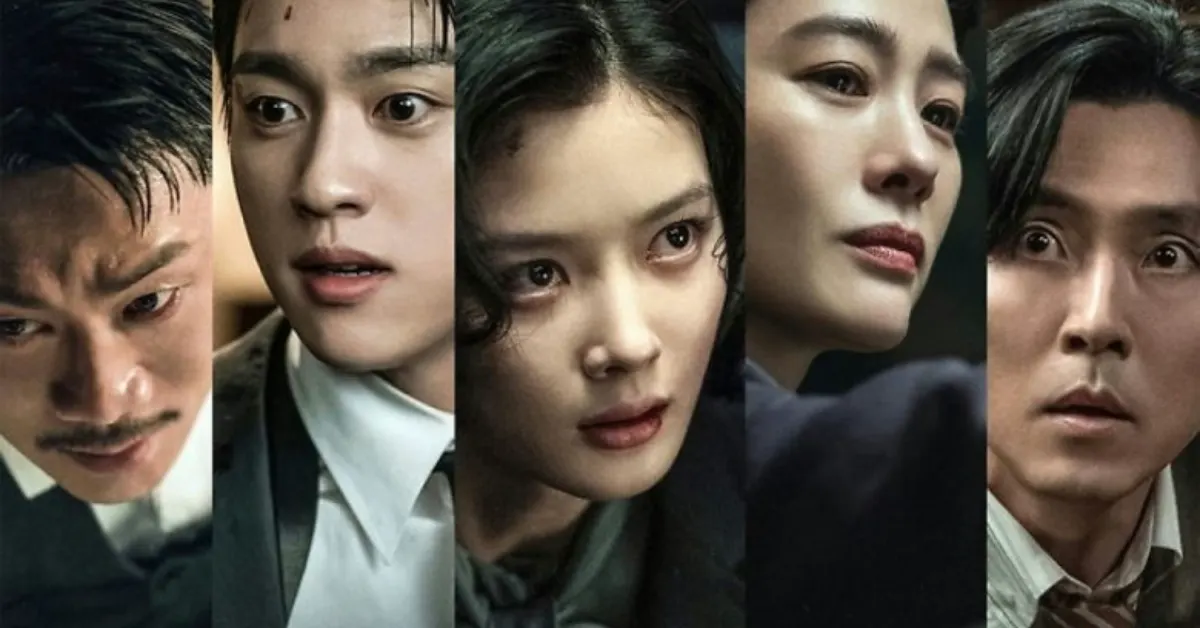

The 100 Days of Deception cast has caught the attention of Japanese audiences for a reason that goes beyond the drama’s story. Several actors in the tvN series delivered their Japanese dialogue so naturally that some local viewers believed they were watching Japanese performers. The reaction has turned the cast’s language work into one of the most discussed parts of the show’s early run.
Japanese Viewers React to the 100 Days of Deception Cast
Social media reactions from Japan focused on how comfortable the actors sounded in Japanese. Comments highlighted by Korean media described the performances as unusually polished for a Korean production.
“His Japanese was so fluent that I was shocked. I think his pronunciation and intonation are among the best I’ve heard in a Korean drama.”
Another viewer wrote that the dialogue was clear enough to follow without subtitles.
“His lines were so clear that I was surprised. It was at a level where I could understand him without subtitles.”
The praise was not limited to one actor. Jin Seon-kyu, Kim Yoo-jung, and Park Jin-young each handled large amounts of Japanese dialogue, and their efforts became a talking point from the premiere episode onward.
Jin Seon-kyu Built His Performance From Zero Japanese
Jin Seon-kyu plays Sato Shinichi, a powerful colonial official in 1932 Gyeongseong. The actor started with no knowledge of Japanese writing systems and built his performance through an intensive routine.
Reports say he spent around two months in Japan and studied his script for about seven hours a day. His mornings went into conversational Japanese, while afternoons were used for line practice. He also reviewed material through video calls with his language coaching team twice a week.
The preparation went beyond memorization. Jin worked on pronunciation, intonation, and the natural flow of sentences, while also learning how Japanese speakers would deliver Korean lines. A Japanese viewer noted the seriousness behind the work.
“Beyond simply sounding natural in Japanese, I respect the way he seriously approached the role and the historical background.”
His efforts drew reactions describing his Japanese as good enough to mistake him for a Japanese actor.
Kim Yoo-jung Spent Five Months on Japanese Before Filming
Kim Yoo-jung plays Lee Ga-kyung, a pickpocket who goes undercover as an interpreter trainee. Her character uses Japanese and English as survival tools, which meant the actress had to sound believable in both languages.
The 100 Days of Deception cast member devoted around five months to Japanese study before cameras started rolling. She took separate lessons in grammar, conversation, and script work, often handling two classes a day even during busy schedules.
Her Japanese coaching team said she absorbed the intonations so thoroughly that she could later catch small pronunciation errors on her own. The team described her practice volume as difficult to estimate because she kept refining details without being prompted.
For English, Kim kept in mind that her character learned the language by listening to others, so she worked on sounding like someone assembling words rather than speaking with perfect textbook fluency.
Park Jin-young Took On Three Languages and Two Accents
Park Jin-young plays Kim Tae-woong, also known as Sato Hideo, an elite interpreter raised in Japan. The role required Korean, Japanese, and English, and the actor began practicing Japanese from February until all filming wrapped.
He chose a British English accent to match his character’s background, while Kim Yoo-jung used an American accent for hers. The difference was a deliberate choice tied to each character’s history.
Park said practice was the only answer. His Japanese coaching team recalled that he listened to recorded lines so often that the voices stayed in his head even when he tried to sleep. The coaching team also noted that he handled back-to-back Japanese and English lessons without losing energy.
Kim Hyun-joo and Lee Moo-saeng Added More Language Layers
Kim Hyun-joo plays Yoo So-ran, a sniper in the independence group Gugukdan. She took on Chinese dialogue for the role, playing a character who speaks Korean while not being a professional language user. Her focus stayed on natural delivery rather than overly precise pronunciation.
Lee Moo-saeng plays Yoo Philip, a Korean-American correspondent and member of the same group. His character adds another layer to the drama’s multilingual setup, which the 100 Days of Deception cast carries across both the resistance storyline and the colonial administration storyline.
Director Yoo In-sik said the actors were already delivering high-level foreign-language lines at the first script reading.
“From the moment they were cast, the actors prepared eagerly for foreign-language acting. I was surprised that they already spoke foreign languages at a high level at the first script reading.”
Yoo added that because the volume of foreign-language dialogue was large and the actors often performed opposite Japanese and English-speaking actors, practice continued until the final day of filming, sometimes for more than a year.
Why Language Matters in the Story
Set in 1932 Gyeongseong, the drama follows Lee Ga-kyung as she infiltrates the Japanese Government-General of Korea as an interpreter trainee. Her mission is to gather secrets within 100 days while hiding her real identity.
Language in the series is not just decoration. Speaking Japanese signals proximity to colonial power. Speaking Korean signals belonging, risk, or resistance. English signals access to the outside world and to Western press circles.
That is why the 100 Days of Deception cast language work has drawn attention from viewers who usually skip past subtitle discussions. The switches between languages carry information about who each character is and what they are hiding.
Ratings and Streaming Details for Global Viewers
The drama premiered on October 10, 2026, on tvN in South Korea. It also streams on TVING in South Korea and on Netflix for global audiences.
The series has 16 episodes and airs every Saturday and Sunday at 9:10 p.m. KST. It is scheduled to run until November 29, 2026, with the final two episodes set for November 28 and November 29.
Ratings moved quickly after launch. The premiere recorded an average nationwide rating of 5.3%, and the second episode rose to 7.6%. By the fourth episode, the drama reached 9%, its best performance in the run so far.
On Netflix, the show entered the Netflix Japan Top 10 at No. 10 after its premiere and held that position as of October 15. It also reached No. 5 on Netflix’s global TV show ranking on October 13.
For viewers in the USA, UK, Canada, Australia, India, and other markets, Netflix carries the series with new episodes arriving weekly. South Korean viewers can watch through tvN and TVING.
Related Stories





View all articles about
The drama is a tvN 20th-anniversary special project, directed by Yoo In-sik and written by Ryu Bo-ri. Its cast includes Kim Yoo-jung, Park Jin-young, Kim Hyun-joo, Lee Moo-saeng, and Jin Seon-kyu.
Also Read: 100 Days of Deception Is Being Called 2026’s Best K-Drama and Its Three-Language Cast Is the Reason
For more updates on Korean dramas and the actors behind them, keep reading VvipTimes.





























Leave a Reply