



The fourth episode of CBS’s newest franchise expansion, NCIS: New York, delivered its most personal case yet—and the numbers suggest the gamble is paying off. Titled “Homecoming,” the episode aired Tuesday, October 27, 2026, at 9 p.m. ET/PT, pulling the show’s lead, Sam Hanna (LL Cool J), back to his Queens roots for a deadly armored truck robbery investigation that forced him to confront a mentor from his past. The episode’s central conflict—gratitude versus evidence—gave the freshman spinoff its strongest emotional stakes to date, even as the series continues to work out the kinks in its central partnership.
The Ratings Reality: How “Homecoming” Performed for CBS
CBS has not released final live-plus-same-day numbers for “Homecoming” at the time of publication, but the season’s trajectory provides clear context. The series premiere drew 5.62 million live viewers on October 6, a figure that outperformed its timeslot predecessor. When delayed and multiplatform viewing is factored in, the premiere ballooned to 10.25 million viewers, an 82 percent lift that ranks NCIS: New York as the most-watched new broadcast series of the 2026–27 season.
The show has also posted a 52 percent audience increase over the previous occupant of its Tuesday 9 p.m. slot, giving CBS a third NCIS property that performs across both linear and streaming platforms. Paramount+ distributes new episodes the day after broadcast for Essential subscribers, while Premium tier members can watch live. That dual-window strategy matters: NCIS: New York is not merely a broadcast asset but a retention tool for Paramount’s streaming ecosystem, and the multiplatform numbers reflect that priority.
- Premiere live viewers: 5.62 million (October 6, 2026)
- Premiere live-plus-7 multiplatform: 10.25 million
- Timeslot audience lift vs. predecessor: 52 percent
- Metascore (critical aggregate): 71
Sam Hanna’s Origin Story: The Queens Backstory That Changes Everything
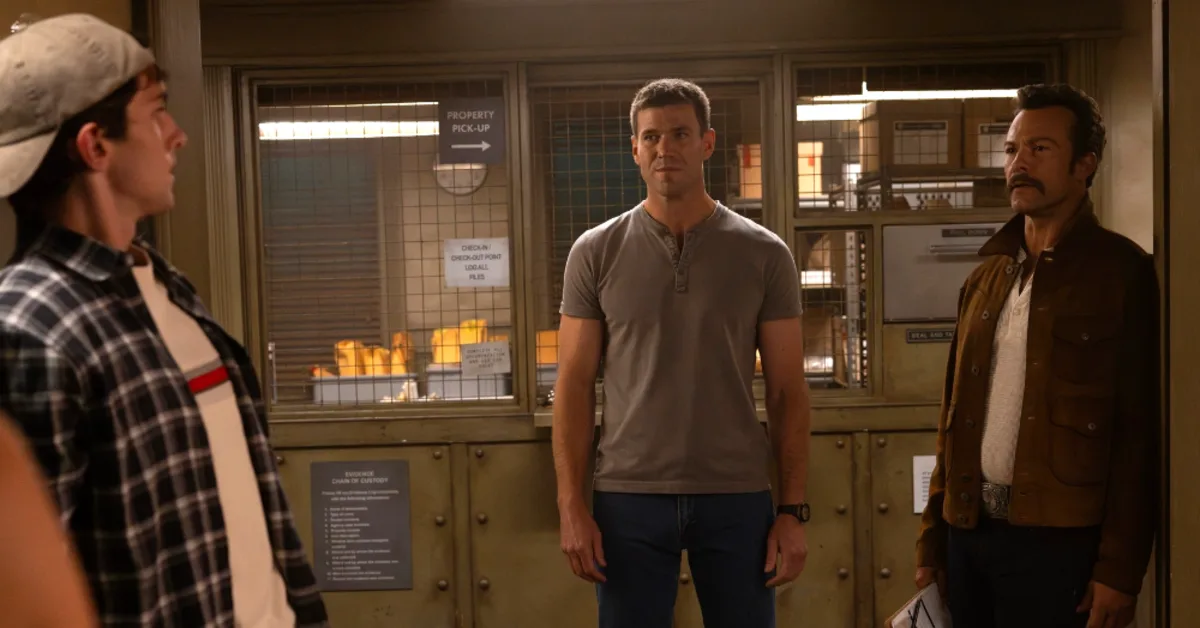
“Homecoming” hinges on a revelation that reframes Sam Hanna’s entire trajectory. The case leads Sam and his partner, Nick Schaeffer (Scott Caan), to Queens after a robbery at the Naval Corps Credit Union leaves two guards dead. The evidence trail points toward a network of exploited veterans, and the investigation brings Sam face-to-face with Curtis Allen (Malik Yoba), a community developer and the man who once stopped a teenage Sam from joining friends on a robbery that ended in lengthy prison sentences for the others involved.
That debt of gratitude becomes the episode’s engine. When evidence begins to implicate Curtis in the robbery operation, Sam cannot simply dismiss the case as a misunderstanding. He has to separate the man who saved him from the man the evidence describes. The episode’s climax—Sam wounding and arresting Curtis after a staged trap—forces the character to accept that both realities can coexist.
This is the first time the franchise has explored Sam Hanna’s pre-NCIS life in sustained detail. Across 14 seasons of NCIS: Los Angeles, Sam’s backstory was sketched in fragments: his Navy SEAL background, his family, his partnership with G Callen. “Homecoming” fills a gap that fans did not know existed, and it does so without turning the episode into a clip show of past trauma. The mentor relationship with Curtis is specific, localized, and rooted in the geography of St. Albans and Farmers Boulevard, giving the story a texture that generic flashbacks rarely achieve.
The Nick Schaeffer Problem: A Partnership Still Finding Its Footing
For all of “Homecoming’s” strengths, the episode also exposes the show’s most persistent weakness: the Sam–Nick partnership. Scott Caan’s Nick Schaeffer is positioned as the roguish counterweight to Sam’s institutional gravity, but four episodes in, the dynamic remains underdefined. Critics have noted that Nick carries the long shadow of G Callen, Sam’s partner of 14 seasons, and the show has not yet given viewers a compelling reason to invest in the new pairing on its own terms.
“Homecoming” does give Nick something useful to do. He is the one who follows the financial trail to Curtis, forcing Sam to confront evidence he would rather ignore. That is a functional role, but it is not yet a personal one. The episode ends with Nick’s own history still largely unexplored, and the show’s choice to center another hour on Sam’s past has left less room for the supporting cast to cohere. The partnership is not broken—it is simply unfinished, and the series needs to decide whether Nick is a foil, a peer, or something else entirely before the audience stops waiting for the answer.
Addy and Wyatt: The Quiet MVP of NCIS: New York
The strongest relationship in the episode does not involve Sam at all. Jacqueline Byers’s Addy and Shane Harper’s Wyatt continue the private conversation that began in the previous episode, “Carousel,” and their rapport has become the show’s most naturally developing thread. When Nick walks in on them, they steer the discussion toward office dynamics to protect Addy’s privacy, and Wyatt listens rather than trying to fix her problems.
That small choice—Wyatt respecting a boundary instead of solving a crisis—does more character work than any exposition could. It establishes trust, it distinguishes their dynamic from the rest of the team, and it gives the episode a lightness that balances the heavier Sam-centered material. The show has not yet pushed them into romance, and it does not need to. The value is in watching two agents become people who enjoy each other’s company, and that is a foundation the series can build on for seasons to come.
Sean and Robyn: A Mentorship in the Making
Devin Druid’s Sean Sullivan and Jennifer Beals’s Robyn Wells also get a small but meaningful beat in “Homecoming.” Sean’s frustration about his place on the team leads to a conversation with Robyn, who recognizes something of her younger self in him. That recognition opens a possible mentorship and gives Sean a reason to appear beyond his technical contributions. Robyn, meanwhile, sees the cost of the case in a way that adds weight to her leadership role.
These scenes matter because NCIS: New York cannot survive on Sam Hanna alone. The show’s long-term viability depends on whether the supporting ensemble becomes specific enough to carry episodes of their own. “Homecoming” takes a step in that direction, even if the step is smaller than the Addy–Wyatt thread.
CBS’s Franchise Strategy: Why New York Matters Beyond Episode 4
NCIS: New York is produced by CBS Studios and distributed by Paramount Global Content Distribution, with R. Scott Gemmill, Byron Balasco, Adam Davidson, Kyle Harimoto, Joe Wilson, LL Cool J, and Jason Barrett serving as executive producers. Balasco, who developed the series with Gemmill, serves as showrunner. The show is the eighth entry in the NCIS franchise and the first to be built around a character transplanted from a concluded series rather than a new ensemble.
That structural choice carries risk. NCIS: Los Angeles ended its 14-season run in 2023, and Sam Hanna’s brief migration to NCIS: Hawai’i did not produce a long-term home before that series was canceled. CBS is now betting that Sam’s established fanbase can anchor a new city, a new team, and a new procedural rhythm. The multiplatform ratings suggest the bet is working commercially. The creative question is whether the show can convert curiosity into loyalty once the nostalgia of Sam’s return wears off.
The network’s scheduling reinforces the priority. NCIS: New York airs alongside the flagship NCIS and NCIS: Origins, giving CBS three franchise hours per week and creating a pipeline of cross-promotion that no other broadcast network can match. Crossovers remain on the table: both LL Cool J and Balasco have publicly welcomed the possibility, and the franchise’s history suggests that event programming will be used to shore up the new series if ratings soften.
What Episode 4 Reveals About the Show’s Long-Term Arc
“Homecoming” ends with Sam choosing to remain involved in the Queens community, providing the kind of positive example that Curtis once provided for him. That decision is not a cliffhanger, but it is a statement of purpose. Sam is not just solving cases in New York; he is reckoning with the version of himself that could have gone a different way. The show has found its emotional thesis, and it is stronger than the procedural mechanics that surround it.
The episode also confirms that NCIS: New York will lean on personal history as a differentiator. The premiere introduced Sam to the team. “Family Business” tied a jewelry heist to military explosives. “Carousel” tested Sam’s ability to solve a case alone. “Homecoming” makes the case personal. That progression suggests a season that will alternate between standalone investigations and serialized character work, with Sam’s past as the connective tissue.
The risk is repetition. If every episode becomes a referendum on Sam’s history, the supporting cast will remain in his shadow. The Addy–Wyatt thread and the Sean–Robyn mentorship offer a way out: build the ensemble’s interior lives with the same care that “Homecoming” gives Sam’s. The show has the cast to do it. It now needs the narrative discipline to distribute the weight.
Fan Reactions and Critical Consensus
Critical response to “Homecoming” has been measured but positive. Seat42F rated the episode 8/10, praising LL Cool J and Malik Yoba’s performances and the decision to let Sam’s gratitude complicate rather than dictate his judgment. Fangirlish noted that the episode “peels another layer of the Sam Hanna onion” while acknowledging that the Nick partnership remains the show’s weakest point. TV Fanatic highlighted the Addy–Wyatt dynamic as the hour’s most effective element, arguing that their private conversation and boundary-setting made the team feel more real than any exposition could.
Fan conversation online has focused on two themes: the emotional weight of Sam’s backstory and the lingering question of whether Nick can ever fill the space left by G Callen. The show’s official social channels have not released episode-specific engagement metrics, but the multiplatform ratings growth suggests that word-of-mouth is trending in the right direction. The test will come in episode 5, “True Love,” which premieres Tuesday, November 10, and shifts the focus to a naval interrogator’s murder and a case involving Nick’s former NYPD partner. If that episode gives Nick the depth that “Homecoming” gave Sam, the partnership may finally click.
The Bottom Line for CBS and Paramount
NCIS: New York Episode 4 is not a perfect hour of television. The central case follows familiar procedural beats, and the Nick–Sam partnership still lacks the lived-in shorthand that defined the franchise’s best duos. But “Homecoming” does something more important than execute a clean mystery: it gives the series a reason to exist beyond brand extension. Sam Hanna’s Queens history is specific, emotionally grounded, and tied to a guest performance—Malik Yoba’s Curtis Allen—that refuses to resolve into simple villainy.
Related Stories




For CBS, the episode reinforces the commercial logic of the spinoff. The multiplatform numbers are strong, the timeslot improvement is measurable, and the Paramount+ pipeline gives the show a second life beyond linear broadcast. For viewers, “Homecoming” is a promise that NCIS: New York will use its New York setting and its veteran lead to tell stories that the flagship and Los Angeles could not. Whether the show keeps that promise depends on what comes next.
Also Read: NCIS: New York Episode 3 Recap: Kidnapping Case, Nick’s Subpoena and Sam’s Past
VVIPTimes will continue tracking NCIS: New York’s ratings, cast developments, and franchise trajectory as the season unfolds.






























Leave a Reply