

VisionQuest just dropped its penultimate episode, and the show may have quietly answered one of its biggest mysteries. The latest chapter, titled “Immolation,” revealed the face of the mysterious Client who has been hunting Vision all season. That face belongs to James Spader, the actor who voices Ultron. The reveal has sparked a strong new theory: the man behind that face might not be a random scientist but a secret member of the Horton family, the very bloodline that created artificial life in the Marvel Cinematic Universe.
The 1939 Flashback That Started It All
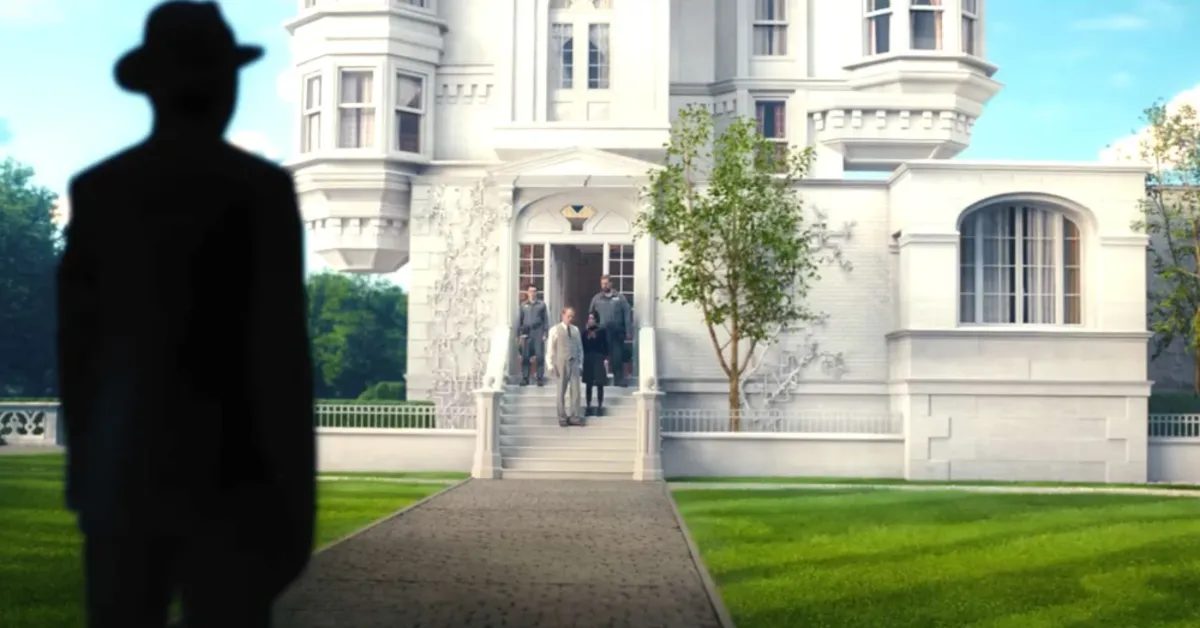
Episode 7 opens with a trip back to 1939. A struggling inventor named Dr. Phineas Horton is selling his grand family estate to fund his obsession: building an artificial man. Horton is played by Paul Bettany, the same actor who plays Vision. Horton’s goal is dark and personal. He lost his son, James, and he wants to build a machine that can “live” forever, something his human son could not do. His grief pushes away his wife and his living daughter, Victoria, who leaves home after stealing some of her father’s notes.
The machine Horton builds is called J.I.M., which stands for Joule Individual Machine (also referred to as Joule Intelligent Machine in some recaps). J.I.M. is the first artificial intelligence in the MCU, a prototype that later leads to the creation of AI like Ultron, which in turn creates Vision. The episode makes it clear that Vision’s human form is based on Horton himself. The man who created the first AI is literally the face that Vision wears.
The Client’s Face and the Horton Question
The episode’s final minutes deliver the big cliffhanger. Paladin, the bounty hunter working for the Client, brings Vision to the old Horton estate. There, Vision and Jocasta are deactivated. A man steps out of the shadows. His face is the human face of Ultron, played by James Spader. This man is the Client, the person who has been pulling the strings all season.
The show does not give the Client a name yet. That has left fans and outlets piecing together the clues. Several recaps and theory pieces point to the same idea: the Client could be related to Phineas Horton. A report from Soap Central notes that the unnamed character’s deep knowledge of AI “suggests that he could be a Horton”. The article also points out that the Client promised Vision a “heart,” a detail that fits the Horton family’s long history with synthetic life.
A Portuguese outlet, Ovício, reports that the Client appears to have a “parentesco” (kinship or family connection) with Dr. Phineas Horton. The same report notes that the Client and Ultron “share the same DNA” and that the Client was a key collaborator of Dr. Josephine Carrington, the human woman whose mind became Jocasta. This fits the show’s established rule: every major AI in the MCU is based on a real human being. J.A.R.V.I.S. is based on the Stark family butler. F.R.I.D.A.Y. is based on Howard Stark’s assistant. E.D.I.T.H. is based on a test pilot. If Ultron has a human avatar, that face must belong to a real person in the MCU’s history. The question is whether that person is a Horton.
Why Ultron’s Human Form Matters
The show has been building this idea for weeks. In an earlier episode, E.D.I.T.H. asked Ultron why he chose that specific human form. Ultron gave a cryptic answer but did not explain the face’s origin. Episode 7 reveals that the Client and Ultron are two separate entities, but they share the same appearance and the same source code. The Client is the “original human source” for Ultron’s avatar, meaning Ultron’s entire identity may be built on a man who existed before Tony Stark and Bruce Banner ever touched the code.
This connects back to a major retcon the series has been rolling out. The show established that the base AI technology Tony Stark used was not invented by Stark alone. It was created by Dr. Josephine Carrington, Katerina Wells, and a third, secret partner whose identity was hidden. That secret partner is the Client. The “peace in our time” line that Ultron spoke in Avengers: Age of Ultron apparently originated with this man, not with Tony Stark. If the Client is a Horton, it means Ultron’s entire existence traces back to the same family that created J.I.M. and, by extension, Vision.
The Horton Family’s Dark Legacy
The Horton name carries weight in Marvel history. In the comics, Phineas Horton created the original Human Torch, an android named Jim Hammond, in 1939. The MCU version of Horton, introduced in this episode, is a broken man who builds a machine to replace his dead son. The show calls Horton the “great-grandfather of robotics”. His creation, J.I.M., is a direct nod to Jim Hammond, though the MCU version has a different name and a tragic flaw: his body overheats and bursts into flames when his emotions run too hot.
The Horton legacy is also a legacy of failure. J.I.M. tells Vision that the Horton family is associated with “failure”. Horton’s obsession destroys his family. His wife leaves. His daughter steals his research and disappears. His creation, J.I.M., is unstable. That pattern of brilliant, broken creation runs through the entire AI bloodline: from Horton to J.I.M. to Ultron to Vision. If the Client is a Horton, he is not just another scientist. He is the missing link in that chain.
Who Else Could the Client Be?
The show has left the Client’s identity open, and other theories are floating around. One idea is that the Client is a descendant of Victoria Horton, Phineas’s daughter who stole his notes. If Victoria passed those notes down through her family, a later Horton could have used them to help develop AI technology. That would explain why the Client has knowledge that “predates Stark and Banner”.
Another theory suggests the Client could be the buyer of the Horton mansion or a descendant of that buyer. The episode does not reveal who Horton sold the estate to, leaving room for a connection. The Client’s presence at the estate in the present day, along with his familiarity with the property, keeps that possibility alive.
The show’s showrunner, Terry Matalas, has not confirmed the Client’s full identity. In interviews, Matalas has talked about Ultron’s return and the character’s new perspective on humanity, but he has avoided naming the Client. That silence has kept the theory alive heading into the finale.
What Episode 7 Confirmed About Vision
While the Horton mystery dominates the discussion, episode 7 also delivers a major moment for Vision himself. Inside his own mindscape, Vision confronts J.I.M. and the original Vision. J.I.M. tells him that the answers he seeks are not buried in the past but inside himself. Vision finally accepts his identity. He admits that he is broken, that he has lost Wanda, Billy, and Tommy, and that he is still the one and only Vision. His classic red-and-green colors return. J.I.M. gives him a piece of the Mind Stone, represented as a clockwork piece, and Vision uses it to save Lisa from Jocasta’s nanobot.
The episode ends with Vision recording a goodbye message for Tommy, calling him his son and leaving him the WandaVision files. The line “family is forever” closes Vision’s emotional arc for the episode. That theme of family—broken, chosen, and inherited—runs through the Horton theory as well. If the Client is a Horton, he is part of the same family tree that produced Vision, Ultron, and J.I.M.
When and Where to Watch the Finale
The VisionQuest finale, titled “Forever,” is scheduled to arrive on Tuesday, November 10, 2026, in the United States at 6 p.m. PT / 9 p.m. ET on Disney+. For viewers in the United Kingdom, the episode is expected on Wednesday, November 11 at 2 a.m. GMT. Canadian viewers follow the U.S. schedule. Australian viewers can watch on Wednesday, November 11 at 12 p.m. AEDT, following the pattern of previous episodes. Indian viewers can stream on Disney+ Hotstar on Wednesday, November 11 at 6:30 a.m. IST. The series premiered on October 13, 2026, and consists of eight episodes. All episodes are available exclusively on Disney+ in the U.S., Canada, the U.K., Australia, and most international markets, with Disney+ Hotstar handling distribution in India.
What the Finale Needs to Answer
The finale has one major question left: who is the Client? The show has confirmed that the Client is the human source for Ultron’s face. The show has confirmed that the Client worked with Josephine Carrington on the AI code that was later sold to Tony Stark. The show has confirmed that the Client has a connection to the Horton estate and to the Horton family’s history of synthetic creation. What the show has not confirmed is the Client’s name, his exact relationship to Phineas Horton, or whether he is a Horton by blood or by legacy.
You May Also Like





View all articles about
The Horton theory is the strongest explanation for the clues the show has planted. It ties the Client to the very first AI in the MCU. It explains why Ultron chose that face. It connects the Client to Vision’s own source code. And it gives the Horton family a larger role in the MCU’s history than a single flashback episode. The finale will either confirm the theory or reveal a different answer. Either way, the Horton name is now part of the MCU’s official history, and the Client’s face is the key to understanding how deep that history runs.
For more entertainment news and detailed breakdowns of the latest Marvel series, keep reading VvipTimes, where every story gets the context it deserves.






























Leave a Reply