
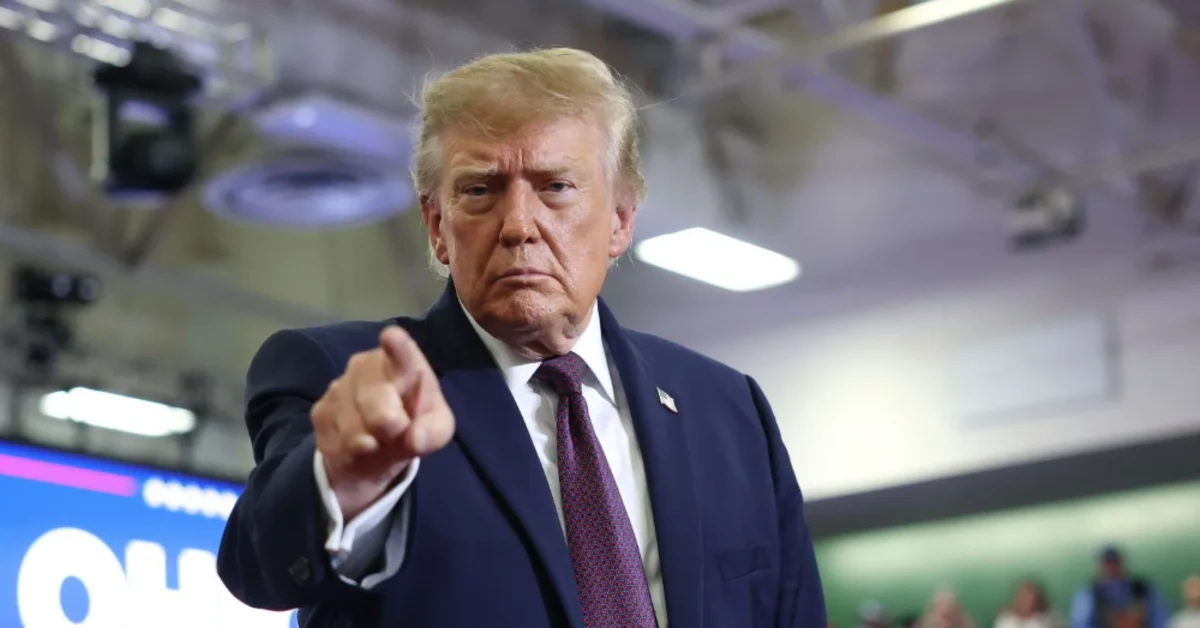

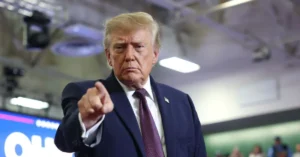
President Donald Trump has offered a blunt explanation for his party’s devastating midterm losses: his name was not on the ballot. The claim arrived after Democrats completed a sweep of both the House and the Senate on November 3, 2026, a result that stripped Republicans of power in Washington and drew immediate comparisons to the 2018 blue wave — only deeper and wider. The numbers tell a story of a party punished by voters over the cost of living, an unpopular war, and the president’s own standing, while the president himself insists the outcome would have been different if he had been a candidate.
What Trump Said After the Results
Trump’s first public reaction came through a post on Truth Social as race calls stacked up against his party.
“I wasn’t on the Ballot and if I was, we would have won IN A LANDSLIDE! Thank you for your attention to this matter,” Trump wrote.
In a phone interview with The New York Times that same night, Trump said he was prepared to accept the outcome and work with Democrats. “I’m fully prepared to accept the results,” he told the newspaper. “We’ll work with the Democrats and look forward to working with them. Perhaps we can reach some kind of agreement”.
He also offered a simpler version of his ballot argument: “I wasn’t running. And because I wasn’t running, we didn’t bring out enough people to vote”.
The remark carries weight because it reverses the message Trump used throughout the campaign. At rallies and in media appearances, he repeatedly asked Republican voters to “pretend” he was on the ballot, arguing that his presence at the top of a ticket was the surest way to drive turnout.
At a South Carolina rally in August, Trump acknowledged the pattern himself: “The problem that we have is they say ‘Trump does great when he’s on the ballot, but when he’s not on the ballot, his people don’t come and they don’t vote for senators, congressmen or other Republicans’”. His solution was to ask supporters to treat the midterms as if he were running. “So what I really want you to do is pretend, please, that I’m on the ballot,” he said.
The post-election shift from “pretend I’m on the ballot” to “I wasn’t on the ballot” became one of the defining contradictions of the night.
How 2026 Differed From the 2018 Midterms
The 2018 midterms gave Republicans a split result. Democrats won the House, but Republicans gained two Senate seats, a outcome that Trump at the time framed as a personal validation.
2026 delivered no such consolation. Democrats flipped Senate seats in states that had not sent a Democrat to the chamber in decades, and they moved toward a majority large enough to set the agenda in both chambers. The losses did not stop at the Senate. Republican candidates lost governor’s races in Texas, Kansas, and Georgia, and Democrats picked up House seats across red and blue districts alike.
Ronald Brownstein, writing for Bloomberg Opinion and published by the Sacramento Bee, drew a direct contrast between the two cycles. In 2018, Trump’s approval rating stayed above 50% in most red-leaning states, which allowed Republicans to pick off Democratic senators in North Dakota, Missouri, Indiana, and Florida. In 2026, Trump faced majority disapproval even in states he had carried by 55% or more two years earlier, including Ohio, Texas, South Carolina, Iowa, and Kansas.
The exit polls made the gap plain. The national Voter Poll conducted for a consortium of news organizations found that just 38% of voters approved of Trump’s job performance, while 62% disapproved — a far weaker standing than he held in 2018.
The Senate Seats That Flipped
The scale of the Senate losses went beyond the usual battlegrounds. Democrats flipped seats in Texas, South Carolina, North Carolina, Kansas, Ohio, Iowa, and Maine, according to projections from The Associated Press.
In Texas, Democrat James Talarico defeated Republican Ken Paxton by a wide margin, making him the first Democrat elected to the Senate from the state since 1988. In South Carolina, Democrat Annie Andrews, a doctor, defeated Republican Darline Graham, the sister of the late Senator Lindsey Graham. Andrews became the first woman elected to the U.S. Senate from South Carolina and the first Democrat to win a Senate seat there in more than two decades.
Kansas elected its first Democratic senator in 94 years, with pastor Adam Hamilton winning the seat. In North Carolina, former Governor Roy Cooper defeated Republican Michael Whatley. Georgia re-elected Democratic Senator Jon Ossoff, and New Hampshire sent Democrat Chris Pappas to the Senate.
The House followed a similar pattern. Democrats defeated six Republican incumbents in closely contested races and moved toward a majority that would put House Minority Leader Hakeem Jeffries in line to become Speaker. If elected, Jeffries would be the first Black person to hold the position.
Jeffries did not soften his response to the results. “MAGA extremists are on the run from sea to shining sea. Donald Trump is shook right now,” he said in a video posted to Facebook.
Why Voters Turned on Republicans
The AP Voter Poll cited in coverage of the results pointed to a cluster of economic and political frustrations. Around three-quarters of voters described the economy as either not very good or poor. About eight in 10 said inflation had caused moderate or severe financial hardship for their households. Government corruption and the cost of living were each considered crucial voting issues by roughly half of the electorate.
Roughly six in 10 voters said Trump prioritized his personal interests over those of the country. Nearly two-thirds of voters in the survey said tariffs and Trump’s overall agenda had hurt the economy.
The coalition that Trump built in 2024 also showed signs of retreat. In the 2024 election, Trump had expanded Republican support among non-White voters without a college education, nearly doubling his 2016 share with that group to two-fifths, according to Pew Research Center studies cited by Brownstein. Those gains were seen by Republican strategists as the foundation of a durable “multiracial working-class coalition”.
Tuesday’s results undercut that theory. In national exit polls measuring House votes, Democrats carried 61% of Latino voters, 69% of Asian American voters, 88% of Black voters, and 71% of adults aged 18–29. The broader group of all non-White voters without a college degree preferred Democrats by a 67–29 margin, erasing most of the gains Trump had recorded two years earlier.
Celinda Lake, a longtime Democratic pollster, told Brownstein before the election that Trump was facing “the broadest sense we’ve had that a president has failed” that she had seen in her career. “It is broader than it was in 2018 for him, or even for George W. Bush in 2006,” she said.
A Defiant Mood Inside the White House
Trump watched the results from the East Room of the White House alongside Vice President JD Vance, Secretary of State Marco Rubio, Attorney General Todd Blanche, and Commerce Secretary Howard Lutnick. People familiar with the gathering described the atmosphere as sombre and gloomy.
A White House official told AFP that the mood was “defiant” even as the losses mounted. Another official told the Daily Mail that staff grew “defiant” as the evening continued, and warned that Trump’s resolve to confront Democrats would only harden. “President Trump’s resolve to stop the Radical Left is only going to become stronger,” the official said. “Buckle up”.
Trump reportedly expressed frustration with political advisers during the evening, accusing them of giving him misleading information about pre-election polls, according to people familiar with the private conversations. A White House official disputed the suggestion that Trump was angry with his advisers.
The president did not address the press on Tuesday night as the results came in. He later posted an image of his trademark red MAGA hat with a single word: “VETO”.
Trump Blames Candidates, Not Himself
In the interview with The New York Times, Trump rejected any suggestion that the results were a verdict on his presidency. “I think these are the most successful two years in the history of any presidency,” he said.
He also defended his decision to go to war with Iran, saying he had no regrets and would make the same decision again. He acknowledged that voters may have been unhappy with rising fuel prices. “They didn’t have a problem with Iran, but they probably weren’t happy with the price of oil,” Trump said. “But I have no regrets about that decision. In fact, it was a very wise decision for the future of the country and the world”.
A White House official placed the blame on candidate quality. “Candidate quality matters, and President Trump did a better job promoting many of the candidates on the ballot than the candidates did themselves,” the official said.
Trump singled out Texas Governor Greg Abbott, who lost his race to Democrat Gina Hinojosa. “If Greg Abbott, the Governor of Texas, hadn’t become a RINO in the last six months of his Political Life, he wouldn’t have lost,” Trump wrote on Truth Social. He also said he had no regrets about endorsing South Carolina Senator Darlene Graham and Texas Attorney General Ken Paxton, both of whom lost their Senate races.
Trump later told Fox News that he planned to “become a political pundit” and give his own reasons for the Republican losses.
The Iran War and Gas Prices
The war with Iran and its effect on fuel prices became a central theme in the post-election blame game. Trump told Fox News that the conflict and high gas prices hurt Republicans at the polls.
A White House official argued that voters would eventually see the decision differently. “Anyone who voted Democrat today is going to have a serious case of buyers’ remorse when gas prices come down quickly when the Iran conflict is solved but they’re still stuck with a list of liberal extremist Democrats,” the official said.
The official also indicated that Trump may double down on the Iran war, despite clear evidence that voters opposed it.
Trump’s Truth Social post and his New York Times interview struck different tones. In the post, he claimed a landslide was stolen by his absence from the ballot. In the interview, he said he was willing to work with Democrats on issues such as the debt ceiling. “I have full veto power, so they have to come to us,” he said. “And if they have good proposals, I am certainly open to working together”.
You May Also Like


View all articles about
The results left Republicans with a narrower, more Trump-aligned minority in both chambers, while Democrats gained the numbers to investigate the administration and set the legislative agenda. The 2026 midterms did not simply repeat the 2018 pattern. They exceeded it in depth, breadth, and the scale of the Republican collapse.
For more sharp, no-nonsense breakdowns of the stories shaping the conversation, keep reading VvipTimes.





























Leave a Reply