

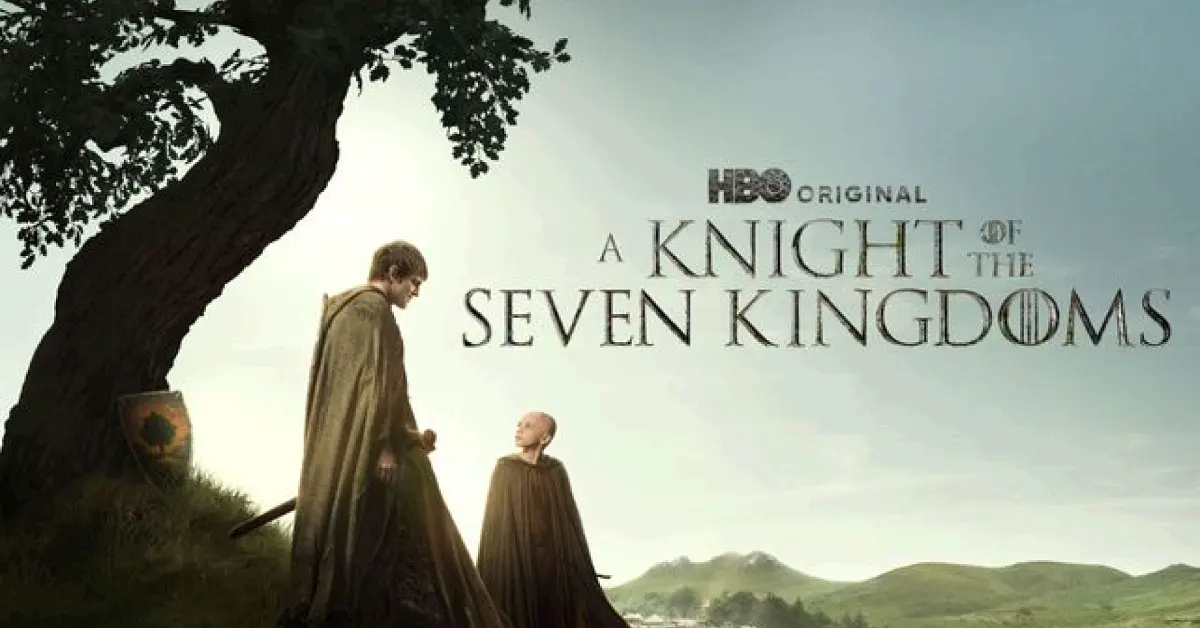
The first season of A Knight of the Seven Kingdoms came to a close on HBO and Max with an episode that delivered emotional goodbyes, major character moments, and one surprising musical choice that has everyone talking. The Game of Thrones spin-off, based on George R.R. Martin’s “Dunk and Egg” novellas, took a bold swing by ending its season with a real-world American folk song from the 1940s.
The song in question is “Sixteen Tons,” made famous by Tennessee Ernie Ford, and its presence over the finale credits marks the first time in the history of the Thrones franchise that a modern, non-diegetic song from the real world has been used. For 15 years, these shows have relied on sweeping orchestral scores from composers like Ramin Djawadi or the occasional in-universe ballad covered by artists like Florence + The Machine. So why the sudden change? As it turns out, the choice makes perfect sense for the story of Ser Duncan the Tall (Peter Claffey) and his young squire, Prince Aegon “Egg” Targaryen (Dexter Sol Ansell)
A Song About Working-Class Struggle
To understand why “Sixteen Tons” fits so well, you have to look at what the song is actually about. Written by Merle Travis in 1946, “Sixteen Tons” is a classic piece of American folk music that describes the brutal life of coal miners in the company towns of Kentucky and West Virginia. The lyrics paint a picture of backbreaking labor, perpetual debt, and a system designed to keep workers trapped .
The most famous lines from the chorus tell the whole story:
“You load sixteen tons, what do you get? / Another day older and deeper in debt / Saint Peter, don’t you call me, ’cause I can’t go / I owe my soul to the company store” .
The “company store” referenced in the song was a real and exploitative system where miners were forced to buy goods at inflated prices from stores owned by the mining companies. They were paid in scrip instead of real money, which meant they were permanently in debt and could never leave. This cycle of endless work with no hope of financial freedom is the core theme of the song .
Connecting the Song to Dunk’s Journey
At first glance, a 20th-century song about American coal miners seems to have nothing to do with a fantasy series set in the medieval-style world of Westeros. However, the themes of “Sixteen Tons” align almost perfectly with the journey of Ser Duncan the Tall.
Dunk is a hedge knight, which is the lowest rung on the ladder of knighthood. He owns nothing but his horse, his armor, and his sword. He travels from town to town, entering tournaments and hoping to win enough gold to survive another day. He is, in every sense that matters, a working-class laborer, just like the miners in the song. He sells his sword and risks his life for the chance to make a living .
Throughout the first season, the show makes it clear that Dunk comes from nothing. He was taken in by Ser Arlan of Pennytree as a boy and served him for years. In the finale, a flashback confirms a long-held fan theory: Dunk was never actually knighted by Ser Arlan. He has been living a lie, calling himself a knight despite never receiving the formal accolade. This revelation deepens his connection to the working class because he is essentially a peasant playing a role far above his station .
One of the key lyrics from “Sixteen Tons” is: “A mind that’s weak and a back that’s strong.” This line reflects how the ruling class views the working class, and it mirrors how the nobles at the Ashford Tournament view Dunk. They see him as a brute with no breeding, no education, and no right to stand among them. But the show, like the song, argues that there is dignity in that struggle .
Egg’s New Life as a “Miner”
The song’s title, “Sixteen Tons,” refers to the amount of coal a new miner was expected to load on his first day, which was double or triple the normal workload. This tradition of forcing newcomers to do the hardest labor connects directly to the fate of Prince Aegon “Egg” Targaryen at the end of the season .
In the finale, it is revealed that Prince Maekar (Sam Spruell) did not actually give his permission for Egg to squire for Dunk. The final stinger scene shows Maekar frantically searching for his son after realizing Egg has run off to join the hedge knight. This confirms that Egg has essentially run away from his royal life to become a servant to a poor, landless knight .
Egg is trading a life of comfort at Summerhall for a life on the road. He will now sleep in ditches, eat hard salt beef, and walk for miles in the mud. He is the new miner, forced to load his “sixteen tons” and learn what it really means to struggle. Dunk made this point directly to Maekar earlier in the episode when he contrasted Egg’s potential future with the spoiled lives of his brothers, Daeron and Aerion. Daeron never slept in a ditch, and Aerion only ate thick, bloody steak. Egg is about to experience the opposite of that privileged upbringing.
Breaking the Rules of the Franchise
Using a real-world song is a massive departure for the Game of Thrones franchise. Previously, the only music allowed was either the score or songs that exist within the world of the story, like “The Rains of Castamere” or “The Bear and the Maiden Fair.” HBO has always kept the universe isolated from modern cultural influences to maintain the immersive fantasy feel .
A Knight of the Seven Kingdoms deliberately breaks that rule. The showrunner and music team chose to use “Sixteen Tons” because the message was more important than the strict adherence to the “no modern music” policy. The song serves as a thematic summary of everything the season was trying to say about class, honor, and the value of common people .
Showrunner Ira Parker and composer Dan Romer have spoken about the show’s grounded approach. Unlike the epic scale of the mothership series or House of the Dragon, this show is visually and tonally rooted in a more realistic depiction of the 14th century. It focuses on the mud, the rain, and the common folk. However, by using this song, they connect that medieval struggle to a universal human experience that transcends time periods .
Fan Reactions to the Finale’s Music
The decision to end the season with “Sixteen Tons” has sparked a lot of discussion among viewers. Many fans took to social media and forums to share their thoughts on the unusual choice. Some admitted it was jarring at first, as hearing a familiar American folk song after an hour of medieval fantasy is definitely a shock to the system .
However, most fans quickly came around to appreciate the deeper meaning. On forums like SuperHeroHype, viewers noted that while the song initially seemed like a head-scratcher, it made sense after thinking about the themes of the show. The song underscores the point that A Knight of the Seven Kingdoms is about the people that the history books forget, much like the miners in the song are forgotten by history .
One fan pointed out that the show is a “return to form for Westeros,” focusing on grounded character interactions rather than dragons and epic battles. The use of a working-class anthem perfectly capped off that theme .
Other fans appreciated the humor and irony of the choice. The opening shot of the finale also features a similarly modern jazz trumpet and piano medley, which signals early on that this show is willing to play by its own rules. The ending credits simply follow through on that promise .
What the Lyrics Mean for Dunk and Egg
Looking closer at the lyrics of “Sixteen Tons” reveals just how carefully this song was selected for the series. The song opens with: “Some people say a man is made out of mud / A poor man’s made out of muscle and blood.” This directly reflects how the nobility views Dunk. He is made of mud, a lowly creature, while they are made of dragon steel and gold. But the song insists that the poor man is real, made of flesh and blood, and that his life has value .
The line, “I was born one mornin’, it was drizzlin’ rain / Fightin’ and trouble are my middle name,” could easily be Dunk’s personal anthem. Throughout the season, trouble follows him everywhere, from the inn at Ashford to the tournament grounds. He doesn’t seek it out, but his sense of honor forces him to confront it every time .
The most important line for the duo’s future is the final plea to Saint Peter. By refusing to answer the call to heaven because his soul is “sold” to the company store, the singer acknowledges that he is trapped in a system he cannot escape. For Dunk and Egg, this represents their future. They will wander the roads of Westeros, serving lords who don’t respect them, fighting for causes that aren’t their own, and trying to survive. It is a hard life, but as the show demonstrates, it is an honest one .
You May Also Like:


Season 2 is Already in the Works
As fans digest the finale and its unique musical ending, HBO is already moving forward with the next chapter. Season 2 of A Knight of the Seven Kingdoms is currently filming in Belfast. The new season will adapt the second Dunk and Egg novella, The Sworn Sword, and is expected to release on HBO and Max in 2027 .
George R.R. Martin remains heavily involved in the production, ensuring the show stays true to the source material. The cast, including Peter Claffey and Dexter Sol Ansell, will return to continue the adventures of the unlikely pair as they travel deeper into the Seven Kingdoms .
For viewers in the USA, UK, Canada, Australia, and India, the entire first season of A Knight of the Seven Kingdoms is available to stream on Max (or Binge in Australia, and JioCinema in India). The finale’s use of “Sixteen Tons” has given fans something to think about long after the credits rolled, proving that even after 15 years, this franchise can still find new ways to surprise its audience .
Also Read: Is Apple TV’s ‘For All Mankind’ Connected to ‘The Expanse’? The Timeline Explained
For more updates on your favorite shows from Westeros and beyond, keep checking back with VvipTimes for the latest news and deep dives.








Leave a Reply