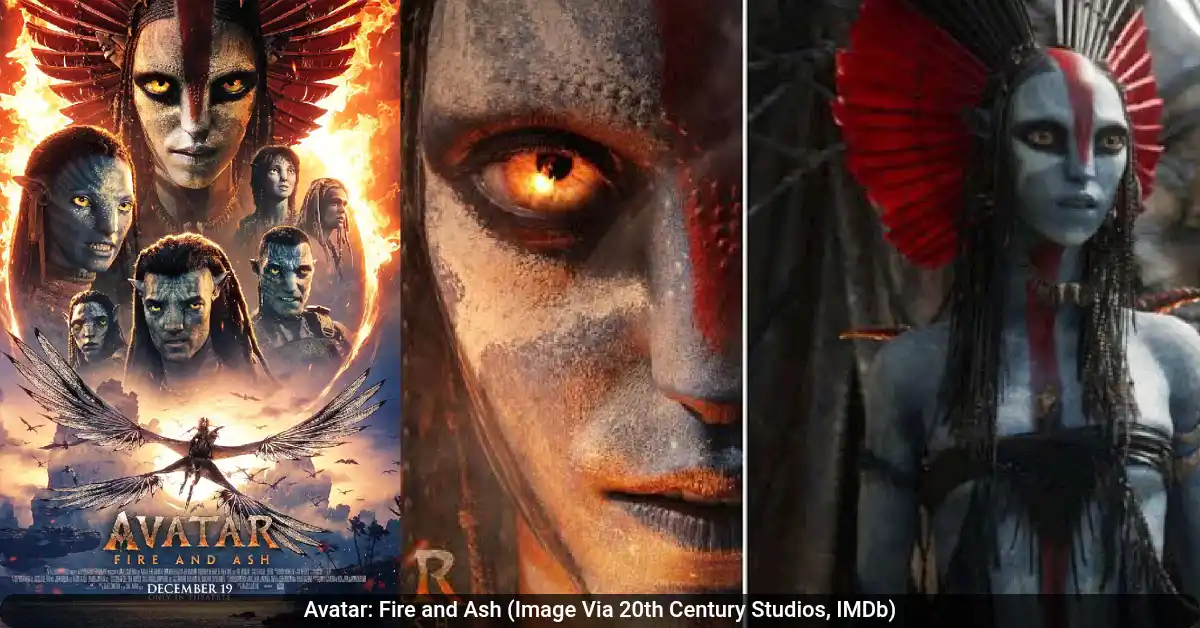
The third chapter of James Cameron’s saga, Avatar: Fire and Ash, concludes with a monumental battle and leaves the futures of its key antagonists, Varang and Colonel Quaritch, deliberately unresolved. While the Sully family secures a hard-won victory against the RDA and its new allies, the film closes with the fiery leader of the Ash People escaping and Quaritch choosing a mysterious fate, keeping their stories open for potential sequels.
What Happens to Quaritch in Avatar: Fire and Ash?
The climax of Avatar: Fire and Ash sees the long-running rivalry between Jake Sully and Colonel Miles Quaritch reach a new peak. Their final confrontation occurs high above the battlefield on a floating, magnetically charged landmass. During their fight, Spider—the human son Quaritch shares a complicated bond with—nearly falls to his death. Both Jake and Quaritch immediately stop their duel to save him.
With Spider safe and his side losing the larger battle, Quaritch is faced with a choice. Jake extends a hand, seemingly offering him a chance to stand down. However, as other members of the Sully family arrive, Quaritch makes a decisive move. He refuses to surrender and instead throws himself backward, plummeting into the fiery depths or a swirling vortex below. The film does not show his body, leaving his survival ambiguous.
As one analysis notes, this mirrors his history: “But while it’s safe to say that things don’t look altogether rosy for the villain, we don’t actually see his dead body after the fall… this is a character who has escaped death before.” Given that the current Quaritch is a recombinant avatar with implanted memories, the possibility of his return remains.
The Fate of Varang and the Ash People
The formidable leader of the Ash People, or Mangkwan clan, meets a different end. Varang, portrayed by Oona Chaplin, is a ruthless leader who turned to the “dark arts” after a volcanic disaster destroyed her clan’s home and shattered their faith in Eywa. She forges a potent alliance and romantic relationship with Quaritch, united by their warrior spirits and desire for power.
During the final battle, Varang directly confronts Neytiri, overpowering her at one point. The tide turns when Kiri intervenes, using her own unique connection to Pandora to subdue Varang. Rather than kill her, Neytiri and Kiri let her go. Varang is last seen fleeing the carnage, escaping to fight another day.
Her survival is a clear narrative choice, as one outlet states: “She too was heavily involved in the climatic battle… Neytiri and Kiri decided to let her go – meaning the coast is clear for her to return in the fourth movie.” This leaves open the potential for her to search for a possibly surviving Quaritch or to return as a primary antagonist herself.
Key Events of the Final Battle
The ending of Avatar: Fire and Ash resolves several major storylines through an extended sequence of conflict and spiritual resolution.
- The Tulkun’s Decision: Lo’ak and the exiled Tulkun Payakan successfully convince the pacifist Tulkun species to fight back against the RDA whalers, led by the hateful Captain Scoresby. In a moment of poetic justice, Scoresby is dragged to his demise by a Tulkun.
- A Major Loss: The Metkayina spiritual leader Ronal, played by Kate Winslet, is fatally wounded in combat. In her final moments, with Neytiri’s aid, she gives birth to a daughter before passing away.
- Eywa’s Intervention: As the battle swings against the Na’vi, Kiri, Spider, and Tuk journey to a Spirit Tree. Together, they successfully plead for direct help from the planetary deity Eywa, who summons Pandoran wildlife to turn the tide. This marks a significant shift, as Eywa becomes a more active, visible force.
- Spirit World Reconciliation: In the film’s closing moments, Kiri takes Spider into the Spirit World. There, they are greeted by the spirits of the departed, including Neteyam, Ronal, and Grace Augustine. This experience serves as a final acceptance of Spider as a true member of the people and the Sully family.
Also Read:

A Changed Spider and the Movie’s Central Conflict
A pivotal new development in Avatar: Fire and Ash is the transformation of Spider. After a near-fatal accident, Kiri uses her powers to save him, somehow fusing Pandoran flora with his biology. This grants him the ability to breathe the planet’s air without a mask and even grow a neural queue.
This transformation creates the film’s central moral dilemma. Jake fears the RDA will capture Spider to reverse-engineer this process for all humans, which would doom Pandora. This fear drives Jake to a dark extreme, seriously considering killing Spider to protect the planet. He ultimately cannot go through with it, a moment that reaffirms Spider’s place in the family. Spider’s new biology is a major plot point the RDA seeks to exploit, and it remains a key factor for the franchise’s future.
The Director’s Last-Minute Change to the Ending
In a revealing piece of background, it was reported that director James Cameron reshaped the film’s final act late in production. The original climax reportedly featured Jake Sully uniting the Na’vi clans and arming them with human automatic weapons for a large-scale firefight.
Cameron had a crisis of conscience, realizing this mirrored the destructive colonial tactic of arming indigenous groups against each other. “At a certain point it just hit me – this maps to colonial history,” Cameron stated. “Arming the tribes and pitting them against each other is actually the wrong thing. That was part of the North American genocide of indigenous people. I can’t have Jake doing the same thing.” He ordered reshoots to create the more spiritually and character-driven climax seen in the final film.
Also Read: Tom Cruise’s New Comedy ‘Digger’ with Alejandro Iñárritu Reveals First Look, 2026 Release Date















![New ‘Battle Spirits [Re]’ Anime Confirms Fall 2026 Premiere in Explosive Teaser Trailer](https://vviptimes.com/wp-content/uploads/2026/03/Ku_Bashin_a_fan_of_Battle_Spirits_-_Source__Bandai_Namco_Pictures_53kb-300x157.webp "Ku Bashin a fan of Battle Spirits Source Bandai Namco Pictures 53kb")