
The medical drama has been a television staple for decades, but HBO Max’s The Pitt does something different. Instead of clean, polished shots of doctors saving the day, the camera feels like it’s right in the middle of the chaos, moving with the staff as they rush between trauma bays. According to the person who created that look, it was all about understanding what the doctors were feeling and translating that to the screen.
Johanna Coelho, the sole cinematographer for the show’s 15-episode first season, calls herself a “visual psychologist.” For her, the job is more than just framing a shot. It is about getting inside the heads of the characters to build a visual world that pulls the audience directly into their experience .
“We have to understand the psychology of the character and really dig into it to understand how to visually create the right atmosphere and pass it through to the audience,” Coelho explained in a recent interview. “I think that’s such a great combination of art and psychology”.
Making the Camera a Person in the Room
The unique hook of The Pitt is that each of its 15 episodes covers one hour of a single 15-hour shift in a Pittsburgh emergency room, running from 7 a.m. to 10 p.m. . To make viewers feel every minute of that shift, Coelho knew the camera work had to be immersive.
“You need to be in the middle of it and actually living the shift yourself as an audience,” she said . That meant throwing out the traditional filmmaking rulebook. There are no tripods on the set of The Pitt. There are no camera dollies, no tracks on the floor, and no lighting stands getting in the way .
Instead, the camera operators move constantly, weaving through the action right alongside the actors. Coelho described it as a “full dance choreography” where the camera flows with the doctors and nurses as they work on patients, grab equipment, and rush down hallways .
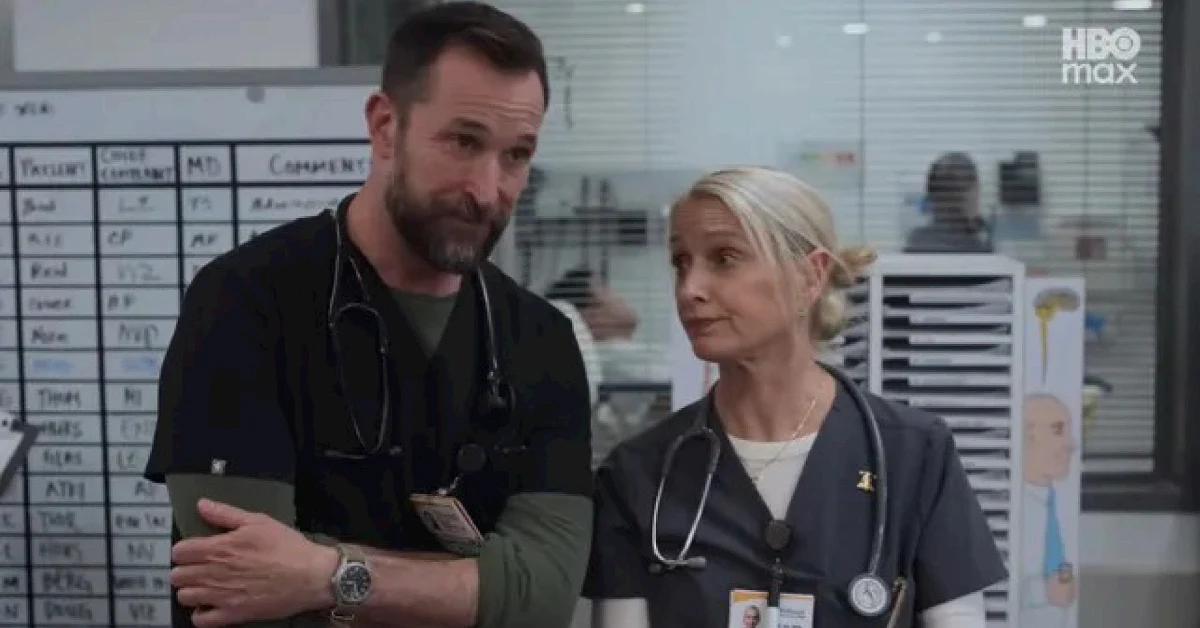
To achieve this level of freedom, the production team built a completely functional 360-degree set. Every direction is fully dressed with real medical equipment because the camera can—and does—point anywhere at any time . Noah Wyle, who stars as Dr. Michael “Robby” Robinavitch and also serves as an executive producer, explained that this setup was intentional to create a specific feeling for the viewer.
“It’s intentionally sloppy,” Wyle told The Sydney Morning Herald. “It’s intentionally, slightly off-perfect because you want it to be grounded in the perspective of a voyeur, analogous to being in the back seat of a squad car on a ride-along, or maybe being embedded with a combat unit… You can’t leave, you can turn your head, but you can’t escape this experience” .
Looking to the Trenches for Inspiration
When Coelho was searching for a visual reference that captured the feeling of being trapped in a high-pressure environment, she looked to the battlefields of World War I. She cited Roger Deakins’ 1917 as a major inspiration for the show’s style .
In 1917, the camera follows soldiers as they cross no man’s land, putting the audience right in the trenches with them. Coelho wanted the same effect for the ER.
“I was like, the soldiers in the trenches need to be the doctors in the ER. And that’s what it needs to feel like,” she recalled .
This comparison shaped the entire visual language of the series. The handheld cameras give the footage a documentary-like realism, as if a news crew is embedded with the medical team . The actors move freely without having to hit specific marks on the floor, and the focus pullers adjust on the fly, adding to the raw, unstaged feel of the footage.
Engineering the Perfect White
Creating a realistic hospital environment that could be shot from any angle presented a massive challenge for the lighting department. Because there are no lighting stands on the floor, all the light had to come from above, just like in a real hospital .
Coelho worked closely with production designer Nina Ruscio to build the lighting directly into the set. Over 200 individual LED lights were installed in the ceiling, all of which can be remotely controlled for brightness and color temperature in real-time as the scene shifts from day to night .
However, overhead lighting can be unflattering, often casting harsh shadows on faces. The solution was surprisingly simple: the walls. The set features bright white walls, which act as a giant reflector, bouncing the light back onto the actors .
But finding the right shade of white was a scientific process. Coelho and Ruscio tested over 50 different shades of white paint to find one that looked realistic on camera and, more importantly, worked beautifully with the diverse skin tones of the cast .
“We wanted to pick a ‘white’ for the walls that would not only look cinematic and right for our hospital but would also work and give accuracy to our vast range of skin tones,” Coelho explained to No Film School . They even tested the level of shine on the paint, settling on a “pearl” finish to avoid distracting hot spots while still giving the walls enough dimension .
When the Crew Wears Scrubs
With cameras moving everywhere and no place to hide, the filmmaking team faced another problem: reflections. The set is full of glass doors and windows that give the hospital a sense of depth, but they also act as mirrors .
The solution was simple but effective. Everyone working on the set—from the sound technicians to the grips—wears hospital scrubs . If a crew member accidentally appears in a reflection, they just look like another nurse or technician walking through the ER.
“We all looked the same on set. Crew, cast, background—we were all part of one big team. You couldn’t tell who was who anymore,” Coelho told Backstage magazine .
Also Read:

Emotional Moments in the Chaos
While the camera is almost always moving, Coelho made a deliberate choice to let it go still during the show’s most powerful moments. She explained that because the camera never stops, the few times it slows down carry immense emotional weight .
For example, in a scene where Dr. Robby realizes he cannot save a young patient, the camera stops moving. It simply watches his face as the realization hits him.
“We used a longer lens on his face, narrowing the environment around him with a shallower depth of field,” Coelho described to British Cinematographer. “The camera simply watched his emotions” .
These moments of stillness give the audience a chance to breathe and connect with the character’s pain, making the intense scenes that follow feel even more chaotic.
The second season of The Pitt is currently in production and is set to return on January 9, 2026, on HBO Max . Coelho and most of the crew have returned to continue refining their unique approach, shooting the new episodes in script order to maintain the authenticity of a single, draining shift .
Also Read: Fate/strange Fake Episode 8 Release Date, Story, and Streaming Details
For more breaking news and exclusive interviews about your favorite series, keep it locked on VvipTimes.