


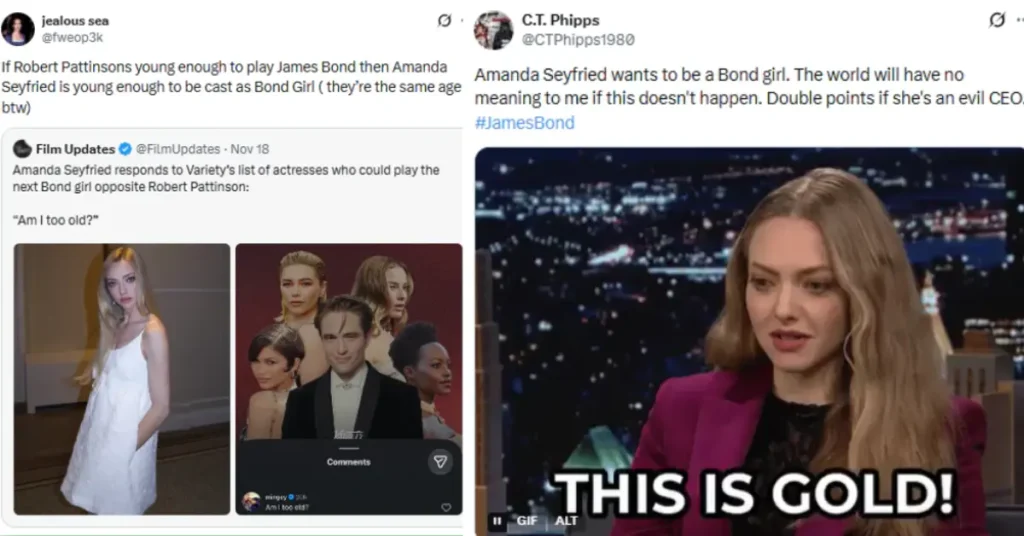
Amanda Seyfried asked a simple question under a Variety Instagram post. The internet turned it into a full-blown debate about who gets to age on screen and who gets left behind. The actress, 40, was missing from a speculative list of women who could star opposite Robert Pattinson in the next James Bond film. Her comment—“Am I too old?”—was short, sharp, and impossible to ignore.
The question landed because of one detail nobody could brush aside. Seyfried and Pattinson are both 40. She is reportedly only about six months older than the newly announced 007. A man at 40 is just starting his Bond era. A woman at 40 is already asking if she has aged out of the conversation.
That contrast is the story. Not the shortlist. Not the speculation. The story is what Seyfried’s two-line comment revealed about an industry that keeps pairing older men with much younger women and calls it tradition.
The Shortlist That Started the Conversation
Variety published a speculative list of 19 actresses who could play the female lead opposite Pattinson in the untitled Bond film. The names included Zendaya, Florence Pugh, Margot Robbie, Lupita Nyong’o, Sydney Sweeney, Anya Taylor-Joy, Gemma Chan, and Sophie Turner.
Seyfried was not on it. The actress, known for Mamma Mia! and Mean Girls, noticed and left her comment under the post. The remark was playful on the surface. The reaction it triggered was anything but.
Online, users pointed out the obvious math. Pattinson gets to play James Bond at 40. Seyfried gets asked if she is too old to stand next to him. One fan wrote on X that the actress is the same age as Pattinson and should be considered.
“The fact that he gets to be 40 and play Bond but we can’t have a 40-year-old Bond Girl? Can we pair these men with age appropriate partners?”
— Fan comment on X, as reported by Mashable
Another reply was shorter: “She would be killer.” A third said, “Never too old for Bond. She’d bring the class and the edge that role needs. Mamma Mia to MI6, I’d watch that”.
Not every reaction was supportive. Some users said Seyfried does not have the “Bond Girl aura.” Others argued that pairing her with Pattinson would make them “the same age, so rather not”. That split reaction is its own data point. Even when a woman points out the double standard, the audience has been trained to defend it.
The Math Behind the Bond Girl Myth
The Bond franchise has spent six decades teaching audiences that a certain kind of age gap is normal. The average Bond Girl is in her early to mid-twenties, roughly ten years younger than 007, who is usually written as being in his mid-thirties.
Some gaps are far wider than ten years. Roger Moore was 54 and Carole Bouquet was 24 during the filming of For Your Eyes Only—a 30-year difference. Daniel Craig and Léa Seydoux had a 17-year gap. Pierce Brosnan and Izabella Scorupco were 17 years apart.
Only three of the 26 official Bond films have featured a female lead who was older than the actor playing 007. Those three are Honor Blackman in Goldfinger, Diana Rigg in On Her Majesty’s Secret Service, and Monica Bellucci in Spectre.
Bellucci became the oldest Bond Girl in franchise history when she played Lucia Sciarra at 50. She was also four years older than Craig, who was 46 at the time. Her casting was treated as a groundbreaking moment. It should not have been. It was a rare exception in a franchise that has spent most of its life doing the opposite.
Seyfried at 40 would still be a statistical outlier. That is the point she was making without saying it directly.
An Actress Who Has Spoken About This Before
The Bond comment did not come out of nowhere. Seyfried has talked about Hollywood’s age problem before, in different words and on different stages.
During an appearance on Jimmy Fallon’s show, she joked about fans suggesting that Sabrina Carpenter could play her daughter in Mamma Mia 3. The joke was funny. The subtext was not.
At the Berlin Film Festival, Seyfried spoke more plainly. After becoming a mother, she said, she was mostly offered mother roles. She blamed Hollywood for the shift.
That experience is not unique to her. Sienna Miller has said actresses are warned they will become “obsolete” after 40. Elizabeth Perkins has described Hollywood’s attitude toward age as a world where “older is like anything over 40”.
The pattern is well documented. Women over 40 are frequently moved into supporting roles—mothers, mentors, background characters—while men of the same age continue to be cast as romantic leads and action heroes.
Seyfried’s Bond comment was a joke. It was also a résumé of everything she has already lived through in an industry that starts writing women off at the same age it starts writing men in.
Why This Bond Casting Cycle Feels Different
Robert Pattinson’s casting as the seventh James Bond was confirmed by Amazon MGM Studios on November 16, 2026. The announcement ended a long search for Daniel Craig’s successor and came with a first-look photo of Pattinson in Bond’s signature tuxedo.
Denis Villeneuve will direct the 26th Bond film from a screenplay by Steven Knight. Amy Pascal is among the producers. The studio has not announced the female lead, the film’s title, its release date, or its shooting schedule.
That silence is normal for a franchise that guards its casting news. But the silence is also the space where speculation fills in the gaps. Variety’s list was speculative. The shortlist was not official. Seyfried was never confirmed to be in the running, and she has not been officially linked to the project.
What made the moment newsworthy was not the list itself. It was the reaction. A 40-year-old actress asked a public question that thousands of women in Hollywood have asked privately. The answer, based on the industry’s history, is uncomfortable.
The franchise that gave Monica Bellucci a major role at 50 is the same franchise that has spent most of its existence pairing its male lead with women young enough to be his daughter. One exception does not erase the pattern.
What the Age Debate Is Really About
The Bond Girl conversation keeps returning to the same fork in the road. Should the franchise cast a woman in her twenties because that is what it has always done? Or should it cast the best actress for the role, regardless of whether she is the same age as the man playing 007?
The audience is split. Some fans want the fantasy. Some fans want the math to change. Seyfried’s comment put both sides in the same comment section and let them argue it out.
“She’s the same age as Pattinson and she should be considered.”
— Fan comment on X, as reported by Mashable
That sentence is the entire debate in one line. The question is not whether Amanda Seyfried should be a Bond Girl. The question is why a 40-year-old woman is even asking whether she is too old to stand next to a 40-year-old man.
Hollywood has answered that question for decades with its casting choices. Seyfried just made the answer harder to ignore.
The Roles That Come After the Question
The roles offered to actresses after 40 tell their own story. Seyfried said motherhood shifted what she was offered. Miller was warned about becoming “obsolete.” Perkins described 40 as the line where Hollywood stops seeing women as leads.
Meanwhile, the men keep working. Pattinson at 40 is beginning a Bond era. Craig played 007 into his fifties. Moore was 54 when he filmed For Your Eyes Only and 57 when he made A View to a Kill.
The double standard is not a theory. It is a casting pattern that has repeated itself for 60 years. Seyfried’s comment did not create the pattern. It just made the pattern visible in a comment section where everyone could see it.
You May Also Like:





The next Bond film will cast a female lead. The studio has not said who it will be. The shortlist is speculation. The release date is unknown. The only certainty is that the conversation Seyfried started will follow whoever gets the role.
“Am I too old?”
— Amanda Seyfried, commenting on Variety’s Bond Girl post
The answer, for now, is another question. How old is too old for a man? Hollywood has never given a clear number.
For more entertainment news and updates, visit VvipTimes.

































Leave a Reply