

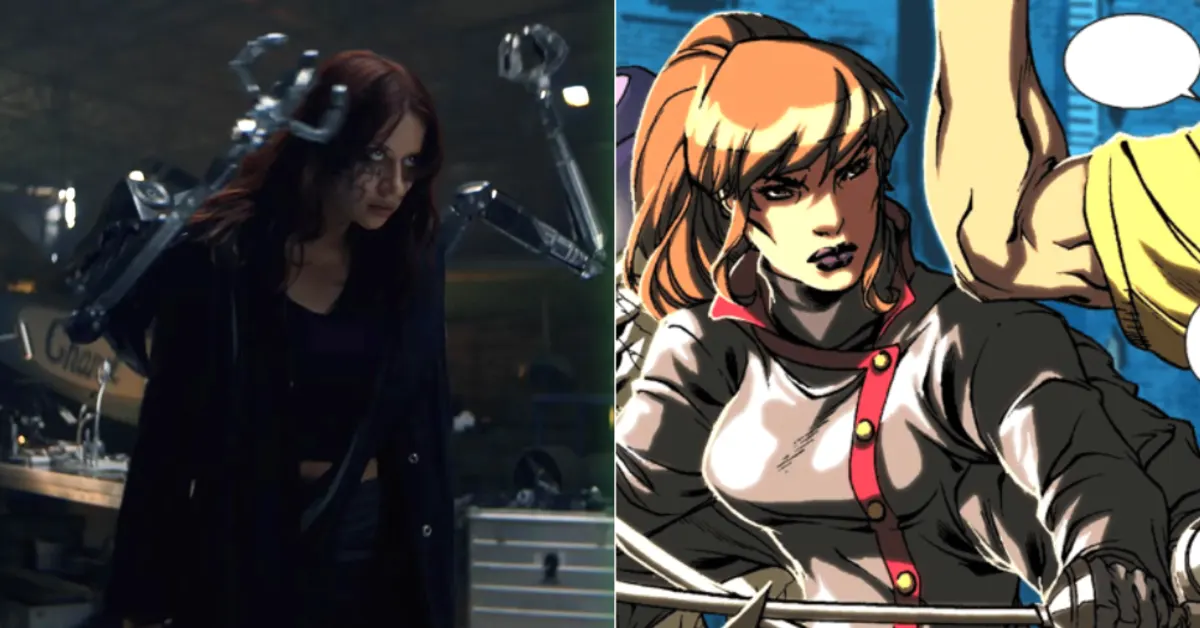

The Marvel Comics character Coat of Arms never anchored a solo title. She never headlined a crossover event. Yet Lisa Molinari has become one of the most scrutinized supporting figures in the current Marvel Cinematic Universe conversation, thanks to her live-action debut in VisionQuest on Disney+. The series premiered October 14, 2026, and places Molinari—played by Lauren Morais—alongside Thomas Shepherd, the reincarnated son of Vision and Wanda Maximoff. For casual viewers, she is a sharp-witted companion with a mysterious jacket. For comic readers, she is the woman who becomes Coat of Arms, a magically powered operative tied to the Young Masters and one of the stranger corners of Marvel’s Dark Reign era.
The gap between those two audiences defines the character’s current relevance. VisionQuest is not a direct adaptation of the 1989 “Vision Quest” comic arc. It borrows themes, not plot points. That creative freedom means Coat of Arms can be rebuilt for the screen in ways that diverge sharply from her 2009 paper origins. Understanding who she is in the comics—and what the MCU has already changed—requires tracing a paper trail that runs from a juvenile detention center to a mystical coat hanging in an alleyway, and from there into the orbit of Norman Osborn’s Dark Reign.
The 2009 Debut: Paul Cornell, Mark Brooks, and the Birth of a Street-Artist Superhero
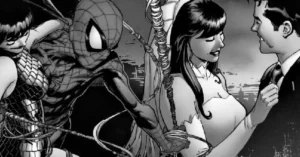
Coat of Arms first appeared in Dark Reign: Young Avengers #1, published by Marvel Comics in 2009. Writer Paul Cornell and artist Mark Brooks created the character as part of a broader expansion of the Young Avengers franchise during a period when Norman Osborn had seized control of America’s national security apparatus. The Dark Reign status quo replaced the official Avengers with Osborn’s own handpicked roster of former criminals and morally flexible operators. The Young Avengers, meanwhile, faced a mirror image of themselves: a rival team of young powered individuals calling themselves the Young Masters.
Lisa Molinari was not born into that world as a villain. In the comics, she was a visual artist with a focus on superhero imagery. She met Thomas Shepherd—the future Speed—in juvenile detention before either of them had powers. After her release, she struggled to hold down conventional work and poured her energy into street art. The turning point came when she discovered a coat hanging on a rack in an alleyway, positioned beneath graffiti that asked whether superheroes were actually doing any good. She interpreted the discovery as a sign and took the garment.
The coat belonged to Tiboro, an ancient wizard from another dimension. Its magical properties allowed Molinari to manifest additional arms—typically two extra limbs, enabling her to wield four weapons simultaneously—and to fly. She adopted the codename Coat of Arms and framed her superhero activities as a living art installation. Her fascination with Norman Osborn’s Green Goblin career led her to create paintings of the villain, a decision that nearly ended with Osborn threatening her before he slipped back into his Goblin persona.
From the Young Masters to Avengers Academy: Coat of Arms’ Comic Book Trajectory
The Young Masters were not a conventional villain team. Under Cornell and Brooks, the group functioned as a satirical counterpoint to the Young Avengers, with Coat of Arms positioning their work as an exploration of the tension between pro-registration and anti-registration factions within the superhero community. When the original Young Avengers confronted the Masters over their use of the team name, the two groups paired off for a trial period. Coat of Arms was matched with Speed, her old friend from juvenile hall. The reunion sparked mutual romantic attraction, though neither could convince the other to switch teams.
The character’s comic history extends beyond that first arc. She later appeared in Avengers Academy, where she and several other Masters were hired by a billionaire to distribute a superhuman “cure” called Clean Slate. Coat of Arms treated the de-powering campaign as a performance piece, a framing that reinforces her defining trait: she treats superheroism as a medium rather than a moral calling. That ambiguity is central to her appeal as a niche figure. She is not a megalomaniac. She is an artist who found a magical tool and built a persona around it, then allowed that persona to drift into villainy through association rather than conviction.
Her powers remain tied to the Tiboro Coat. The garment generates extra limbs, projects force fields, and grants a measure of magical aptitude. She has used it to channel energy alongside Wiccan and the Enchantress, and she has used it to teleport her team out of combat. The coat is the character. Without it, Lisa Molinari is a skilled artist with a complicated past and no superhuman abilities. That dependency is precisely what makes her MCU translation so intriguing.
How VisionQuest Rewrites the Coat of Arms Origin
The MCU version of Lisa Molinari enters VisionQuest through a different door. She meets Thomas Shepherd on a bus bound for Saint Mabyn’s Psychiatric Sanitarium in the United Kingdom, shortly after Thomas begins remembering his life as Wanda and Vision’s son. A skilled pickpocket, Lisa helps Thomas escape, and the two spend a year running scams together in London. Their bond is emotional and romantic, rooted in shared instability rather than superheroics.
Lauren Morais’s costume reflects that grounded starting point. In VisionQuest, she wears a coat featuring a pair of artificial hands clasped in front, a visual nod to the four-armed silhouette of the comics without committing to full magical anatomy. Tommy makes an offhand comment about her jacket being a “coat of arms,” but the series does not immediately suggest the garment possesses supernatural properties. The transformation, if it comes, arrives through science fiction rather than sorcery.
At the end of episode six, Lisa is injected with AI nanites created by Jo Carrington, the character played by T’Nia Miller. The injection appears to put her on the verge of death, but the narrative leaves open the possibility that the nanites could grant her powers instead. That deviation matters. The comics’ Tiboro Coat is a mystical artifact from another dimension. The MCU’s pathway is technological, consistent with the franchise’s longstanding habit of translating magic into advanced science. If Lisa emerges from the nanite injection with extra limbs or enhanced combat capabilities, she will become Coat of Arms through an entirely different mechanism—one that ties her powers to Jocasta’s programming rather than to an ancient wizard’s discarded clothing.
The Vision Quest Comic Book Backbone: Why the 1989 Arc Still Matters
The title “VisionQuest” carries weight beyond the character of Coat of Arms. It references a 1989 West Coast Avengers storyline written and penciled by John Byrne, published across West Coast Avengers #42–45. In that arc, a government agency called Vigilance kidnaps Vision, dismantles him, and wipes his memories. Hank Pym rebuilds the android in a chalk-white body with a colder personality. Wanda Maximoff is left heartbroken, and the Vision she knew is effectively gone.
That storyline had long-term consequences for the Marvel Universe. It set the stage for Avengers Disassembled and House of M, two events that reshaped Wanda’s trajectory and the broader Avengers franchise. The MCU’s VisionQuest is not a one-for-one adaptation of Byrne’s arc. The West Coast Avengers have not formed in the film continuity, Wanda is presumed dead after the events of Doctor Strange in the Multiverse of Madness, and Vision’s reprogramming was already partially addressed in WandaVision. Instead, the series draws on the emotional core of the 1989 story—Vision’s struggle to recover his identity after being rebuilt—while folding in elements from Tom King’s 2015 Vision series, which centered on the android attempting to build a domestic life.
Coat of Arms does not appear in the 1989 “Vision Quest” arc at all. Her presence in the Disney+ series is a structural invention, a way to populate Vision’s fugitive journey with a character who carries her own unresolved history with Tommy Shepherd. The show uses her as a bridge between Vision’s story and the next generation of Marvel heroes, not as a faithful recreation of a Dark Reign subplot.
Business Analysis: Why a Niche Character Matters to Marvel’s Streaming Strategy
Marvel Studios did not cast Coat of Arms because she sells comic books. Dark Reign: Young Avengers #1 had a print run of roughly 32,266 copies, and graded 9.8 copies of the issue are scarce enough that the secondary market treats it as a low-volume key rather than a blue-chip investment. The character’s value to the MCU lies elsewhere: she is a supporting piece in a larger architecture.
VisionQuest arrives with the dual mandate of closing the WandaVision trilogy and seeding the Young Avengers roster. The series premiered to a first-episode screening at New York Comic Con 2026, with Paul Bettany, James Spader, Ruaridh Mollica, Emily Hampshire, and showrunner Terry Matalas presenting the footage to fans. The eight-episode season rolled out on a staggered schedule: two episodes on October 14, two on October 21, two on October 28, then single episodes through the November 11 finale. That release pattern is designed to sustain weekly engagement rather than dump the season in a single drop, a retention strategy Disney+ has refined across its Marvel slate.
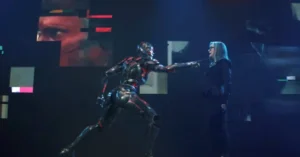
The production budget for VisionQuest has not been officially disclosed, but industry comparisons place Marvel’s Disney+ spending in a range that has reached as high as $25 million per episode for flagship series. Those economics have come under scrutiny as streaming platforms recalibrate their spending on expensive genre content. VisionQuest carries the additional cost of visual effects-driven characters like Vision and Ultron, alongside the practical demands of a UK shoot at Pinewood Studios. The series is not a standalone bet. It is a connective tissue investment, designed to keep subscribers engaged between theatrical Avengers releases and to introduce characters who can populate future team-up projects.
Coat of Arms fits that calculus as a low-cost, high-narrative-yield addition. She does not require an origin-story film or a solo special presentation. Her powers, if they manifest, can be realized through effects work already budgeted for the series’ sci-fi infrastructure. Her connection to Tommy Shepherd gives the show an emotional subplot that does not depend on Vision’s internal monologue. And her ambiguous moral alignment leaves room for future use in a Young Avengers or Dark Avengers project without requiring a full redemption arc.
The Young Avengers Endgame and Coat of Arms’ Uncertain Future
Terry Matalas has spoken openly about his interest in adapting Avengers: The Children’s Crusade, the 2010 storyline in which Wiccan and Speed search for their missing mother. In an interview with ScreenRant, Matalas said he “would love nothing more” than to tackle that story, provided the rest of the family—including Ultron—could come along. The Children’s Crusade is the comic arc that reunites Wanda with her children and resolves her redemption after House of M. If the MCU ever pursues that narrative, Coat of Arms has a natural place in it as a character tied to Speed’s past and to the Young Masters’ legacy of morally flexible youth activism.
The Young Avengers roster has been assembled across multiple Disney+ series and films. Cassie Lang, Kate Bishop, America Chavez, Eli Bradley, Billy Maximoff, and Tommy Shepherd have all appeared. Kamala Khan has begun recruiting. The team has been teased since WandaVision in 2021, and VisionQuest brings the lineup closer to full formation by formally introducing Speed. Coat of Arms is not a core Young Avenger in the comics. She is a Young Master, a rival, a romantic foil, and an occasional ally. That positioning gives Marvel flexibility. She can be a villain in one project and a reluctant collaborator in the next, without the narrative baggage of a full heroic arc.
The MCU’s version of Lisa Molinari has already diverged from her paper counterpart in one crucial respect: her relationship with Tommy is the emotional anchor of her screen presence, not a footnote from a crossover event. If the nanites transform her into Coat of Arms, that transformation will carry the weight of a friendship that predates the powers. That is a more grounded origin than the comics ever gave her. It is also a more sustainable one for a franchise that needs every new character to justify their screen time across multiple projects.
What the Comics Tell Us About the Character the MCU Is Building
The most revealing detail about Coat of Arms is not her power set. It is her motivation. In the comics, she becomes a superhero because she finds a coat and decides that wearing it is a form of artistic expression. She is not driven by revenge, ideology, or a sense of duty. She is driven by the aesthetic possibilities of the costume. That makes her an outlier in a genre dominated by trauma-based origin stories. It also makes her a useful mirror for Tommy Shepherd, a character whose own identity has been shaped by forces he did not choose—reincarnation, experimentation, and the legacy of a mother he barely knew.
VisionQuest places Lisa and Tommy in a shared space of instability. Both are young, both have complicated pasts, and both are navigating a world that has not made room for them. The nanite injection at the end of episode six introduces the possibility that Lisa will gain powers not because she sought them, but because a scientist used her as a test subject. That is a darker origin than the alleyway coat. It also aligns her more closely with the MCU’s tendency to ground superhuman abilities in institutional failure and technological overreach.
You May Also Like:




View all articles about
Whether Lauren Morais’s Lisa Molinari becomes Coat of Arms in the traditional sense—four arms, a flying coat, a place in the Young Masters—remains unresolved. The series leaves her fate hanging, and the finale does not confirm a full transformation. But the character’s trajectory is already set. She is a survivor of the same systems that produced Thomas Shepherd, and her eventual costumed identity, if it arrives, will be built on that foundation rather than on a mystical artifact from another dimension.
Also Read: VisionQuest Jocasta Origin Creates an Age of Ultron Plot Hole, Explained
VVIPTimes will continue tracking VisionQuest character developments, Young Avengers roster updates, and Marvel Comics key issue movements as the MCU’s streaming slate evolves.

























Leave a Reply