

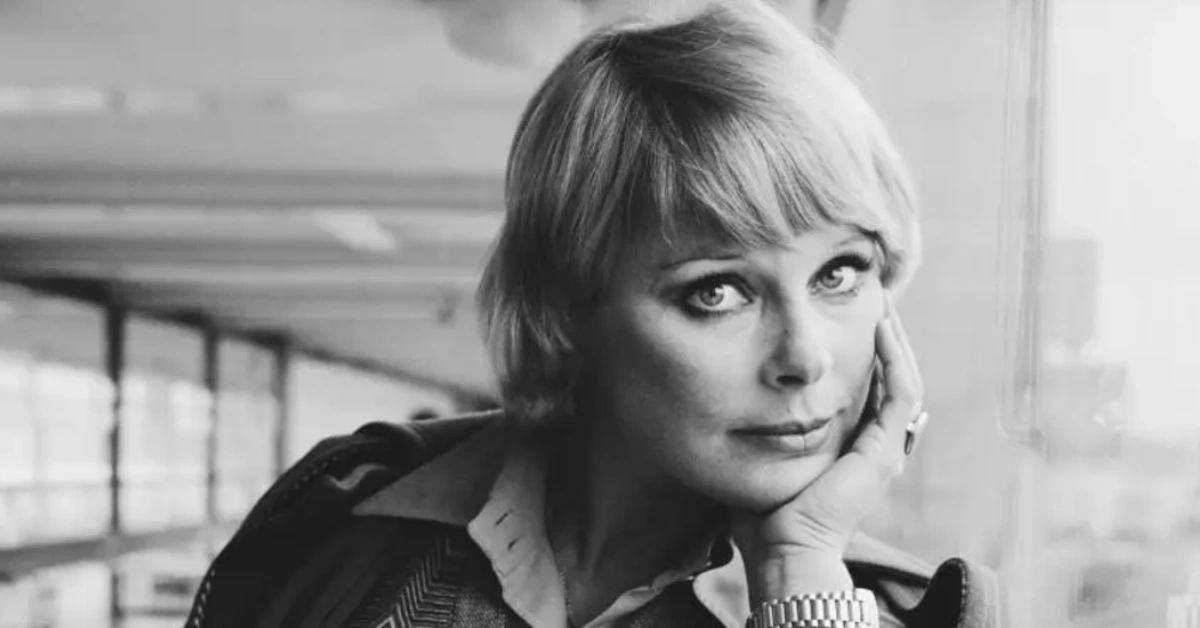

Elke Sommer, the Berlin-born actress who became one of the most visible European imports in 1960s Hollywood, died Wednesday, October 28, 2026, at her home in Bel Air, Los Angeles. She was 85, one week shy of her 86th birthday. Her stepson Sebastian Walther confirmed the death to the German outlet Bild, citing heart failure following a prolonged period of declining health. The Los Angeles Police Department told the Associated Press that officers responded to a death call on Sommer’s block Wednesday night.
Her death arrives three months after the loss of her husband, German hotelier Wolf Walther, who died of prostate cancer on July 22, 2026, at 77. Sebastian Walther’s statement to Bild framed the timing with stark intimacy: “Elke passed away peacefully around 10 p.m. Now she can finally be with her beloved husband again”. Sommer had told Bunte months earlier that she could not imagine life without the man she called “Papabär,” and friends said her condition deteriorated steadily after his death.
A Berlin Childhood and an Accidental Discovery in Italy
Sommer was born Elke Schletz on November 5, 1940, in Berlin, while the city sat under Nazi occupation. Her father, Peter, was a Protestant pastor; her mother, Renata, was a homemaker. The family evacuated the capital during World War II and relocated to Bavaria, then later to the small town of Niederndorf. Her father died when she was 14.
She intended to work as an interpreter. That plan collapsed on a holiday in Italy. In 1958, while sitting in a café in the seaside town of Viareggio with her mother, someone pinned a ribbon on her and declared her the winner of a beauty contest. A photograph in the next day’s newspaper reached an Italian producer. The result was a small role in L’amico del giaguaro (1959), shot for a $2,000 fee. Director Vittorio De Sica noticed her during the same period and cast her in Men and Noblemen (1959). She adopted the surname Sommer and began working across Italy, Spain, and England.
The Hollywood Breakthrough: ‘The Prize’ and a Shared Golden Globe
Sommer’s American break came from producer Pandro S. Berman, who had seen her in the West German drama Das Mädchen und der Staatsanwalt (1962) when it screened for the Golden Globes. Berman tracked her down in Germany and offered her a role opposite Paul Newman in The Prize (1963), an espionage thriller adapted from Irving Wallace’s novel. She played Inger Lisa Andersson, the Swedish chaperone to Newman’s Nobel Prize-winning character.
The performance earned Sommer the 1964 Golden Globe for Most Promising Newcomer – Female. The award was shared that year with Tippi Hedren for The Birds and Ursula Andress for Dr. No, placing Sommer in a cohort of blonde screen presences that defined the era’s international cinema. Variety’s contemporary review noted that Sommer “hasn’t a very scintillating role, but has the looks to make that a secondary issue,” a line that captures how the industry framed her early stardom.
Maria Gambrelli and the ‘Pink Panther’ Effect
If The Prize made Sommer a name, A Shot in the Dark (1964) made her a fixture of American pop memory. Directed by Blake Edwards, the film was a sequel to The Pink Panther and cast Sommer as Maria Gambrelli, a maid framed for a series of murders who also becomes the romantic fixation of Peter Sellers’ bumbling Inspector Clouseau. The role required comic timing and physical comedy, and it leaned into the “sexpot” image that Hollywood had already attached to her.
Sommer later said the role followed her into ordinary life. “It has happened frequently that I am on a golf course, for example, with the regular crowd on Tuesdays, and from a distance, I hear someone yelling, ‘Hey, Maria Gambrelli! How are you!’” she recalled in a 2014 interview. “It makes me feel very privileged — all of the Pink Panther films were very good, and I’m very happy that a lot of people say A Shot in the Dark is the best, which I think is very true”.
A Prolific 1960s Run Across Genres and Continents
Sommer’s 1960s filmography reads like a map of mid-century transatlantic commercial cinema. She appeared opposite James Garner and Dick Van Dyke in Norman Jewison’s The Art of Love (1965), with Glenn Ford and Rita Hayworth in The Money Trap (1965), with Stephen Boyd in The Oscar (1966), and with Bob Hope in Boy, Did I Get a Wrong Number! (1966). She played one of two assassin partners in the satire Deadlier Than the Male (1967), starred alongside Dean Martin and Sharon Tate in the Matt Helm spy spoof The Wrecking Crew (1968), and headlined The Wicked Dreams of Paula Schultz (1968) as an East German athlete who pole-vaults over the Berlin Wall in lingerie.
Her linguistic range — she was fluent in multiple languages — allowed her to move between Italian comedies, German dramas, British comedies, and Hollywood studio pictures without the dubbing that constrained many European performers of her generation. She was billed alongside Melina Mercouri, Jeanne Moreau, and Romy Schneider as one of the “six most exciting women in the world” in Carl Foreman’s 1963 war film The Victors.
The Zsa Zsa Gabor Feud and a $3.3 Million Libel Verdict
Sommer’s career also carried a tabloid subplot that outlasted many of her films. In 1984, she appeared with Zsa Zsa Gabor on the television show Circus of the Stars. The pairing produced friction, and by 1990 a war of words had erupted in the German press. Gabor was quoted saying Sommer was broke, spent time in sleazy bars, and sold hand-knitted sweaters for $150. Gabor’s husband, Frédéric Prinz von Anhalt, was quoted in another publication claiming Sommer lied about her age and looked far older than her stated years.
Sommer sued for defamation, seeking $10 million. In December 1993, a Santa Monica Superior Court jury awarded her $3.3 million in damages from Gabor and von Anhalt — one of the largest personal libel judgments in celebrity-versus-celebrity litigation at the time. The verdict cemented a public association between Sommer and the feud, but it also demonstrated that she was willing to litigate her own reputation on her own terms.
Later Career, Painting, and a Life Beyond the Screen
Sommer never fully left acting, but from the 1990s onward she concentrated on painting. She had held her first one-woman exhibition at the McKenzie Galleries in Beverly Hills in 1965, and her canvases drew comparison to Marc Chagall. She hosted the PBS program Painting With Elke Sommer and another syndicated show, Elke Sommer’s World of Speed and Beauty, reflecting a long interest in automobiles. She recorded several albums as a cabaret singer and performed in stage productions of Irma la Douce, Born Yesterday, Cactus Flower, Woman of the Year, and Same Time, Next Year.
On television, she played Magda Goebbels opposite Ian Holm in the 1982 ABC miniseries Inside the Third Reich and appeared on St. Elsewhere, Fantasy Island, and The Love Boat. She voiced Yzma in the German dub of Disney’s The Emperor’s New Groove. Her final credited screen role was a 2017 animated short.
A Husband’s Death and a Rapid Decline
Sommer’s marriage to Wolf Walther began in August 1993. Walther was a hotelier who had served as general manager of the Essex House in New York and managing director of the Century Plaza Hotel. The pair were together for more than three decades, and Sommer’s friends described the marriage as the stabilizing center of her later life. Walther died on July 22, 2026, after a long battle with cancer. Sommer said at the time, “My heart is broken”.
Her stepson’s statement to Bild placed her death in direct continuity with that loss. “Now she can finally be with her beloved husband again”. Munich-based photographer Erwin Schneider, a friend of Sommer’s, told German outlets that she struggled immensely after Walther’s death and could never imagine navigating life without him. The heart failure that killed her followed a period in which she was largely bedridden, according to reports cited by Bild and Bluewin.
Industry Reaction and the German Film Legacy
German officials moved quickly to frame Sommer’s death as a national cultural loss. Culture Minister Wolfram Weimer called her “an extraordinary actress and an ambassador of German film in Hollywood.” He added that “with her outstanding talent, her charm, and her elegance, she touched and inspired generations of people”. Bavarian Minister-President Markus Söder described her on X as a “true screen icon” who “became a Hollywood star at a young age — and remained one her whole life”.
Fan reaction online echoed the specific texture of her stardom rather than its generic glamour. One X user wrote: “RIP Elke Sommer [1940 – 2026]. I probably saw her first in A Shot in the Dark where her talent for comedy was apparent. She totally won me over in Carry on Behind — a marvellous addition to the established cast”. The reference to Carry On Behind — the 27th entry in the British Carry On series — captures how Sommer’s career moved between prestige Hollywood, European art cinema, and low-budget popular comedy without her ever treating those registers as incompatible.
What Her Death Means for the Golden Age Hollywood Narrative
Sommer belonged to a generation of European performers who crossed into English-language cinema after the postwar emergence of new wave film culture, and she did so without the auteurist shielding that later actors could rely on. She worked with Paul Newman, Peter Sellers, Dean Martin, Sharon Tate, Rita Hayworth, and Bob Hope. She also worked with Mario Bava on Baron Blood (1972) and Lisa and the Devil (1973), two cult horror films that later critics treated as central to Bava’s reputation. The range is the point: Sommer was a studio contract player, a sex symbol, a comic foil, a horror muse, a painter, and a litigant, often within the same decade.
You May Also Like:








Her death also closes a specific chapter in the transatlantic entertainment economy of the 1960s. Sommer was not a method actor or a countercultural figure. She was a working star in an era when studios still built careers on presence, languages, and the willingness to move between markets. That model has largely disappeared, replaced by franchise casting and global streaming algorithms. The fact that her most quoted line about stardom is a defense of glamour itself — “movie stars … should be something extraordinary and above normal, above average to the people who pay a lot of money to go see them” — reads now as a statement from a vanished industrial order.
Sebastian Walther’s confirmation did not include funeral or memorial details. German outlets reported that Sommer died at home, in Bel Air, with her stepson describing her final hours as peaceful. She is survived by her stepchildren and by a body of work that runs from Italian postwar comedy to the Pink Panther franchise to Mario Bava’s baroque horror.
Elke Sommer’s screen presence carried the specific charge of a performer who knew exactly what the camera wanted and refused to pretend otherwise.





































Leave a Reply