

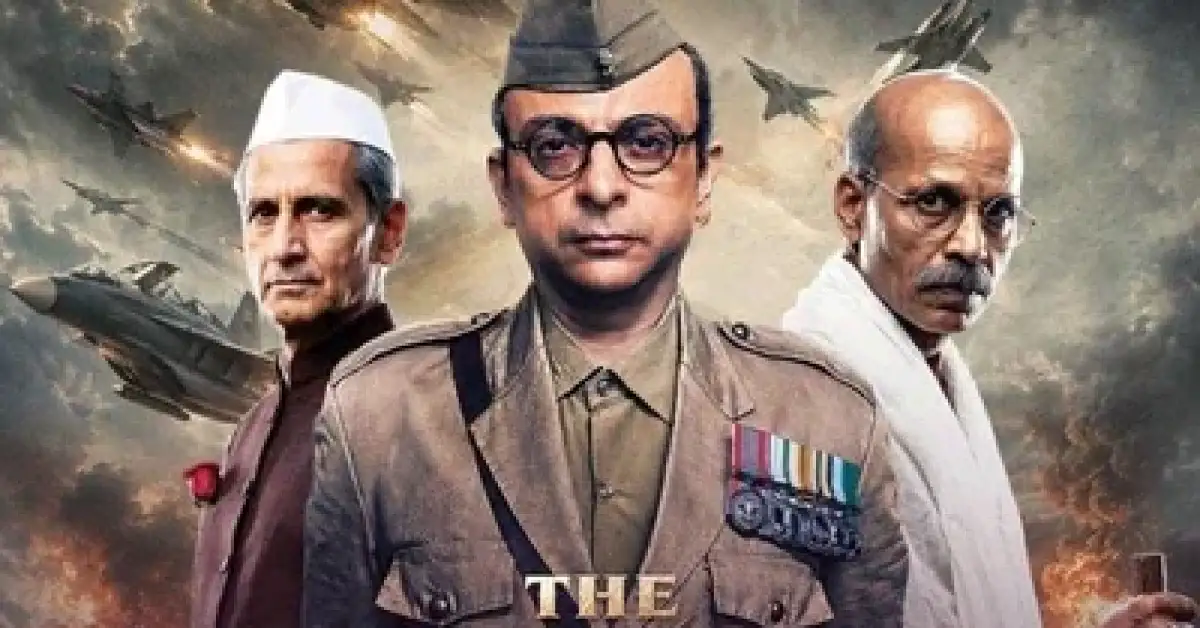

Historian and author Chandrachur Ghose has spent 22 years investigating the mysterious disappearance of Netaji Subhas Chandra Bose. His research now forms the backbone of a new microdrama series called The Bose Network. The series premiered on August 15 on the Story TV app. Ghose strongly believes that Netaji did not die in the 1945 plane crash in Taiwan. His theory challenges the official narrative that has been accepted for decades.
What Chandrachur Ghose’s Research Reveals About Netaji’s Death
Ghose and his colleague Anuj Dhar have worked tirelessly to uncover the truth about Netaji’s fate. Their efforts led to the declassification of more than 2,000 secret files by the Indian government. They also accessed declassified documents from international agencies like the CIA and MI5. Ghose says that many government documents still remain secret and have not been disclosed to the public.
According to Ghose, the widely accepted story of Bose dying in a plane crash may be a fabrication. He suggests that the crash was a smokescreen organized by the Japanese military. The goal was to help Bose escape to Russia. Ghose points out that the Japanese government announced the crash four days after it supposedly happened. This delay, he argues, allowed Bose to evade capture and continue his fight for India’s freedom from a safer location.
“Based on the study of these files, and not just from India, but we also got files declassified by the US’s CIA, from …”
Ghose theorizes that Bose returned to India in the early 1950s. He believes Netaji lived in India until his death in 1985. This theory connects to the legend of Gumnami Baba, a mysterious figure who lived in Faizabad. Many believe Gumnami Baba was actually Netaji living in secret. Ghose describes Gumnami Baba as someone who had given up political ambitions and worked quietly for India’s interests. He claims that Baba had a network of supporters and made important contributions during global conflicts like the Korean and Vietnam Wars.
The Bose Network: A Microdrama Based on Real Research
The Bose Network is a historical thriller that brings Netaji’s wartime journey to vertical screens. The series is set in the 1940s and follows Bose’s movements across different locations. It recreates important settings including Calcutta, Kabul, Berlin, and the interiors of two submarines. The show draws on archival material and documented accounts to reconstruct Bose’s journey.
The series has been written and directed by Lalit Marathe, who was one of the writers of the famous film Swades. Joy Sengupta plays the role of Netaji Subhas Chandra Bose. Sudip Sengupta handled the cinematography, and Jar Pictures is the executive producer. All episodes are available on the Story TV app in Hindi, Tamil, and Telugu.
How AI Technology Brought the 1940s to Life
The Bose Network is being called India’s first hybrid AI drama. The makers used an AI-integrated production pipeline to recreate the period settings. The technology helped bring 1940s Calcutta, Kabul, wartime Berlin, and submarines to the screen. According to Story TV, AI currently contributes to 50% of its production workflow. The company is targeting more than 1,000 AI-powered shows by the end of the fiscal year.
GSN Aditya, COO of Eloelo Group, spoke about the production approach:
“Microdrama is evolving into a premium storytelling format, defined by the quality and ambition of its stories.”“With The Bose Network, we are raising the bar across storytelling, talent, production and visual scale.”
Lalit Marathe said recreating the period required both research and imagination. He explained that a period film is not built on research alone but also on imagination. The production team worked to recreate a Calcutta that no living person remembers. Marathe said Story TV’s production approach allowed the team to recreate the 1940s across four countries while keeping the scale of a feature-film production.
Chandrachur Ghose’s Journey from Activist to Author
Ghose’s journey into Netaji’s mystery began long before his books. He grew up surrounded by stories about Netaji. His family had freedom fighters, and his interest in unraveling the mystery only grew stronger over time. In 2018, he left a two-decade-long career as an environmentalist and business strategy consultant to become a full-time author.
His first book, Conundrum: Subhas Bose’s Life After Death, was co-written with Anuj Dhar. The book examined the mystery surrounding Netaji’s death. Ghose also founded Mission Netaji, a group that campaigned for the declassification of documents related to Bose’s disappearance. His work has made him one of the most prominent researchers on Netaji Subhas Chandra Bose.
Ghose’s latest book, Many Shades of Saffron: Decoding 100 Years of RSS, was published in 2025. The book re-examines the Rashtriya Swayamsewak Sangh (RSS) without political labels. Ghose says he does not believe in political or social labels. He believes in presenting history through archives, parliamentary records, and facts.
Related:




The Controversy Surrounding Netaji’s Death Continues
The mystery of Netaji Subhas Chandra Bose’s death remains one of India’s longest-running political controversies. The official story says that Bose died in a plane crash in Taiwan on August 18, 1945. But Ghose cites new data to prove that no crash took place on that particular day. The Justice Mukherjee Commission has already established that Netaji did not die in the plane crash.
Ghose’s research suggests that the Japanese General Tsunamasa Shidei, who was reportedly on the same flight as Bose, was actually killed in a separate incident. This adds more weight to the theory that the crash story was a cover-up. Declassified files also reveal extensive snooping by the Nehru government, which Ghose says proves that the government too believed Netaji was alive.
Thank you for reading. For more such deep dives into history, entertainment, and the stories that shape our world, keep visiting VvipTimes.

















Leave a Reply