

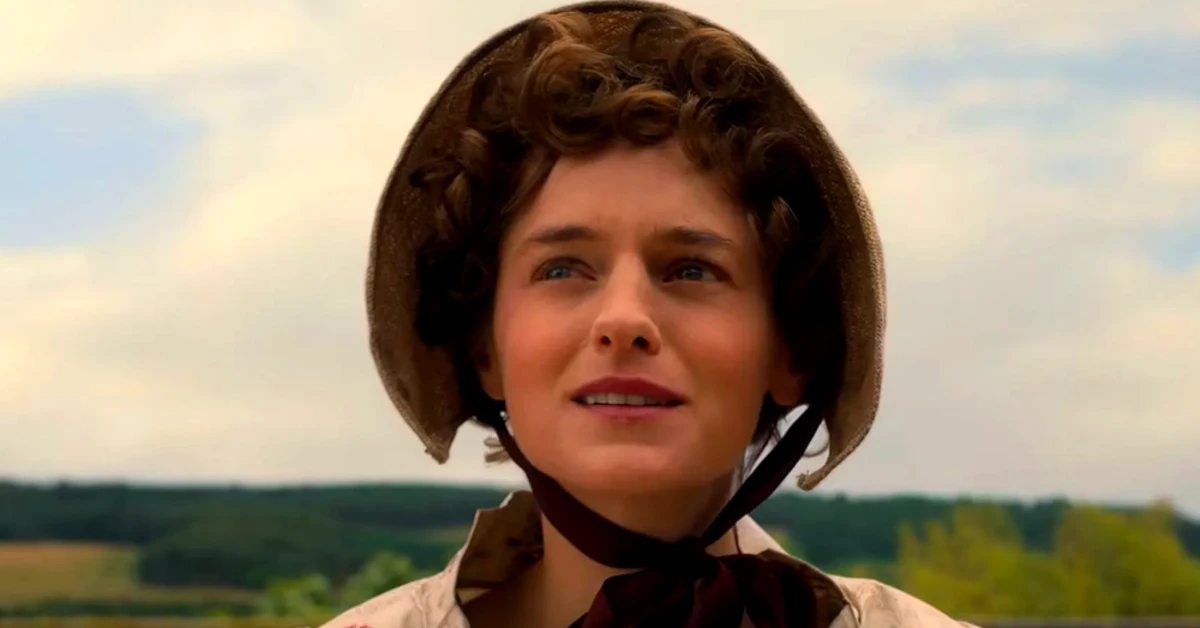

Netflix will release its six-part adaptation of Pride and Prejudice on December 3, 2026, with Emma Corrin as Elizabeth Bennet and Jack Lowden as Fitzwilliam Darcy. Dolly Alderton wrote and executive produced every episode. Euros Lyn directed the limited series. Netflix bills the project as a faithful take on Jane Austen’s 1813 novel. The first trailer already shows one deliberate departure that reframes the story’s economic logic.
Olivia Colman’s Mrs. Bennet speaks the novel’s most famous sentence in the trailer: “It is a truth universally acknowledged, that a single man in possession of a good fortune, must be in want of a wife”. In Austen’s text, the narrator owns that line. In several previous adaptations, Lizzie voices it. Alderton gives it to the mother. The move is an interpretive choice, not a plot rewrite.
That swap turns the marriage plot into Mrs. Bennet’s conscious worldview rather than an ironic authorial aside. The trailer also has Colman describe her daughter as a “strong-willed sort of girl”. That phrase signals the adaptation’s central tension. It wants Lizzie’s independence intact while acknowledging the market pressure that makes marriage urgent.
What the Six-Episode Format Changes for Austen’s Plot
Runtime is the structural advantage here. Joe Wright’s 2005 film compressed roughly 400 pages into 127 minutes. The 1995 BBC miniseries used six episodes and became the benchmark for novelistic detail. Netflix returns to that six-part shape. The format gives Alderton room to test whether faithfulness can be more than a marketing label.
Netflix’s own material says the longer format allows the writer to “dig deeper into some oft-overlooked plotlines and characters”. That claim is credible on paper. Pride and Prejudice contains several threads that films routinely trim: the Bingley sisters’ social maneuvering, Mary’s pedantry, the Lucas family’s pragmatism, and the economic desperation that sits beneath Mrs. Bennet’s matchmaking.
Lookout Point, a BBC Studios company, produces the series. Lisa Osborne produces. Laura Lankester, Will Johnston, and Louise Mutter executive produce for Lookout Point, alongside Alderton, Lyn, and Corrin. That corporate lineage matters. This is a British literary adaptation made inside a public-service production ecosystem, not a Shondaland-style reimagining.
Dolly Alderton’s Reluctant Commission and the Faithfulness Test
Alderton’s first response to the job was refusal. “I absolutely cannot do this. This is everyone’s favorite book. It’s too much responsibility,” she told Netflix’s Tudum. She accepted anyway and wrote all six episodes. Her background is memoir and fiction — Everything I Know About Love and Good Material — not heritage television. That outsider profile cuts both ways. She has no inherited loyalty to the BBC house style, but she also has no track record with Regency material.
Netflix’s marketing leans hard on the word “faithful.” That word carries weight because the streamer’s recent Austen-adjacent record is mixed. The 2022 Persuasion adaptation drew criticism for breaking the fourth wall and modernizing the dialogue. Fans who felt burned by that approach will read “faithful” as a corrective promise. The Mrs. Bennet line change complicates the promise without breaking it. Alderton explained that the line belongs to Mrs. Bennet because marriage is “all she’s thinking about”. That rationale reframes the character from comic obstacle to strategic parent.
Casting, Chemistry, and the 1995/2005 Shadow
Corrin is the first non-binary actor to play Elizabeth Bennet in a major adaptation. The casting drew both praise and backlash when it was announced in 2025. Some fans argued the role should go to a cisgender woman. Others called the choice a meaningful update to a character whose wit has always exceeded her era’s gender rules. The debate is unresolved, but it has kept the project in the search conversation for eighteen months.
Lowden faces a harder comparison. Colin Firth’s 1995 Darcy became a cultural shorthand for repressed desire. Matthew Macfadyen’s 2005 version added a wounded softness. Lowden’s trailer footage shows a brooding, restrained reading. The Daily Mail published insider claims that the series is “desperately sexless” with “zero chemistry” and no wet-shirt scene. Those claims are unverified and should be treated as pre-release gossip, not confirmed review intelligence. Still, the chemistry question is the right commercial question.
Pride and Prejudice lives or dies on the slow burn between Lizzie and Darcy. If six episodes cannot generate longing, textual fidelity will not save the series. Netflix knows this. The trailer’s final image — Lizzie at the piano, Darcy watching — is a direct appeal to the yearning audience that made Bridgerton a juggernaut.
The Business Case: Netflix’s Period Drama Pivot After Bridgerton
Netflix’s period drama strategy is not abstract. Bridgerton Season 4 drew roughly 100 million views in the first half of 2026. It ranked second among all Netflix releases in that window. Its premiere jumped 52% over Season 3 and hit No. 1 in 83 countries. The Regency audience is measurable, global, and repeatable.
Pride and Prejudice is a different product inside that market. Bridgerton is a Shondaland fantasy of color-conscious casting, string-quartet pop covers, and explicit desire. Austen is the prestige-faithful alternative. Netflix can serve both audiences without cannibalizing either. The company’s UK commissioning slate has expanded aggressively through 2026, with projects from Kate Winslet, Anya Taylor-Joy, Sarah Lancashire, and a Top Boy expansion. Pride and Prejudice sits at the literary prestige end of that slate.
The release date is strategic. December 3 places the series in the awards-adjacent holiday corridor. It also lands after the fall festival season, when attention returns to television. A six-part limited series is easier to market than an ongoing drama. It has a clear beginning, middle, and end. Subscribers can finish it in a weekend. That completion rate matters for Netflix’s engagement metrics.
A Crowded Austen Season and the 1995 Echo
2026 is an unusually heavy Austen year. A Sense and Sensibility film with Daisy Edgar-Jones arrived earlier this month. The BBC’s The Other Bennet Sister, focused on Mary Bennet, also premiered. Netflix’s Pride and Prejudice joins a market already saturated with Austen intellectual property.
The calendar echo is striking. In 1995, the BBC’s Pride and Prejudice and Ang Lee’s Sense and Sensibility arrived within months of each other. Both became canonical. The 1995 comparison is not just about quality. It is about a cultural moment when Austen adaptations felt urgent rather than habitual. Netflix is betting that 2026 can reproduce that urgency.
What Fans and Critics Are Saying Before December 3
Fan reaction splits along generational lines. Viewers raised on the 1995 miniseries treat it as untouchable. “Nothing can top this,” one X user wrote alongside a Keira Knightley gif. Others are open to a new reading. “Jack Lowden can sit on that pedestal alongside Matthew Macfadyen,” one fan posted. “Dolly is an amazing writer so I’m optimistic”.
Critics have focused on Corrin’s expression in the stills. Some argue Lizzie looks “sad and brooding” rather than witty and animated. That criticism may misunderstand how trailers work. A teaser selects for mood, not range. The full performance could be warmer than the marketing suggests. The more substantive concern is structural. A faithful adaptation must decide what to cut and what to compress. Alderton has promised deeper engagement with overlooked characters. If the series delivers on that, it will justify its existence beyond the casting headlines.
The Risk Assessment: Can Faithfulness Win the Algorithm?
Netflix’s algorithm rewards completion and rewatchability. Prestige faithfulness tends to produce lower initial sampling than star-driven fantasy. But it can produce stronger critical reception and longer-tail cultural authority. The 1995 miniseries became a perennial because it respected the novel’s texture. Netflix is trying to buy that kind of longevity.
The biggest risk is tonal. If the series is too reverent, it will feel like a museum piece. If it is too modern, it will alienate the purists. Alderton’s line reassignment suggests she understands the balance. Giving Mrs. Bennet the opening sentence is a small, smart choice. It honors the text while insisting that the adaptation has a point of view.
You May Also Like:








Pride and Prejudice premieres December 3 on Netflix. The series will be judged against two decades of comparison and one very famous wet shirt. Its best chance is not to out-sex the 1995 version or out-romanticize the 2005 film. Its best chance is to be the most novelistically complete Austen adaptation of its generation.
Also Read: PUBG Live-Action Series: Donald Glover to Star, Write, and Direct at Netflix
VVIPTimes will track the December 3 debut, the completion data, and whether faithfulness can still move the algorithm.




































Leave a Reply