

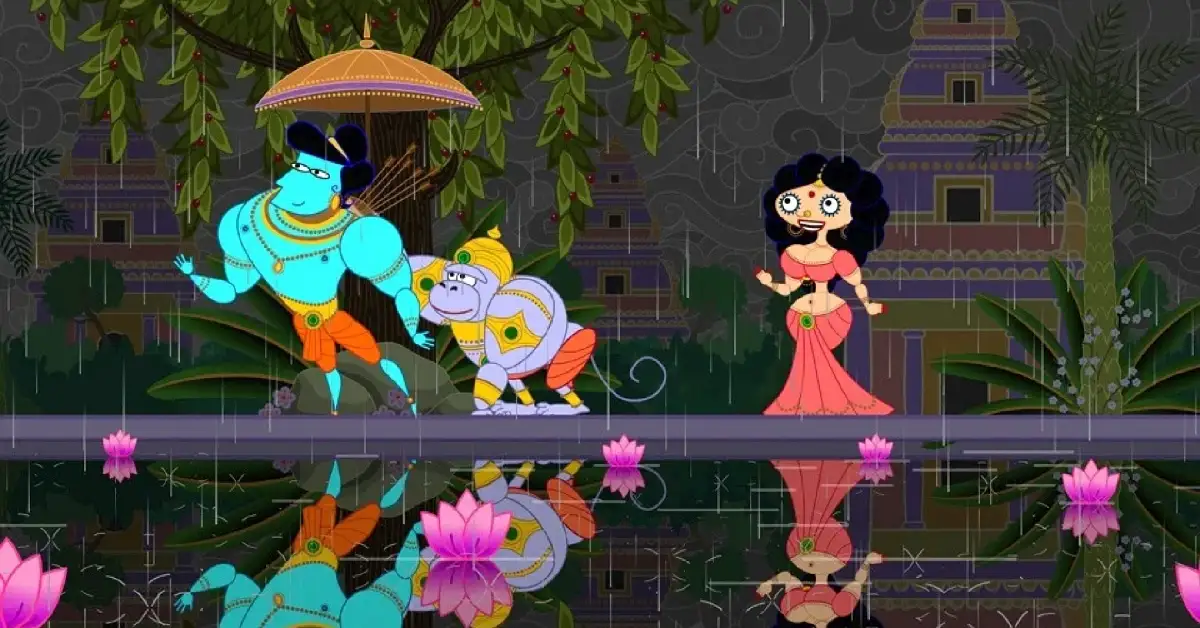
Every time a new Ramayana adaptation gets announced, people start comparing it to the classic versions they grew up watching. Ramanand Sagar’s television series and the Indo-Japanese anime Ramayana: The Legend of Prince Rama are often held as the gold standards. On the other hand, Om Raut’s Adipurush (2023) became a prime example of how not to adapt the epic, facing massive criticism for its dialogues, VFX, and character portrayals. But years before Adipurush even went into production, an American feminist animated film created an even bigger storm. The movie Sita Sings the Blues, directed by Nina Paley, arrived in 2008 and sparked protests, ban petitions, and cancellations that went beyond what Adipurush experienced.
What Is Sita Sings the Blues
American artist Nina Paley created Sita Sings the Blues as an animated musical inspired by her time in India. She called it “the greatest break-up story ever told”. The film presents a light-hearted and feminist retelling of the Ramayana. It uses a mix of vector graphics, traditional Indian shadow puppets, and flat 2D art inspired by Rajput and Pahari miniature paintings.
The movie weaves together scenes from the Ramayana with moments from Paley’s own life, drawing parallels between Sita’s story and a modern woman’s relationship struggles. All of this is set to 1920s jazz vocals by Annette Hanshaw. Paley described her work as “a tale of truth, justice and a woman’s cry for equal treatment”.
A limited number of DVD copies were printed, and in 2009, Paley made the film available for free download on the movie’s website. This strategy helped the film spread quickly across the internet at a time when going viral was not as common as it is today.
Critical Acclaim and Strong Ratings
Despite the controversy, Sita Sings the Blues received excellent reviews from critics. The film holds a 100% rating on Rotten Tomatoes and an 85% score on the Popcorn Meter. Reviewers praised its storytelling and the unique mixed-media animation style. The film’s popularity grew not just in India but across the world.
The Backlash and Ban Petitions
As the film gained more viewers, the backlash also grew stronger. In 2009, the Hindu Janajagruti Samiti launched a petition calling for a complete ban on the film. They described the movie as “derogatory” because of how it depicted Ram. The organization believed the film disrespected Hindu religious sentiments by showing Ram in a less-than-perfect light.
Unlike Adipurush, which faced criticism for poor execution, Sita Sings the Blues was attacked specifically for its feminist perspective. The film gave Sita a voice and showed her suffering in ways that most traditional adaptations had not done before. This was exactly what some viewers appreciated, but it was also the very reason others protested against it.
Protests and Canceled Screenings
In 2011, protests broke out at screenings of Sita Sings the Blues. Hindu outfits demonstrated outside the San Jose Museum of Art in California. Screenings were canceled at the Starlight Pavilion in New York and at Goa’s Art Chamber in India. The film was never officially banned in India, but the protests and cancellations showed how deeply it had upset certain groups.
Director’s Response to the Criticism
Nina Paley addressed the backlash in a 2010 interview with CWB. She said:
“For them, there is only one true story, and that is the TV series from the 80’s. If it is not from the TV show, then it is wrong. As far as they are concerned, that is the true one, and they need not bother with any other translation.”
Her words highlighted the strong attachment many Indians had to Ramanand Sagar’s television adaptation, which they viewed as the definitive version of the epic.
You May Also Like:
![Battle Spirits [Re] Zekkai No Ku Episode 1 Worldwide Release: Exact Streaming Times for USA, UK, India, Australia, and More](https://vviptimes.com/wp-content/uploads/2026/10/image-48.webp "image 48")




Why the Controversy Surpassed Adipurush
While Adipurush faced widespread criticism for its dialogues, VFX, and costume choices, the controversy around Sita Sings the Blues was different in nature. Adipurush was criticized for poor quality and lack of respect for the source material. The feminist animated film, however, challenged the very structure of the story by focusing on Sita’s pain and showing Ram as a flawed character.
Many viewers felt uncomfortable with a version of the Ramayana where Sita was not just a passive figure but a woman with her own voice and emotions. The film’s portrayal of Ram as someone who causes Sita suffering went against the traditional image of the ideal husband and king. This kind of storytelling touched a nerve that went beyond cinematic quality and entered the realm of cultural and religious identity.
Availability and Lasting Impact
Despite all the protests and calls for a ban, Sita Sings the Blues remains available to watch. The film can be found on YouTube for free. Paley’s decision to make it freely downloadable helped the film survive the attempts to suppress it.
The movie continues to invite discussion and debate. Even after Paley faced cancellation in 2017 over her views on transgender individuals, Sita Sings the Blues remained a significant work in the conversation about feminist retellings of mythology.
The Film’s Place in Ramayana Adaptations
Whenever a new Ramayana project is announced, comparisons are inevitable. Nitesh Tiwari’s upcoming Ramayana film, starring Ranbir Kapoor as Ram and Sai Pallavi as Sita, has already generated conversations about casting and visual effects. The makers recently faced criticism over costume designs, with designers Rimple and Harpreet Narula defending their creative choices.
But the controversy surrounding Sita Sings the Blues shows that debates about Ramayana adaptations are not new. The feminist animated film from 2008 proved that presenting a different perspective on a beloved epic can create waves that last for years. It challenged audiences to think about Sita not just as a symbol of virtue, but as a woman with her own story of heartbreak and struggle.
For more entertainment news and deep dives into the stories behind your favorite films and series, keep reading VvipTimes. We bring you the latest updates and thoughtful analysis from the world of cinema and pop culture.


Leave a Reply