

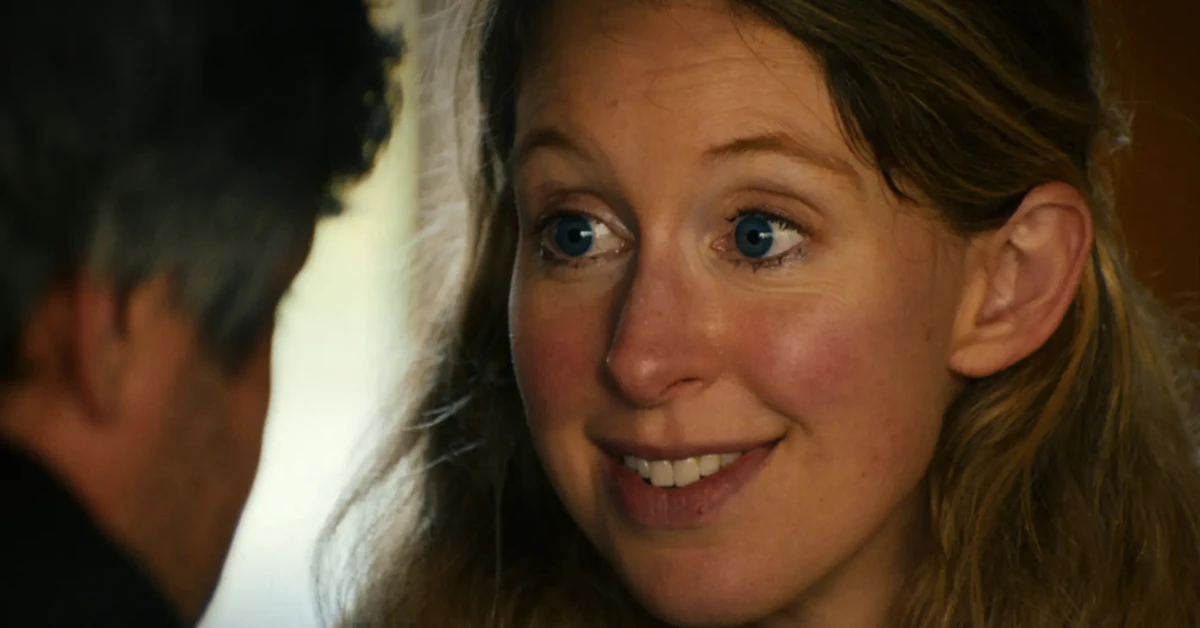

A24’s documentary You Can See Everything has officially become the highest-rated feature film of all time on Letterboxd with an average score of 4.8 out of 5. The 174-minute film, directed by Nathan Fielder and Lance Oppenheim, follows disgraced Theranos founder Elizabeth Holmes in the days before she began her prison sentence. It released in US theaters on October 16, 2026, and crossed the previous record held by the 1962 Japanese film Harakiri (4.7) in less than 24 hours.
The record is not just a Letterboxd story. The film holds a 99% critics’ score on Rotten Tomatoes, a 99% audience score, a 98 out of 100 on Metacritic, and a 9.3 on IMDb — a score tied with The Shawshank Redemption at the top of IMDb’s all-time rankings, though documentaries are not included in the site’s official Top 250 list.
Letterboxd Record and the Films It Surpassed
You Can See Everything climbed past several long-standing favorites to take the top spot. The films it now sits above include Harakiri (4.7), The Human Condition III: A Soldier’s Prayer (4.7), 12 Angry Men (4.6), and Come and See (4.6). The 4.8 score is described by Letterboxd as a weighted average, meaning it is not a simple count of star ratings but a figure shaped by user activity and review depth.
A fan reaction shared on X captured the mood around the score.
“A 4.8 on Letterboxd is actually insane; that doesn’t happen unless it really hits something real”
The platform’s official Top 250 list excludes documentaries, which is why Harakiri still sits at the top of that specific ranking. The 4.8 figure reflects the film’s early reception across all feature-length releases, and Letterboxd ratings can shift as more viewers log and score the film.
What the Film Actually Shows
You Can See Everything began as a simple project. Elizabeth Holmes and her partner Billy Evans invited a film crew into their rented home in Del Mar, California, about 34 days before Holmes was due to report to federal prison to serve an 11-year sentence for conspiracy and fraud.
Holmes wanted to tell her side of the story. She believed the journalists and shows like The Dropout had gotten her wrong. The person she and Evans chose to document that story was Nathan Fielder, a comedian known for Nathan for You and The Rehearsal, shows that blur the line between reality and performance.
What follows is not a standard interview documentary. Fielder becomes part of the film, appearing on camera and staying with the family for part of the shoot. The film moves between intimate family moments, direct conversations about the fraud case, and creative choices that critics have described as “genre-defying” and “performance art”.
CNN’s review noted that the film includes scenes of Holmes having her likeness scanned more than 200 times so she can be reproduced through video and artificial intelligence while in prison. The review called the project “a bold, perhaps impossible, quest for truth” and said it “absolutely lives up to the hype”.
Box Office and Budget Numbers
The opening weekend numbers back up the online response. You Can See Everything grossed $15 million from just 855 theaters across the United States and Canada. That averages out to roughly $17,544 per screen, one of the strongest per-theater averages of the year.
The $15 million opening is the second-best debut ever for a documentary and the largest documentary opening in 13 years. A24 reported more than 2,000 sellout showings across the weekend.
The film was made for under $7 million and marketed for less than $10 million, according to reports. That means the opening weekend alone covered both the production and marketing costs.
Cast, Directors and Production Background
Nathan Fielder and Lance Oppenheim directed the film together. Oppenheim’s previous work includes Some Kind of Heaven and the Robert Pattinson-led Primetime. Fielder is credited as both director and on-screen participant. Elizabeth Holmes and Billy Evans appear as themselves, alongside their two young children.
A24 released the film. The project was kept secret until a surprise trailer dropped in September 2026, just weeks before release. The film had its first screening as a secret showing at the 53rd Telluride Film Festival on September 6, 2026.
The film carries an R rating from the Motion Picture Association for “language and some graphic nudity”. The 174-minute runtime places it close to three hours, but multiple reviews noted that the length does not feel slow.
Release Dates for the US UK Canada Australia and India
US and Canada: Released in theaters on October 16, 2026, through A24.
United Kingdom and Ireland: Scheduled for November 20, 2026.
Australia and New Zealand: Scheduled for November 12, 2026.
India: No theatrical distribution has been announced. The Hindu reported that there is currently no release planned for India.
Other international markets: A24 has scheduled releases in Poland, Portugal, Serbia, and the Czech Republic, with dates to be confirmed by local distributors.
How Critics and Fans Are Reacting
Reviews have been strong across major outlets. The New York Times called the film “intimate and analytic, informative and incomplete” and “off-the-charts bonkers”. The Village Voice described it as “mendaciously tantalizing” and said it “devolves into metafictional sludge”, showing that not every critic sees the film the same way.
The Associated Press wrote that the film “defies categorization” and is “wildly entertaining, confounding and wholly unique”. SlashFilm called it “a mystifying masterwork of mind-melting manipulation”.
Fan reactions on X were just as intense. Many viewers described leaving the theater unsure of what they had just watched, in a way that matched the film’s blurred line between truth and performance.
“It starts as one thing before evolving into something that literally took my breath away. My lips are sealed, but you’re not prepared”
You May Also Like:


View all articles about
The Surprise Trailer and the Meme Before Release
The film’s marketing started with a surprise trailer in September 2026. The clip spread quickly on X and Instagram, and a frame of Holmes staring wide-eyed with a half-smile became a reaction image. Fans paired the image with captions, and the phrase “Why Would I Deceive You” became a meme before the film even opened.
That early online attention carried into the opening weekend. The combination of Fielder’s reputation for unsettling, reality-bending comedy and Holmes’s notoriety as a convicted fraudster gave the film a reach that most documentaries do not get. The $15 million opening and the 4.8 Letterboxd score both reflect that reach.
For more film records, box office numbers, and release updates, stay with VvipTimes.

















Leave a Reply