

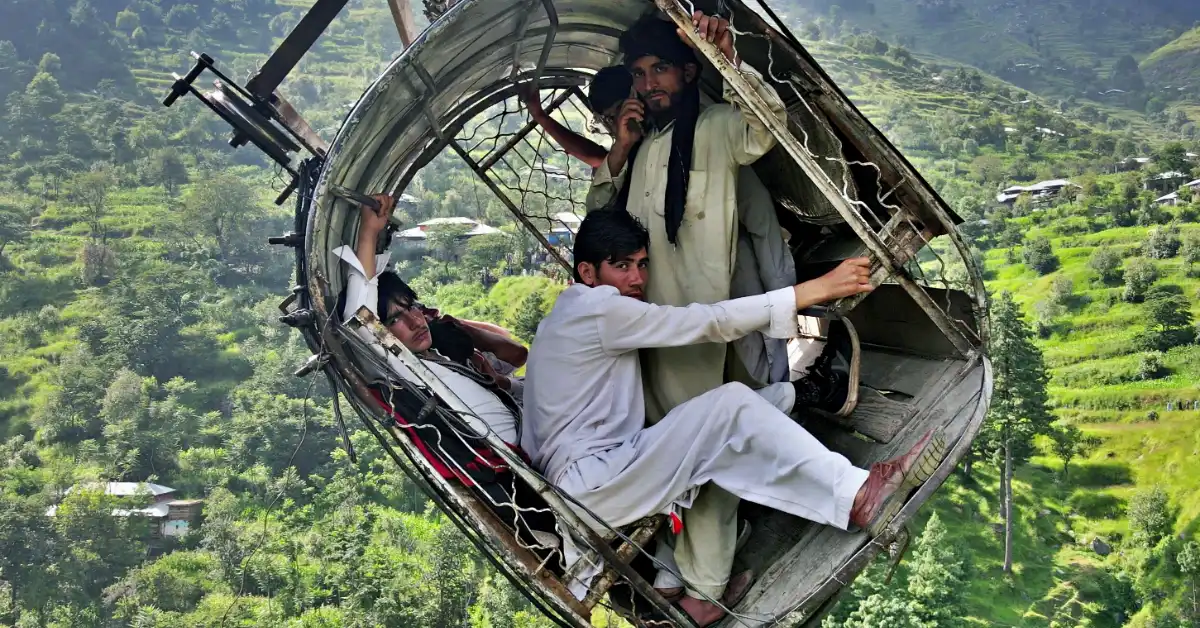

The cable car had a nickname. Locals in Allai, a mountain pocket of Pakistan’s Khyber Pakhtunkhwa province, called it Dolly. It linked the village of Jangri to Batangi, where the school sits. The ride took four minutes. The walk took two hours. That arithmetic is why Dolly existed, and why, on the morning of August 22, 2023, six schoolboys and two adults climbed into a refurbished sheet-metal carriage suspended over a ravine.
Two of the car’s three cables snapped. The carriage tilted onto its side. It hung roughly 900 feet above the ground, close enough to the canyon wall that the passengers could see the rock, far enough that the drop was not survivable. What followed was a rescue that unfolded live on television, on drone feeds, and on the phones of hundreds of people standing on the valley floor. Army helicopters arrived first. A Special Services Group sling team attempted to lower ropes from the air. The downdraft destabilised the car, and the operation shifted to a zip line rigged by local volunteers. A wire repairman named Sahib Khan climbed onto the cable itself. One by one, the passengers came down. The ordeal lasted about 14 hours. All eight survived.
Mohammed Ali Naqvi’s documentary Hanging by a Wire reconstructs that day with an archive that did not exist for most rescue stories. Drone operators captured close-ups of the passengers’ faces. Bystanders filmed from below. Television crews broadcast the attempts in real time. Naqvi and his co-writer and producer Bilal Sami built the film from that footage, survivor testimony, and staged reenactments performed by people who took part in the rescue. It runs 77 minutes. It premiered at the Sundance Film Festival on August 28, 2026, in the World Cinema Documentary Competition, and it begins streaming on Paramount+ on October 28.
It is also Pakistan’s submission for the international feature Oscar at the 99th Academy Awards—the first documentary the country has ever sent to that category. The Pakistan Academy Selection Committee announced the pick on October 3, with deputy chair Sana Zahra Jafri calling it a historic milestone for Pakistani documentary filmmaking. Pakistan has submitted 13 films in the category since 1959 without a nomination; Saim Sadiq’s Joyland was its only shortlist appearance, in 2022. The Oscar selection gives Hanging by a Wire a cultural weight that few streaming documentaries carry. It also makes the film’s omissions harder to ignore.
Naqvi told Variety he wanted to make a “full-on, Hollywood-style action thriller,” and to show the people of Battagram as “resilient, as having agency,” not as victims. That instinct is understandable. Too many films about rural Pakistan arrive pre-loaded with pity. Naqvi’s reframing gives the rescue its proper cast of heroes: Khan, the local repairman Naqvi calls a “sky pirate”; Ali Swati, a gymnast and zipline operator; Sonia Shamroz, a police officer who helped coordinate the response. The reenactments, performed by the rescuers themselves, add a layer of embodied memory that archival footage alone cannot supply.
The craft has been widely praised. The Guardian called the film “tense, skilfully assembled,” singling out drone shots that “zoom close on the terrified faces of those trapped inside the dangling car.” The Hollywood Reporter praised the “stomach-plunging” footage and the landscape that makes the passengers look like “tiny figures suspended precariously amid the unforgiving majesty of the world.” But the same review drew a harder conclusion:
“A great rescue story, not very well told.”
That verdict echoes across the film’s critical reception. IndieWire called it “taut but frustratingly anemic,” too afraid of losing the audience’s attention to sit with the uncomfortable material. POV Magazine said the documentary leaves “many questions and the broader context” dangling. The Guardian noted that the film does not investigate “the safety failures that allowed all this to happen.” These are not quibbles about pacing. They point to a structural choice: Hanging by a Wire treats the incident as an action set piece, and in doing so, it largely skips the question of why the cable car was running at all.
The answer is not mysterious. Allai has no proper roads. For years, residents have relied on makeshift cable cars to cross the canyon. Dolly turned a two-hour walk to school into a four-minute ride. Police told the BBC they inspected the lift every month; the BBC said it could not independently verify that claim. After the rescue, Pakistan’s then-president, Arif Alvi, called for a comprehensive survey of all cable cars in the country. Former prime minister Shehbaz Sharif called for urgent inspections and repairs. Whether those calls produced an enforceable safety regime is a question the film does not ask, and public reporting since 2023 has not supplied a clear answer.
What the film does capture, almost by accident, is the class collision inside the rescue itself. Local volunteers, working with cheap rope and intimate knowledge of the terrain, reached the cable car before the military’s more deliberative operation could. Crowds on the ground shouted instructions and insults. One local rescuer clambered onto the wire while the passengers inside yelled at him to stop putting more strain on the last cable. The film records that tension without fully examining it. The result is a documentary that shows heroism without indicting the conditions that made heroism necessary.
There is a media story here too, and Naqvi knows it. He described the incident to Variety as one of the first rescue operations to unfold as a social media phenomenon, with drone footage, television cameras, and bystander clips drawing global attention and, arguably, pressuring authorities to mobilise. IndieWire put the sharper question: would anyone have cared as much about the outcome if a local drone operator had not been there to capture it in jarring close-up? The film does not answer that either. It benefits from the same spectacle it declines to interrogate.
You May Also Like





View all articles about
None of this makes Hanging by a Wire a bad film. It makes it a revealing one. Pakistan’s Oscar submission is a documentary about a rescue that is reluctant to name the failure the rescue was responding to. The rescuers deserve the spotlight. So do the parents who put their children on that cable car every morning because the alternative was a two-hour walk. The film gives the first group their due. The second group is still waiting.
Also Read: Avengers: Doomsday Betrayal: Fans Are Convinced Doctor Strange Sides With Doom
Hanging by a Wire arrives on Paramount+ on October 28—and the question it leaves hanging is whether the next Dolly will be inspected before it snaps, or after.





































Leave a Reply