



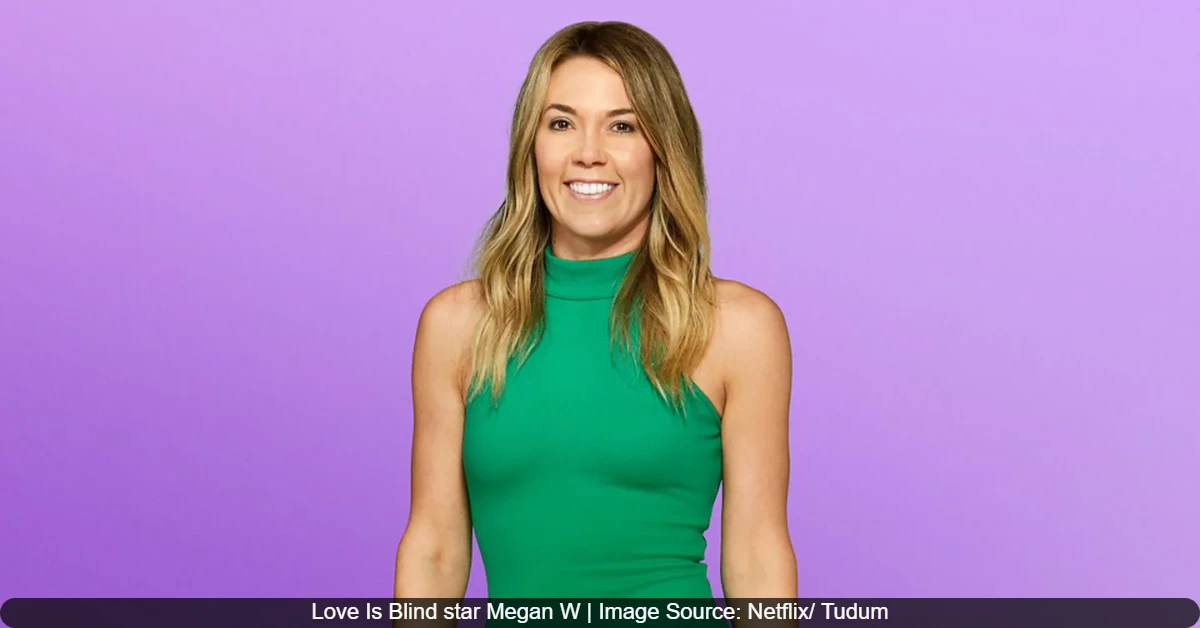
Aneha Singh walked into the Love Is Blind pods as one of the most financially secure singles in the franchise’s history. By the time she left Episode 9, she had articulated a demand that has split the show’s audience and exposed a structural tension Netflix has spent years avoiding on camera: she wants a man who can take care of her financially, and she is unwilling to accept a partner who cannot match that expectation.
The 28-year-old principal engineer in biotech earns an estimated $150,000 to $153,616 a year, roughly $77,000 to $79,753 more than her fiancé, Cam Halloran, a 29-year-old HR generalist earning around $73,000 to $73,863. Their combined household income of more than $227,000 makes them the wealthiest couple in Love Is Blind Season 11, which premiered on Netflix on October 14, 2026, and follows singles from the Boston metro area. Yet the money conversation that unfolded between them became the season’s defining flashpoint, not because Aneha lacks resources, but because she wants a specific kind of financial dynamic inside her marriage.
The disagreement crystallised around rent. When the couple discussed their post-show housing budget, Cam told Aneha he could contribute a maximum of $1,200 toward their monthly rent. Aneha said the number made her emotional. “I do want my man to lead,” she said in a statement to Netflix’s Tudum. “With that being said, I want to have a bomb-a*s career. I remember telling him, ‘That would mean I would have to put up more money than $1,200.’ And he said, ‘Well, the max I’m putting up is $1,200.’ That made me emotional. I want someone who is able to provide for me instead of me always having to”.
Cam’s position was equally clear. He said he felt stuck in their money conversations because he could not double his salary overnight. Even if he received $200,000 the next day, he told Tudum, he would still prefer to live in the same place. The impasse is not about poverty or recklessness. It is about two people with different definitions of what a partnership should cost.
The Salary Gap Nobody on Love Is Blind Signed Up to Discuss
Love Is Blind has always cast professionals. Seasons have featured lawyers, engineers, consultants, and entrepreneurs. But the show’s editing traditionally foregrounds emotional compatibility, family approval, and physical attraction, leaving income disparity to surface only when couples collide over living arrangements or wedding budgets.
Season 11 has inverted that hierarchy. Aneha’s salary is not a footnote to her storyline; it is the engine of it. She is the higher earner by a margin that would make her the primary breadwinner in most two-income American households, yet she is asking her lower-earning partner to assume the role of primary financial provider. That contradiction is precisely what has made the storyline resonate beyond the show’s usual audience.
The numbers are stark when placed against the rest of the Boston cast. Aneha and Cam’s combined earnings of $227,479 top the season. Michaella Giorgio, a retail consultant, earns an estimated $36,850, while her fiancé Rob Feeley works in AI infrastructure sales with a base salary of roughly $165,000 before commission, a gap of $128,150. Sarah Williams and John Shannon are the most evenly matched couple, with a $15,110 difference between a healthcare program manager’s $85,500 and an account executive’s $70,390 before commission. Aneha and Cam sit in the middle of the gap spectrum, but their earnings are high enough that the $1,200 rent ceiling reads less as a survival constraint and more as a philosophical limit Cam has set for himself.
That distinction matters for how audiences interpret the conflict. Cam is not refusing to contribute. He is refusing to contribute beyond a figure he considers sustainable for his income and lifestyle. Aneha is not demanding luxury. She is demanding a signal that her partner is willing to stretch beyond his comfort zone to carry a share she considers appropriate for a man in a traditional provider role. Neither position is irrational. They are simply incompatible without a negotiated third option, which the show has not yet provided.
Why the $1,200 Rent Cap Became the Season’s Flashpoint
The rent figure functions as a proxy for a larger question: what does financial leadership look like when the woman out-earns the man? Aneha framed her desire in explicitly traditional terms. “I just envision being taken care of,” she said during the episode, acknowledging that the mindset can be traditional but adding that it is comforting to know someone has you. She also made clear that she does not need a partner to make her financial decisions, and that she brings other things to a relationship. But on the specific topic of money, she wants her partner to be the main person responsible.
Cam countered with a model of partnership in which both people work and both people have each other’s backs, citing his parents as the example. His willingness to pay $1,200 was not a rejection of Aneha’s career or ambition. It was a statement about the kind of financial life he believed he could honestly sustain. The conflict, as both described it to Tudum, came from the gap between honesty and expectation rather than from any hidden financial secret.
For viewers, the $1,200 number became a concrete anchor for a debate that usually stays abstract. It is easy to argue about whether men should provide in theory. It is harder to argue about whether $1,200 is a reasonable rent contribution in the Boston housing market, where median one-bedroom rents routinely exceed $2,500. The figure forced the audience to confront the arithmetic of Aneha’s request: if Cam caps his contribution at $1,200, Aneha must either accept a lower standard of living, cover the difference herself, or walk away. None of those outcomes satisfies her stated preference for a partner who leads financially.

The Backstory: How Love Is Blind Casting Created This Collision
Aneha’s storyline did not emerge from nowhere. Love Is Blind is produced by Kinetic Content, the company behind Married at First Sight, and the show’s casting process is designed to produce emotionally open participants, not financially compatible ones. Kinetic vets applicants through online applications, background checks, and psychological evaluations, but the show has never publicly disclosed a financial compatibility screening. Contestants are cast for their willingness to marry a stranger sight unseen, not for their alignment on household budgeting.
The show’s pay structure adds another layer of irony to the on-screen money disputes. Cast members receive $5,000 for their ten days in the pods, another $2,500 if they get engaged and go on the post-pod vacation, $3,000 for the month of post-pod filming, $1,000 for the wedding, and $1,500 for the reunion, for a maximum total of $13,000 if they make it through the entire process. Netflix does not comment on these figures, and they are based on reporting from cast members rather than confirmed contracts. But the broader point stands: the show pays contestants a stipend that is meaningful for the time commitment yet nowhere near enough to reshape their actual financial lives. Aneha’s salary and Cam’s salary are the numbers that will govern their marriage, not the Netflix cheque.
Kinetic Content has also faced sustained legal scrutiny over its labour practices. A former contestant filed a class action alleging unpaid wages and inhumane working conditions, and Netflix settled a separate $1.4 million claim over unpaid wages in December 2024. These cases do not directly involve Aneha or Cam, but they establish a context in which the show’s financial relationships with its cast are already under a microscope. When a participant like Aneha talks about money on camera, she is doing so inside a production ecosystem that has its own unresolved financial practices.
Fan Reaction: The Split Over What Aneha Is Actually Asking For
The public response to Aneha’s comments has been sharply divided, and the divide does not map neatly onto gender or geography. One camp reads her as honest about a preference many women share but rarely articulate on national television: the desire to be with a partner who can provide, even when she can provide for herself. The other camp reads her as contradictory, asking for traditional provision while holding a salary that makes the request feel like a test rather than a need.
On TikTok, one widely shared reaction described Aneha as “mad annoying” and accused her of looking for reasons to complain about Cam. A NewsBreak opinion piece argued that her latest comments suggested she might be looking to break up with Cam and that the financial storyline was a pretext rather than a genuine obstacle. Conversely, other viewers defended her right to state a preference clearly before marriage rather than discover the mismatch after the wedding. A podcast episode covering Episodes 3 through 5 framed the season’s central question as whether the men of Love Is Blind: Boston are actually ready for marriage, implicitly placing Cam’s $1,200 ceiling inside a larger pattern of male ambivalence about commitment.
The split matters for Netflix because the debate has extended beyond the show’s usual recap ecosystem into general financial and relationship commentary. Aneha’s salary has become a data point in a broader cultural argument about high-earning women and the men they marry. Her request is not unusual in survey research on relationship preferences, but the show’s format makes the negotiation visible in a way that a private couple’s conversation never would be. Cam’s willingness to say “I can’t double my salary overnight” on camera has been read by some viewers as refreshingly honest and by others as evidence that he does not share Aneha’s ambition.
The Industry Analysis: Why Netflix Needs This Conflict to Stay Legible
Love Is Blind is one of Netflix’s most durable reality franchises, with ten previous seasons and international adaptations spanning Brazil, Japan, Sweden, the United Kingdom, Germany, Argentina, Mexico, France, the United Arab Emirates, Italy, and Poland. All of its U.S. seasons have ranked in the Netflix global Top 10, and Season 11 has already amassed 17.1 million viewing hours and 3.6 million completed views in its first week on the platform. The show is not a niche experiment. It is a mass-audience property that functions as a weekly conversation generator, and the Aneha-Cam money conflict has given that conversation a sharper edge than the usual “are they going to say I do” suspense.
The business logic of the show depends on casting people who are articulate about their desires and willing to voice them under pressure. Aneha fits that model perfectly. She is specific, she is emotional, and she is willing to say the quiet part of a traditional provider fantasy out loud on a streaming platform that reaches millions of subscribers. The risk for Netflix is not that the conflict alienates viewers. The risk is that the conflict becomes so specific to one couple’s income bracket that it loses the universal resonance the show needs to sustain weekly viewership across a twelve-episode season.
The show’s answer to that risk has been to surround the Aneha-Cam storyline with a wider set of class and compatibility tensions. Michaella and Rob’s $128,150 salary gap, Wilnie and Wilson’s $50,839 gap, and Erika and Blake’s $48,522 gap collectively establish Season 11 as the franchise’s most economically self-aware installment. Boston, with its high cost of living and stark neighbourhood income disparities, provides a backdrop that makes these conversations unavoidable. The show did not set out to become a documentary about American income inequality. But by casting professionals across a wide earnings spectrum and then asking them to plan weddings and apartments on camera, it has accidentally produced one.
Related Stories








View all articles about
What Happens When the Cameras Stop and the Lease Begins
Aneha and Cam are still engaged as of the season’s current episode batch, and Netflix’s Tudum coverage describes them as a couple navigating the aftermath of their pod connection rather than a couple on the verge of collapse. Aneha has defended the relationship publicly, telling Tudum that she can be “a little bit sassy” and that she says things she does not always mean, but that she genuinely wanted someone who understood her. Cam has said he was drawn to her energy and that rewatching the show made their dynamic look worse than it felt to him in the moment.
The unresolved question is not whether Aneha and Cam love each other. The show has provided enough evidence that they do. The unresolved question is whether their definitions of financial partnership can be reconciled before a lease is signed and a wedding date is set. Aneha wants a man who leads with provision. Cam wants a partnership in which both people contribute according to their capacity. Those two visions can coexist, but only if one of them changes, and the show has not yet revealed which one will move first.
You May Also Like:




View all articles about
For Netflix, the larger takeaway is that money is now a first-order reality TV subject, not a background detail. Viewers who once tuned in for the pods and the reveals are now arguing about rent ceilings, salary gaps, and what it means to be a provider in a relationship where the woman earns more. That argument is good for engagement. It is also a signal that the next season’s casting team will need to think harder about financial compatibility than any previous iteration of the franchise has been asked to. Love Is Blind can survive a bad match. It cannot survive a mismatch that the audience believes should have been caught before the pods opened.
Also Read: Love Is Blind: Michaella Says She “Cannot Marry” Rob After His Aggressive Outbursts
For VVIPTimes, the Aneha-Cam money conflict is not a footnote to a dating show. It is a live case study in how American households negotiate power, provision, and pride when the numbers on the paycheque do not match the scripts people carry into marriage.






























Leave a Reply