

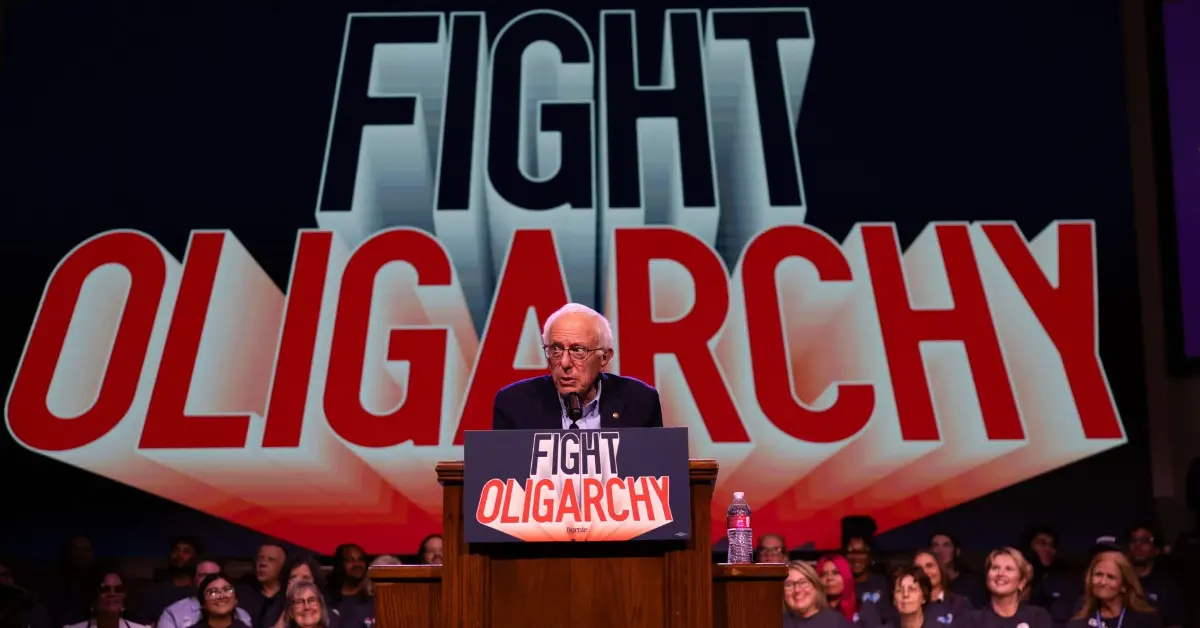

Bernie Sanders stood on a stage in El Paso, Texas, on October 13 and delivered a line that was built for the algorithm. “Greed is not good,” he said at the Abraham Chavez Theatre, midway through a stop on his Fighting Oligarchy Tour. “Love and compassion is good. Empathy is good. But billionaires with more money than they can spend in a thousand lifetimes, who say, ‘I need more and more and more, and I don’t care what happens to ordinary people.’ We have got to take that on full steam ahead.”
The clip spread quickly. By October 20 it was circulating on X, and by the following week conservative outlets had picked it up as fresh evidence of what they call Sanders’ inverted moral universe. Ben Shapiro, the Daily Wire co-founder and one of the most listened-to conservative voices in the country, did not let it pass. His response, delivered across his show and social channels, cut to the core of a argument he has been making against Sanders for more than a decade: that the senator from Vermont has greed exactly backwards.
Shapiro’s case is not complicated. He argues that Sanders consistently conflates self-interest—the voluntary pursuit of profit by creating value for others—with greed, which Shapiro defines as the desire to take what someone else has earned. It is a framing he has used repeatedly against Sanders, most memorably in a 2020 column that accused the Democratic Party of treating wealth itself as an indicator of immorality. “Never mind that creating tens of billions of dollars in value via voluntary exchange, employing tens of thousands of people, and providing goods and services to millions is far less indicative of greed than living as a taxpayer-funded…” Shapiro wrote at the time, leaving the sentence to finish itself.
The same logic underpins his current pushback. Shapiro has often cited the economist Thomas Sowell’s formulation—that he has never understood why it is “greed” to want to keep the money you have earned but not greed to want to take somebody else’s money. For Shapiro, Sanders’ El Paso speech is a textbook example of that inversion: a demand that the state confiscate private wealth, dressed up as compassion.
The timing matters. Sanders is not making a abstract philosophical point. He is in the middle of a midterm push that frames November as a referendum on concentrated wealth. He has endorsed more than 80 candidates, campaigned for a 5% billionaire wealth tax in California, and argued that a small group of extremely rich people holds too much power while working families struggle with health care, education, and housing costs. The numbers he cites are real: Forbes’ 2026 list counted a record 989 billionaires in the United States, with combined wealth of $8.4 trillion. In 1990, the Forbes 400 included just 66 billionaires.
But Shapiro’s counterargument is also structural. He has long contended that Sanders’ wealth-tax proposals are not merely economically unworkable but morally incoherent—that they punish the very mechanism that produces the goods and services Sanders promises to protect. On his show and in his Daily Wire commentary, Shapiro has described Sanders as a “lifelong redistributionist leech” and argued that the senator’s own financial success, including multiple properties and book royalties, exposes a hypocrisy at the heart of his critique. The personal jab is familiar. In June, Shapiro posted on X that Sanders was a “redistributionist leech who still uses a dial-up modem,” urging followers to “seize the means of production along with Bernie”. The tone is vintage Shapiro: rapid-fire, combative, and designed to frame the debate as a choice between free enterprise and command economics.
You May Also Like:







What makes this latest round more than a cable-news food fight is the broader realignment Sanders is trying to engineer. His Fighting Oligarchy Tour, launched in early 2025, has become a vehicle for channeling populist anger on the left away from culture-war skirmishes and toward class and wealth. He has argued explicitly that Democrats lose when they “tinker around the edges” and that the party must offer a sharp break with the billionaire class. Shapiro’s response is calibrated to that strategy. By framing Sanders’ moral language as a cover for confiscation, he is trying to deny the left the ethical high ground it has claimed since the 2008 financial crisis—and to reposition capitalism as the system that actually delivers compassion through innovation and abundance.
Neither man is a neutral observer. Sanders has spent his career building a brand around the greed of the billionaire class, and Shapiro has spent his building a media empire around the defense of free markets and the exposure of what he sees as left-wing pieties. Their collision over a single sentence in El Paso is not an accident. It is a proxy fight over the language of morality in American politics—who gets to define greed, who gets to claim compassion, and which economic system can plausibly promise a better life for ordinary people.
For now, the clip keeps circulating, and the arguments keep hardening. Sanders will keep saying greed is the problem. Shapiro will keep saying the cure is worse than the disease. And the voters who will decide the midterms will have to choose which definition they believe.
Also Read: Elke Sommer, Golden Globe Winner and ‘A Shot in the Dark’ Star, Dies at 85
this is the kind of fight that defines an election year: two practiced communicators, one loaded word, and a country still arguing over what greed actually means.



































Leave a Reply