

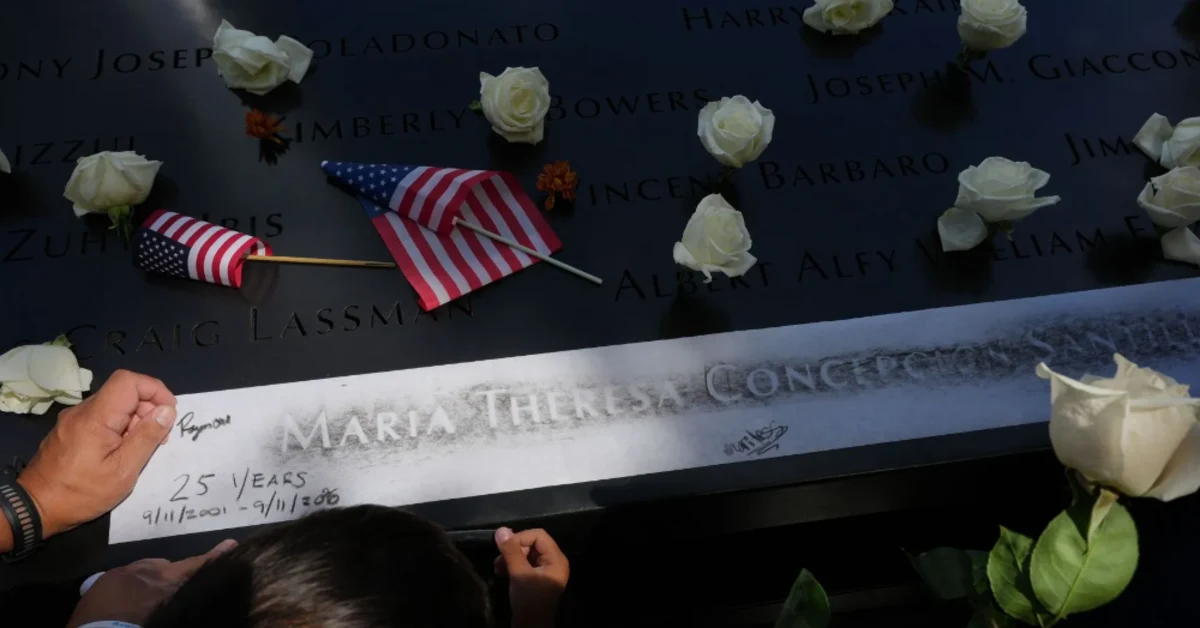

Rep. Nancy Mace (R-SC) on Wednesday condemned the spray-painting of the 9/11 Memorial in Lower Manhattan as “a special kind of evil,” after a 31-year-old gun regulation activist scrawled his website URL in red paint across bronze panels bearing victims’ names. Jonathan Tijerina was arrested Monday evening at the North Pool and charged with criminal mischief, making graffiti, and possession of graffiti instruments. The incident, captured on surveillance video and later admitted in a self-recorded Instagram video, caused more than $2,550 in damage. The 9/11 Memorial & Museum said the graffiti was quickly removed and the site restored to its commemorative state.
The Incident: What Happened at the North Pool
Tijerina approached the North Pool of the 9/11 Memorial around 5 p.m. on Monday, October 26, 2026. He carried two cans of spray paint and scrawled “juststopkillingkids.com” across the bronze panels inscribed with the names of people killed in the September 11, 2001 attacks. A security officer witnessed the act and detained him until Port Authority police arrived. The vandalism was also caught on the memorial’s surveillance cameras.
The damage exceeded $2,550, according to police, pushing the offense beyond a minor violation. The 9/11 Memorial & Museum described the incident as “brief” and said security staff and law enforcement “swiftly addressed” the situation. The site reopened shortly after the paint was removed.
Who Is Jonathan Tijerina? The Suspect’s Motives and Background
Tijerina is a New York-based gun regulation activist who runs the website juststopkillingkids.com. The site demands universal background checks for gun purchases and a mandatory registry for every firearm in the United States. It also invites visitors to “learn how civil resistance works,” framing his actions as part of a broader protest strategy.
In a video posted to his Instagram account, Tijerina admitted to the act while the camera panned toward the red graffiti. “My name is Jon Tijerina, and I just spray-painted stop killing kids on the 9/11 Memorial,” he said. He also complained that the city and media had ignored a seven-day fast he completed to demand two million units of affordable housing within five years. His group described him as a civil resistance organizer who has been arrested in multiple states.
Nancy Mace’s Full Statement and Her Personal History with Vandalism
Mace’s response was among the sharpest from any elected official. “It takes a special kind of evil to vandalize the 9/11 Memorial,” she wrote on X. “Nearly 3,000 innocent Americans were murdered on September 11. Now some anti-American radical has used their memorial to push a political agenda. The 9/11 Memorial is SACRED GROUND. This is absolutely vile”.
Her language carries personal weight. In May 2021, Mace’s Charleston-area home was vandalized over Memorial Day weekend with black spray paint, Antifa symbols, and profanity. She later said the incident left her feeling violated and prompted her to carry a firearm for self-defense. That history shapes her interpretation of the 9/11 Memorial attack as an assault on shared national grief rather than a legitimate protest.
Bipartisan Outrage: Political Reactions from Stefanik, Pataki, and Local Leaders
Rep. Elise Stefanik (R-NY) called the act “heinous” and demanded prosecution “to the fullest extent of the law,” noting that New York had just commemorated the solemn 25th anniversary of the attacks. Former New York Gov. George Pataki asked, “What kind of person looks at the names of innocent people murdered on September 11 and decides to desecrate them?”.
New York City Council Speaker Julie Menin, a Democrat, also condemned the vandalism. “The 9/11 memorial is a sacred space,” she said. “Any defacement of the memorial, no matter the reason or cause, is wholly unacceptable”. The bipartisan tone underscored that the memorial occupies a rare zone of political consensus, even in a polarized era.
Some Republicans went further, linking the vandalism to Democratic figures. Former Los Angeles mayoral candidate Spencer Pratt blamed “communist politicians” like Rep. Alexandria Ocasio-Cortez and New York City Mayor Zohran Mamdani, citing their laughter at last month’s 25th-anniversary ceremony. Councilwoman Vickie Paladino called it the “Mamdani effect”. Those claims lacked direct evidence, but they illustrate how quickly the incident was absorbed into existing partisan narratives.
The 9/11 Memorial as a Contested Political Space
The 9/11 Memorial has long functioned as both a site of mourning and a stage for political expression. Its 2,983 names represent victims of the 2001 attacks and the 1993 World Trade Center bombing. That scale makes any defacement feel like an attack on collective memory rather than property damage alone.
The memorial is not the first such site to be targeted. In 2024, the Indiana 9/11 Memorial in Indianapolis was spray-painted with “Never Forget Gaza,” tying the commemorative space to the Israel-Palestine conflict. Such incidents reveal a recurring tension: memorials are open, public spaces, but their symbolic weight makes them vulnerable to people seeking maximum visibility for political messages.
The First Amendment protects protest, but it does not protect vandalism. The 9/11 Memorial & Museum’s statement made that distinction clear by emphasizing restoration and security rather than engaging with Tijerina’s cause. The legal system, not the court of public opinion, will determine whether his act constitutes protected civil resistance or criminal mischief.
Legal Consequences and the Cost of Desecration
Tijerina faces three charges: criminal mischief, making graffiti, and possession of graffiti instruments. The damage estimate of more than $2,550 is significant because New York law escalates penalties based on the value of destroyed property. A conviction could carry jail time, fines, and restitution.
The case also raises questions about how courts handle politically motivated vandalism at sacred sites. Tijerina’s prior arrests in multiple states suggest a pattern of confrontational activism. Prosecutors will need to balance the defendant’s stated political motives against the clear property damage and the emotional harm inflicted on victims’ families.
The 9/11 Memorial & Museum has not announced additional security measures, but the incident may prompt a review of surveillance and staffing at the North Pool. The memorial’s open design is central to its purpose, yet open access creates risk. Restoring the site cost time and money, and the museum will likely assess whether current safeguards are sufficient.
The Broader Protest Context: Anti-ICE Demonstrations and Civil Resistance
The vandalism occurred during a week of heightened direct action in New York City. Anti-ICE radicals blocked the Brooklyn Bridge, leading to 14 arrests, while Tijerina targeted the memorial on the same day. The proximity of these events suggests a broader climate of confrontational protest in which symbolic sites become targets for attention.
Tijerina’s website explicitly frames his actions as “civil resistance,” a term that borrows from historical movements but applies here to property destruction. That framing is unlikely to persuade victims’ families or elected officials. Still, it reflects a strategic calculation: acts that generate outrage also generate coverage, and coverage amplifies the message.
The risk is that such tactics alienate the very audiences Tijerina claims to represent. Gun regulation advocates have spent years building coalitions around background checks and public safety. Vandalizing a 9/11 memorial hands opponents an easy contrast between their cause and their methods. The political cost may outweigh any visibility gained.
Public and Social Media Reaction
The incident did not gain widespread traction until Wednesday, two days after the arrest. Once it spread, reactions divided along predictable lines. Conservative commentators focused on the suspect’s politics and the sacred status of the memorial. Some progressive voices argued that the outrage was disproportionate compared with other forms of political violence.
Families of 9/11 victims were largely absent from the public debate, but their perspective remains central. The memorial exists for them first. When names are covered in spray paint, the harm is not abstract. It is a direct affront to people who visit the site to mourn spouses, parents, children, and friends.
Social media also amplified Tijerina’s own documentation. His Instagram videos functioned as both confession and promotion. That self-promotional dimension complicates the claim that his act was purely altruistic. The line between protest and performance is thin, and Tijerina crossed it in full public view.
Security and Policy Implications for the 9/11 Memorial
The memorial’s security model relies on a combination of surveillance cameras, uniformed staff, and law enforcement coordination. That model worked in the sense that Tijerina was caught quickly and the graffiti was removed. But the incident also exposed a gap: a single individual with two cans of spray paint could deface dozens of names before being stopped.
The museum may consider tighter restrictions on bags and materials at the pools, though such measures could diminish the open, reflective atmosphere. It may also increase visible security presence during politically charged weeks. The challenge is to protect the site without turning it into a fortress.
Public officials will likely use the case to argue for stronger penalties for vandalism at memorials. Whether such laws would deter future acts is uncertain. Tijerina’s willingness to film himself suggests that he anticipated arrest and treated it as part of his campaign. Deterrence works best when the perceived cost of an action outweighs the perceived benefit, and visibility is a powerful benefit for a protest entrepreneur.
What This Means for Political Discourse
Nancy Mace’s phrase “a special kind of evil” does more than condemn a single act. It draws a boundary between legitimate political disagreement and desecration of shared grief. That boundary matters because democratic politics depends on the existence of spaces that remain outside partisan contestation. Memorials are among the few remaining institutions that command near-universal respect.
The vandalism also tests whether public figures can condemn an act without exploiting it. Some Republicans used the incident to attack Democrats within hours, before all facts were known. That rush to blame reflects a broader pattern in which tragedy becomes raw material for messaging. The families whose names were defaced deserve better than another partisan skirmish.
You May Also Like



View all articles about
Accountability will come through the legal process. Tijerina’s charges, the damage estimate, and the surveillance evidence give prosecutors a straightforward case. The larger question is whether the political system can treat the incident as a shared violation rather than a partisan weapon. The answer will shape how the 9/11 Memorial is protected in the years ahead.
VVIPTimes delivers sharp, independent news analysis without the noise.






















Leave a Reply