

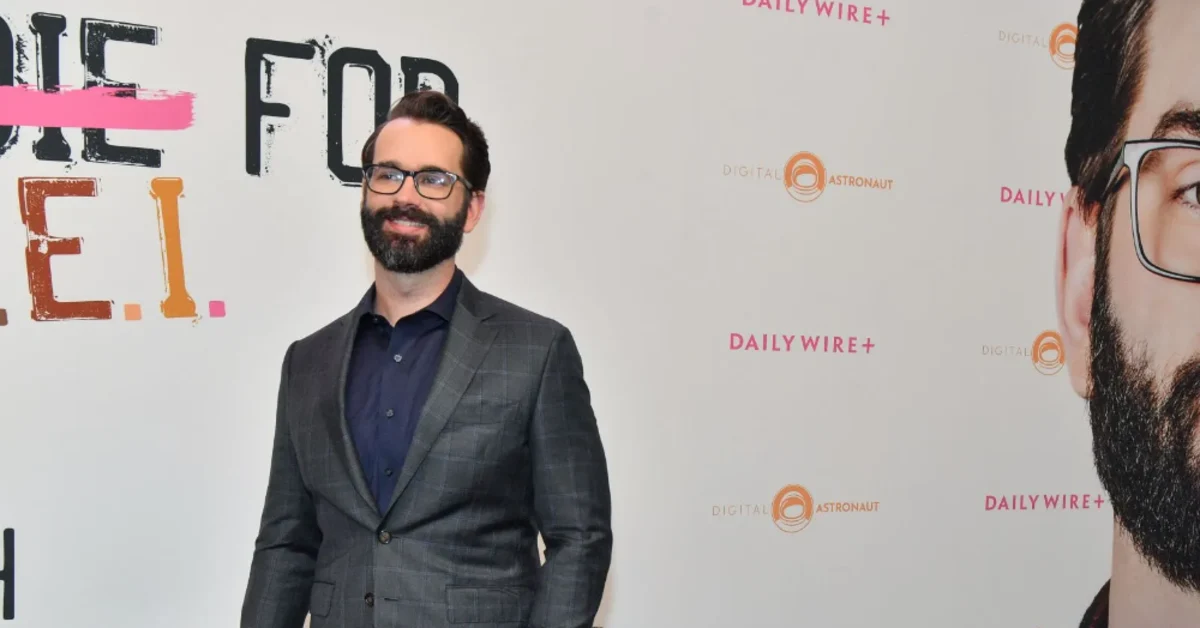

Matt Walsh on October 28, 2026, rejected a viral X post claiming that AI writing matches the output of a 125-plus IQ, the “top 5% of humans,” calling the framing “atrociously bad” and the prose itself “coherently shitty.” The Daily Wire host and commentator quoted the post directly and argued that AI writing is not “too good” but neat, bland, and devoid of style. The exchange drew immediate attention because it inverted the usual AI panic narrative. Instead of warning that machines will outwrite everyone, Walsh argued that machines produce a recognizable category of bad prose that trained readers can spot without detection software.
The October 28 Exchange: What Walsh Actually Said
The viral post Walsh quoted made a technical-sounding case. It claimed AI writing is “generally ‘too good’” because it produces no mistakes, no grammatical errors, no typos, and an “effusive vocabulary”. The post added that once AI begins imitating human errors and bad phraseology, it will become harder to spot. Walsh rejected the premise outright.
“No that’s not it. AI writing is not good writing at all. Much less ‘too good.’ It’s neat, yes. Perfectly spelled and punctuated. This writing itself is atrociously bad, though. Bland and dull and utterly devoid of style or personality. But it’s bad in a bizarre, uncanny way. Bad but perfectly coherent.”
Walsh then sharpened the distinction between machine and human failure. Bad human writing is usually bad because it falls apart structurally, he argued. AI writing is different because it holds together while remaining empty. He called the result “coherently shitty” and described it as “a weird combination”. The post drew thousands of replies and quote-posts within hours, with users split between agreement and accusations that Walsh was simply asserting his own taste as objective detection.
Why the ‘Top 5%’ Claim Collapses Under Scrutiny
The 125 IQ framing sounds empirical, but it confuses fluency with quality. Large language models are trained to predict the next most probable token, which produces smooth, low-perplexity prose. Perplexity measures how predictable word choices are to a language model, and low perplexity signals fluency. The problem is that skilled human writers also produce low-perplexity text because the models were trained on polished human writing.
That training loop creates a measurement trap. When a model writes cleanly, it is mimicking the surface features of edited human prose, not reproducing the judgment that shaped it. The “top 5%” claim treats the absence of typos as evidence of high intelligence. Walsh’s response treats the absence of risk as evidence of low intelligence. Neither claim is a laboratory finding. Both are interpretations of a stylistic signal that readers are still learning to name.
Walsh made a related point in a separate reply. He wrote that the rhythm and construction of AI prose “screams AI” even when the writer cannot precisely describe why. He listed specific tells: the word “quietly,” the phrase “load bearing,” the “it’s not x, it’s y” construction, and the habit of asking questions and answering them in the same paragraph. Those markers are not proof of intelligence or its absence. They are fingerprints of a model’s training distribution.
Walsh’s Longer War on AI Slop
The October exchange did not emerge in isolation. Walsh has spent most of 2026 building a public case against AI-generated writing across social media and media production. In March 2026, he posted that the number of people using AI for “basic posts” and replies was “pretty shocking” and that the technology had existed for “10 seconds” while huge swaths of users had “completely given up on even the simplest forms of creative writing”.
He has also applied the critique to public figures. In October 2026, Walsh accused Matthew McConaughey of delivering “the most ChatGPT speech I’ve ever heard” during a six-minute video urging Americans to support independent candidates. That claim was not verified by any forensic tool. It functioned as a cultural signal: Walsh associates a certain smooth, center-left, consensus-toned rhetoric with machine authorship, whether or not a model was involved.
His anti-AI posture has created an unusual political map. Walsh himself noted in March 2026 that opposing AI was “pretty much the only position I hold that seems to be more popular with the left than the right”. That admission matters for understanding the October 28 post. Walsh is not arguing from a partisan script. He is arguing from a craft position that cuts across ideological lines, and his audience includes writers, teachers, and media workers who feel the same erosion of standards.
The Detection Paradox: When Polished Human Prose Looks Like a Machine
Walsh’s confidence that AI is “screamingly obvious” runs into a structural problem documented in 2026 research. The Authors Guild tested five commercial AI detectors in May 2026 against ten articles published before generative AI became mainstream. The results ranged from flawless to catastrophic. Pangram and Originality.ai returned near-zero AI scores on the human texts. Grammarly performed well. ZeroGPT scored a Joan Didion obituary at 66 percent AI-generated and a letter congratulating Louise Erdrich on her Pulitzer Prize at 76 percent. Sidekicker scored every article as predominantly AI-written, with two reaching 100 percent on texts written years before the technology existed.
The reason is built into how detectors measure text. They look for low perplexity and low burstiness. Low perplexity means predictable word choices. Low burstiness means uniform sentence rhythm. AI produces both. So do experienced human writers who revise for clarity and control. The Authors Guild concluded that “polished, edited prose written by experienced human writers shares many of those same characteristics, because LLMs were trained on polished, edited prose written by experienced human writers”.
That finding does not prove Walsh wrong about the blandness of AI. It does undermine the idea that “I know it when I see it” is a reliable method. Pindrop tested 16 detection systems and found that expert human annotators performed barely better than a coin flip, roughly 45 to 53 percent accuracy, when asked to identify machine-generated text. Walsh’s October post describes a real aesthetic experience. The “top 5%” post describes a statistical illusion. Neither side has a clean measurement.
What This Means for Entertainment and Media Employers
The practical stakes for studios, publishers, and newsrooms are larger than a social media argument. The Writers Guild of America ratified a four-year deal with studios in April 2026 that preserved the 2023 AI protections and added requirements for licensing writers’ scripts or projects based on those scripts to generative AI systems. The deal did not ban AI. It created notification and meeting obligations that keep the guild inside the implementation process.
That structure means the industry is not choosing between human writing and AI writing. It is choosing which tasks get automated, which tasks require credited human authorship, and how much disclosure accompanies the difference. Walsh’s position implies a stricter line: AI prose is not a cheaper substitute for professional writing because the quality gap is visible to audiences. The “top 5%” position implies the opposite: AI can replace a large share of competent writers because it matches their output at lower cost.
Entertainment labor data leans toward Walsh’s concern about market effects, even if his aesthetic claim is debatable. A 2026 Tulsea–Ormax report found that nearly seven in ten Indian screenwriters said AI reduces the perceived value of human creativity in the eyes of producers. Half said producers now expect faster turnaround times because they assume writers will use AI. Those expectations change bargaining power regardless of whether the final script is machine-generated or human-written. The label “AI” becomes a management tool for compressing schedules and fees.
Public Reaction and the Broader AI Divide
Reaction to Walsh’s October 28 post split along three lines. One camp agreed that AI prose has a distinct uncanny quality and praised Walsh for naming it. A second camp argued that Walsh overestimates his own detection ability and that his examples often target writing he dislikes rather than writing proven to be machine-generated. A third camp treated the entire dispute as a status game inside conservative media, where Walsh’s anti-AI brand competes with other Daily Wire personalities for attention.
The teacher reaction added a practical dimension. Walsh replied to a teacher who described the volume of AI writing they encounter, calling it a “nightmare” and saying he could not imagine “the AI slop that teachers and professors are dealing with right now”. That comment moved the argument from media criticism into education policy. Schools are already using detectors that produce false positives at scale, and at least five federal lawsuits have been filed by students since 2024 over AI plagiarism findings. A federal judge ruled in February 2026 that an AI plagiarism finding against a student at Adelphi University was “without merit”.
For Walsh’s audience, the October post functions as a craft defense. For critics, it functions as a taste hierarchy dressed as technical analysis. Both readings can coexist because the underlying evidence is ambiguous. The one clear outcome is that “AI writing” has become a label applied to prose people dislike, not a verified description of how the prose was made.
The Business Calculus for Daily Wire and Conservative Media
Daily Wire’s own position complicates the story. The outlet’s articles are primarily written by human authors, and its public-facing talent has built brands around authorship and voice. Co-founder Jeremy Boreing has publicly mocked AI doomers while acknowledging the technology’s disruptive potential. That posture lets the company criticize AI hype without committing to a formal ban on internal experimentation.
Walsh’s anti-AI stance is therefore both a personal conviction and a product differentiator. In a media market where aggregators and AI summaries compete for search traffic, a personality who promises human-authored analysis can charge a premium in audience trust. The risk is that the same stance makes the brand look hostile to tools that competitors use to cut costs. The October 28 exchange did not resolve that tension. It put it on the timeline.
The larger media industry is watching the same trade-off play out in contract negotiations, detection lawsuits, and audience research. The WGA deal shows that labor can slow AI adoption without stopping it. The Authors Guild study shows that detection cannot reliably enforce the line between human and machine. Walsh’s post shows that audiences are developing a cultural vocabulary for the difference, even when the vocabulary is imprecise.
What to Watch Next
The next phase of this argument will move through three venues. First, publishers and studios will test disclosure rules for AI-assisted drafts, and those rules will determine whether “AI writing” remains a stigma or becomes a neutral production note. Second, schools and universities will face more litigation over detection false positives, which will weaken the administrative case for automated policing. Third, conservative media will keep using AI as a cultural marker, with Walsh positioned as the most vocal craft critic inside the Daily Wire ecosystem.
You May Also Like





View all articles about
The “top 5%” claim will not survive as a technical proposition. Its own logic collapses once training data and perplexity are understood. But the anxiety behind it is real. Audiences suspect that a large share of professional writing is already machine-assisted and undisclosed. Walsh’s answer is to insist that the output is visibly worse. That answer is rhetorically effective and empirically incomplete. The fight over AI writing is now a fight over who gets to define quality, and Walsh has claimed a loud position in that fight.
VVIPTimes will keep tracking the AI authorship debate across media, labor, and education as new contracts, court rulings, and platform policies reshape the line between human and machine prose.
































Leave a Reply