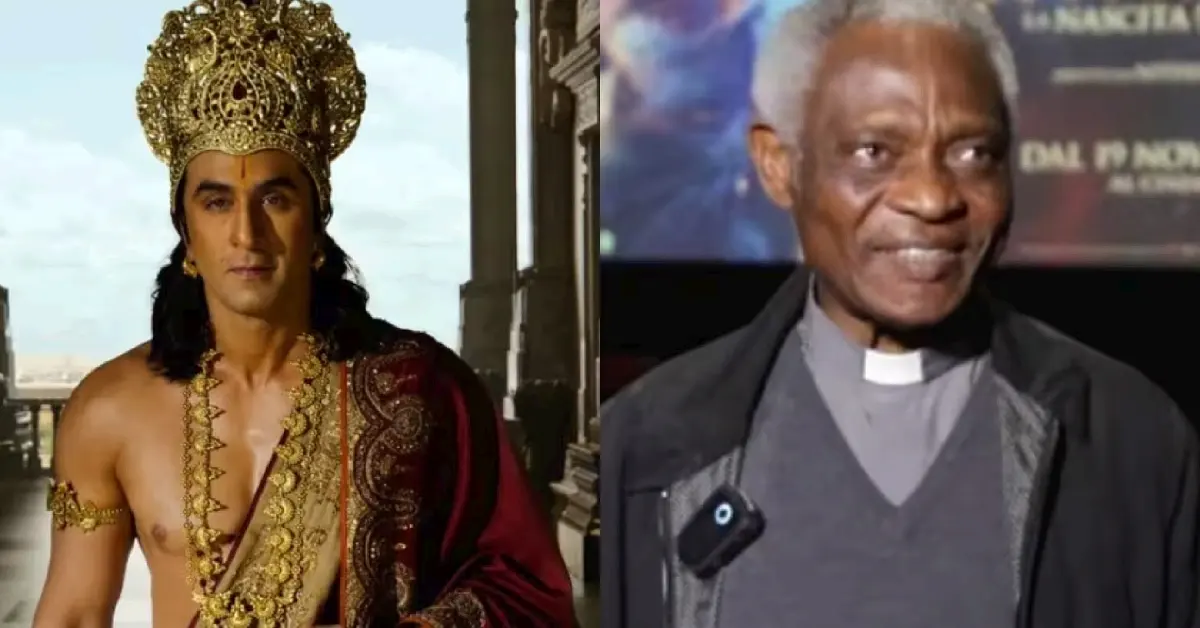

Cardinal Peter Turkson, one of the highest-ranking officials at the Vatican, watched Ramayana: Rise of a Legend in Rome and walked away with a comparison that few would have expected: the Indian epic, he said, shares its storytelling roots with Biblical tales and ancient Babylonian creation myths. The film, which released worldwide on November 5, 2026, has already crossed ₹1,693 crore globally, and the Cardinal’s remarks have added a new dimension to its international run.
The special screening took place at the Pontifical Academies in Rome. The audience was small and invited: staff members of the Pontifical Academy of Sciences, Ghana’s Ambassador to the Holy See, embassy officials, an architect, and other guests. Cardinal Turkson, who serves as Chancellor of the Pontifical Academies of Sciences and Social Sciences, was among them.
What followed was not a typical film review. It was a quiet, detailed comparison between two storytelling traditions that rarely share the same spotlight.
The Rome Screening and Who Was in the Room
The film was shown to a private gathering in the Italian capital. The venue was not a commercial cinema but a space tied to the Vatican’s academic institutions. Cardinal Turkson attended alongside members of the Pontifical Academy of Sciences team and diplomatic figures.
The official team behind Ramayana shared a video of the Cardinal’s remarks on social media. In it, Turkson speaks with the measured tone of someone who has spent decades in theology and public life, but also with the curiosity of a first-time viewer who found something familiar in an unfamiliar story.
The screening was not a festival premiere or a market event. It was a private showing arranged for a specific audience, and the conversation that followed centred on themes rather than box office numbers.
What Cardinal Turkson Actually Said About Good and Evil
Turkson’s most quoted remark came when he described how the film begins.
“The whole story begins as if creation of earth is born out of a conflict between good and evil. Ancient Babylonian history also talks about the earth and having been created by a conflict between deities. So the mythical origins and background is very shared.”
He was not saying the Ramayana is the same as the Bible. He was pointing out that the structural idea—creation emerging from a struggle between opposing forces—appears in multiple ancient traditions. That observation, simple as it sounds, is the kind of cross-cultural reading that rarely makes its way into mainstream film coverage.
Turkson also singled out the relationship between Lord Rama and Lakshman.
“A brother is supposed to keep a brother. This is a theme which is also shared, for example, in the Bible. Therefore, the brother of Rama does not feel like abandoning him, but protecting him and even protecting what belongs to him, which is his wife.”
The Cardinal was describing a specific narrative beat: Lakshman’s decision to stand by Rama and protect Sita. In his reading, that loyalty is not just a plot point but a recognisable human value that travels across faith lines.
He did not stop at themes. Turkson also commented on the film’s visual construction.
“A lot of killing and destruction inside there, symbolised by certain figures which represent the evil. Then you have the other part which represents the good. The photography was very complex and the images presented there also very complex. So it required a lot of skill to put all of it together.”
This is a notable point. A Cardinal praising the technical complexity of a big-budget Indian mythological film is not an everyday occurrence. It suggests that the film’s craft—its photography, its imagery, its scale—registered with someone who spends his life reading texts, not reviewing cinema.
A Film That Has Already Crossed ₹1,600 Crore Worldwide
The Cardinal’s remarks arrived while Ramayana: Rise of a Legend was in the middle of a remarkable box office run.
By Day 18, the film’s worldwide gross collection stood at ₹1,693.50 crore, according to trade tracker Sacnilk. India nett collection had reached ₹942.75 crore, while India gross stood at ₹1,126.50 crore. Overseas markets contributed ₹567 crore in gross collections.
The Hindi version led the domestic numbers with ₹26.25 crore nett from 13,852 shows on its third Sunday. The Malayalam version earned ₹3.40 crore nett, Kannada added ₹2.50 crore nett, Tamil contributed ₹2.40 crore nett, and Telugu brought in ₹1.05 crore nett on the same day.
These are not modest numbers for any film, let alone a mythological epic released in multiple Indian languages. The film crossed the ₹1,500 crore mark worldwide in just 14 days, making it one of the fastest Indian films to reach that milestone. It also crossed the $100 million mark globally in its first week, with the Diwali holiday period giving collections a significant boost.
For context: a film that began as a two-part adaptation of an ancient epic, produced on a reported combined budget of ₹4,000 crore, is now performing at a scale that places it among the biggest Indian releases in recent memory.
The Cast Behind the Screenings and the Numbers
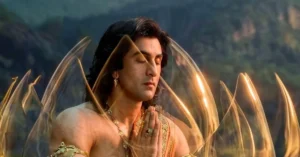
The film stars Ranbir Kapoor as Lord Rama, Sai Pallavi as Goddess Sita, and Yash as Ravana. Sunny Deol plays Lord Hanuman, Ravie Dubey appears as Lakshman, and Arun Govil plays King Dasharatha. The ensemble also includes Lara Dutta as Queen Kaikeyi, Rakul Preet Singh as Supranakha, and Shobana in a supporting role.
The film is directed by Nitesh Tiwari and produced by Namit Malhotra under Prime Focus Studios, in collaboration with DNEG, the eight-time Oscar-winning visual effects company, and Yash’s Monster Mind Creations.
The music has its own story. A.R. Rahman and Hans Zimmer composed the soundtrack together, a pairing that brought two very different musical worlds into the same room. Rahman revealed that he turned down 10–12 films to focus on Ramayana, spending three years crafting its music with Zimmer. Producer Namit Malhotra later shared that Zimmer came on board without even seeing the film’s complete pitch deck.
Why the Cardinal’s Words Matter Beyond the Screening
Turkson’s comparison was not a passing comment. It was a structured reading of the film’s narrative architecture.
He pointed to shared themes: the supernatural, love, deceit, hatred, and fraternal solidarity. In his view, these are not exclusively Indian or exclusively Biblical—they are human themes that appear across cultures because they describe recognisable experiences.
That framing matters because it shifts the conversation around Ramayana away from the usual binaries. The film is not being discussed only as an Indian mythological spectacle or a box office juggernaut. It is being read as a story that can be understood through multiple cultural lenses.
The Cardinal’s remarks also arrived on the same day that Prime Minister Narendra Modi referenced the film during a joint briefing with Nepal’s Prime Minister Balendra Shah. Modi said the story of the Ramayana is reaching younger generations through films and technology, and he encouraged young creators from India and Nepal to work together to represent shared heritage globally.
Two very different public figures—a Vatican Cardinal and an Indian Prime Minister—spoke about the same film on the same day, from entirely different perspectives. One focused on ancient storytelling parallels; the other on youth, technology, and cultural cooperation.
The Film’s Reception Has Not Been Uniformly Smooth
The box office numbers and the Cardinal’s praise tell one part of the story. Another part involves protests.
On November 20, the Hindu Janajagruti Samiti organised protests in Mumbai and Kolhapur, demanding the removal of scenes and dialogues they described as objectionable. Protesters gathered outside Dadar Railway Station and at Chhatrapati Shivaji Maharaj Chowk, signing a memorandum addressed to the Central Board of Film Certification.
The organisation accused the film of glorifying Ravana and disrespecting Bhagwan Shri Ram. These protests did not stop the film’s collections, but they indicate that the adaptation has sparked strong reactions from some groups even as it has drawn praise from international figures.
The film also received a tax-free status in West Bengal. Chief Minister Suvendu Adhikari announced on Dussehra that Ramayana would be exempt from entertainment tax in the state, joining a list of films granted similar status.
What the Rome Screening Says About the Film’s Global Life
The Rome screening was not a publicity stunt in the traditional sense. It was a private showing for a specific audience, and the video of the Cardinal’s remarks was shared by the film’s official team. But the content of those remarks is what makes the moment notable.
Turkson did not say the film was flawless. He did not offer a review score. He described what he saw: a story about creation emerging from conflict, about a brother protecting a brother, about good and evil represented through figures and imagery. He connected those elements to traditions he knows well.
That is a different kind of international reception than a festival award or a foreign box office figure. It is a reading of the film’s story through a theological and cultural lens, offered by someone who has spent decades studying how narratives shape belief.
You May Also Like




The film’s global distribution is being handled by Sony Pictures outside India, with Dharma Productions distributing the Hindi version in the domestic market. It released in Hindi, Tamil, Telugu, Kannada, and Malayalam, and is available in IMAX formats. A second part was initially planned for Diwali 2027 but has since been moved to 2028, with producer Namit Malhotra explaining that the team needed an extra year to deliver the finale.
For now, the first part is still in theatres, still collecting, and still generating conversations that go beyond the usual entertainment pages. A Cardinal in Rome watched it and saw something familiar. That is not the kind of sentence that appears in box office reports, but it may be the one that lingers.
For more stories like this, explore VvipTimes.