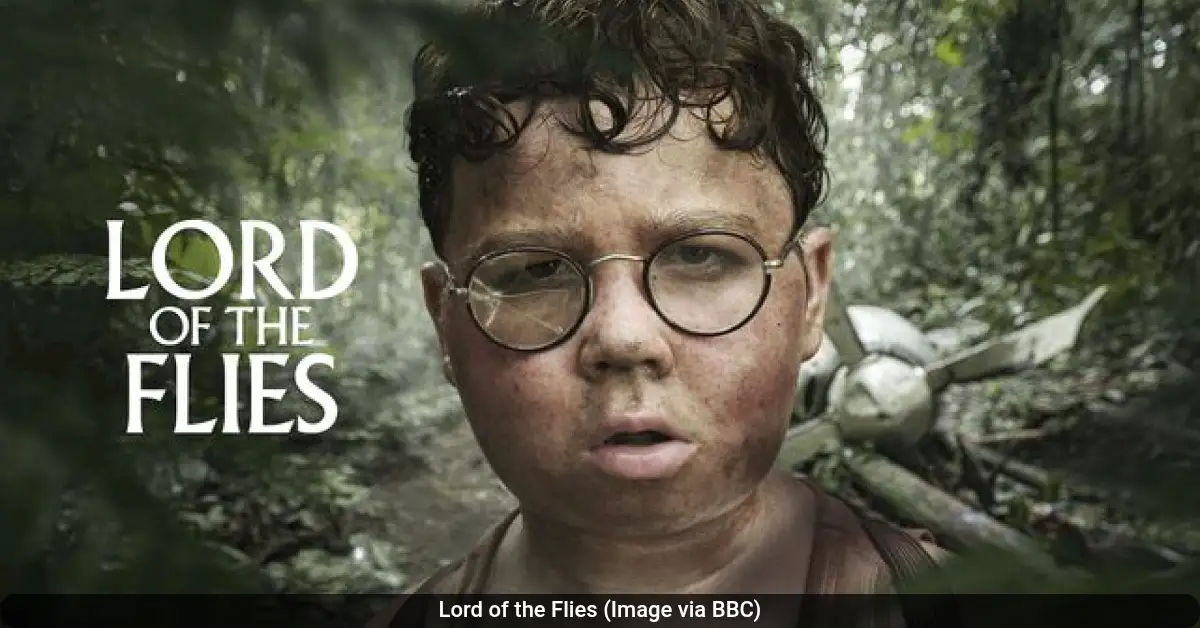
William Golding’s legendary novel, Lord of the Flies, arrives as a major BBC television series for the very first time. Adapted by the award-winning writer Jack Thorne, this four-part drama offers a fresh, character-focused look at the classic story of boys stranded on an island. However, its bold visual style has immediately divided viewers, with some calling it a stunning achievement and others finding the camera work impossible to watch.
The series became available in full on BBC iPlayer and to Australian audiences on Stan starting Sunday, February 8, 2026. In the UK, the first episode premiered on BBC One at 9:00 PM that same night, with weekly broadcasts to follow. The series is a co-production with the Australian streamer Stan, with Sony Pictures Television handling international distribution.
Behind the Scenes: A Major Production
The ambition behind this adaptation is clear from its creative team. The series is directed by Marc Munden and written by Jack Thorne, who both have multiple BAFTA awards to their names. They aimed to create the first television adaptation that stays true to the 1954 novel while offering a new perspective.
Filming took place on location in Malaysia to capture the authentic, lush, and isolating tropical environment of the story. The producers conducted a nationwide search for their young cast, explicitly looking for boys aged 10 to 13 and stating that no prior acting experience was required. This resulted in an ensemble of over 30 actors, many of whom are making their professional debuts.
The music is another highlight, featuring a score by renowned composer Cristobal Tapia de Veer. The series’ main theme was created by the legendary Hans Zimmer and Kara Talve. The production was made with the support of William Golding’s own family.
The Story and Its New Structure
The plot follows Golding’s original narrative. After a plane crash during a fictional war, a group of British schoolboys finds themselves alone on a remote Pacific island in the early 1950s. They attempt to build a civilized society, led by the elected chief Ralph and guided by the intellectual Piggy. Their order is challenged by Jack, who leads a faction more interested in hunting and power than in rules or rescue.
Jack Thorne’s key innovation is the series structure. Each of the four hour-long episodes is named after and told from the perspective of a central character: Piggy, Jack, Simon, and Ralph. This approach provides a deeper look into the minds and motives of the key players as society breaks down.
Meet the Young Cast of Lord of the Flies
The series rests on the shoulders of its young, largely inexperienced cast, who have received significant praise for their performances.
- Winston Sawyers plays Ralph, the initially elected leader who struggles to maintain order. Sawyers describes Ralph as “quite charming, humble, and a little bit goofy at times”. He previously appeared in the Paramount+ series The Crow Girl.
- David McKenna makes his professional acting debut as Piggy, the voice of reason who is consistently bullied. McKenna got the role after a final audition with Jack Thorne himself.
- Lox Pratt also debuts as the antagonist Jack. Pratt describes Jack as “narcissistic, arrogant, and condescending,” but adds that “deep down he’s quite a scared little guy”. Pratt is also set to play a young Draco Malfoy in HBO’s upcoming Harry Potter series.
- Ike Talbut plays the sensitive and spiritual Simon. Talbut has said he feels a personal connection to Simon’s shy and observant nature.
The supporting cast includes Thomas Connor as the cruel Roger, and real-life twins Noah and Cassius Flemyng playing the twins Sam and Eric.
“He had a lot of rough edges and a very tricky background. He’s very narcissistic, arrogant, and condescending, and he knows that he’s the best at everything. Deep down he’s quite a scared little guy,” said Lox Pratt about his character, Jack.
Critical Reception: Praise and Criticism
Professional reviews for the series have been largely positive, with many applauding its bold vision and strong performances.
Publications like Radio Times, The Independent, and The Standard awarded the series four out of five stars. They highlighted it as a “glorious reminder of the novel’s power,” a “bold, brilliant series,” and a “slick, visually rich adaptation”.
Critics particularly praised the lead performances. One review noted that David McKenna as Piggy brings a “naturalism” and “world-weariness beyond his years,” while Lox Pratt as Jack delivers a “dynamism” that is both charismatic and chilling. The technical achievements in cinematography and music were also widely commended.
However, not all reviews were glowing. The Guardian gave the series three stars, arguing that while “the acting is absolutely excellent,” the script and pacing sometimes lack the elemental dread of the original novel. Some critics felt the adaptation over-explained the boys’ behaviors with modern psychological backstories, which could reduce the story’s timeless, allegorical power.
The Big Debate: Viewer Reactions to the Visual Style
While critics praised the visuals, the show’s distinctive cinematography has become the biggest point of controversy among regular viewers. The extensive use of fisheye lenses, vivid color filters, and unconventional camera angles has sparked a strong backlash on social media.
Immediately after the premiere, many took to X (formerly Twitter) to express frustration. One viewer wrote, “I love the Lord of the Flies book but this filmmaking style is horrific. This is too ‘cinematic’. It’s only bleedin’ TV!”. Another stated, “Nope. Can’t watch this fish eye lens car crash,” with others calling the style “disorienting” and “unwatchable”.
Some complained that the bold camera work distracted from the story itself. A viewer remarked, “Look at me screams the cinematographer – takes you out of the film”. Others simply found the adaptation “boring” or “awful,” with several claiming they switched off after just a few minutes.
Despite the vocal criticism, the reaction was not universally negative. Some viewers praised the show, with comments like, “Very impressed by the new adaptation of Lord of the Flies so far,” and “Enjoying it so far, what fantastic actors”. This split highlights how the series’ most ambitious artistic choice is also its most divisive.
Should You Watch BBC’s Lord of the Flies?
Deciding whether to watch this adaptation depends on what you value in a classic story retold.
Watch it if you are interested in a visually daring and ambitious reinterpretation of a classic. The series is worth seeing for the powerful performances from its young cast, its impressive musical score, and its unique structure that delves into individual characters. If you appreciate bold directorial choices and a fresh cinematic style applied to television, this adaptation offers a memorable experience.
Consider skipping it if you are a purest who wants a straightforward, faithful retelling that matches the tense, grim tone of the novel. If you are sensitive to unconventional camera work like fisheye lenses and vivid color grading, these elements may prove too distracting or unpleasant to enjoy. Those hoping for a tight, consistently paced thriller might find some episodes feel slow.
The BBC’s Lord of the Flies is a significant television event that boldly reimagines a literary monument. Its success in capturing the novel’s brutal themes of human nature and lost innocence is evident in its powerful performances and critical acclaim. Yet, its decision to use a radically stylized visual language ensures it will be remembered as much for the debate it sparked as for the story it told.
Also Read: Patrick Dempsey Hopes to Reunite with Eric Dane on New Fox Drama Memory of a Killer