

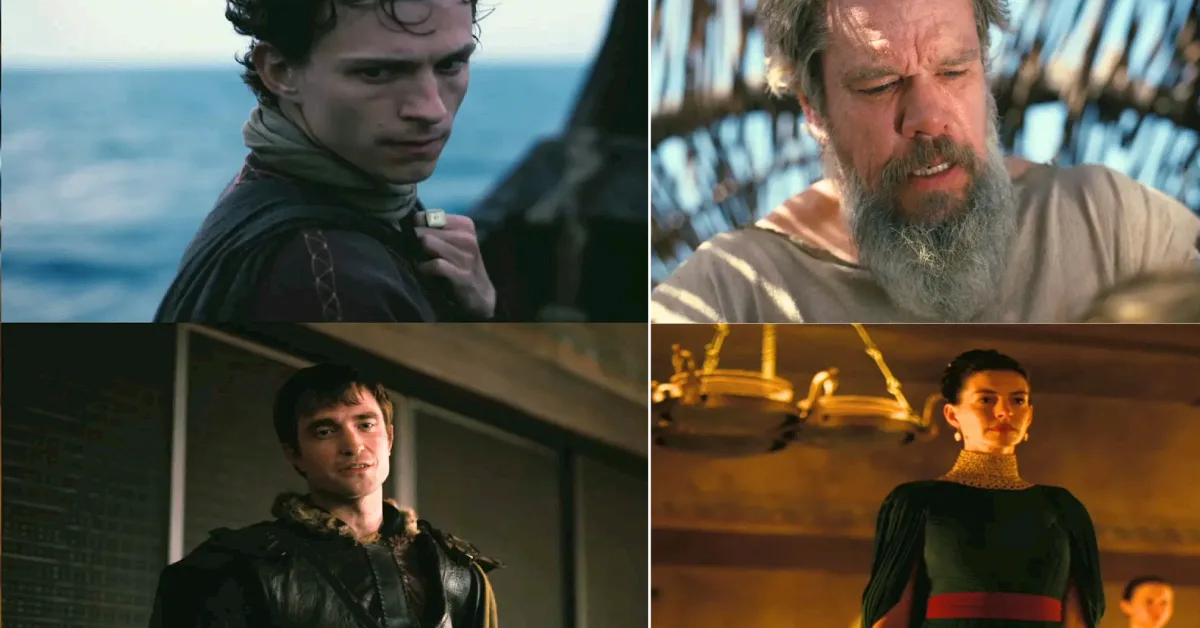

Christopher Nolan’s The Odyssey officially released in theaters worldwide on July 17, 2026. The film has already earned strong praise, holding a 96% score on Rotten Tomatoes from both critics and audiences. One of the most talked-about aspects of the production is Nolan’s decision to shoot almost entirely on real locations instead of using green screens. The production traveled across six countries over a 91-day shoot, using large-format IMAX cameras to capture the ancient Greek epic.
Nolan has always preferred practical filmmaking over digital effects. For The Odyssey, he took that approach to another level. The crew filmed in Greece, Italy, Morocco, Iceland, Scotland, and the United States. Rather than building mythical landscapes on soundstages, Nolan and his team went to some of the most striking natural and historic settings in the world.
“This has been an absolute nightmare to film… but in all the right ways. We went all over the world to make this film because this is The Odyssey. You’ll be pleased to hear how difficult it was for us because it’s meant to be difficult. That’s the nature of the story.” – Christopher Nolan at CinemaCon
Greece: Where the Epic Begins
Since The Odyssey is rooted in Greek mythology, much of the production took place in Greece. The crew filmed extensively in the Peloponnese region, known for its rugged coastline and ancient landmarks. Filming in Greece occurred in March and April 2025.
Voidokilia Beach served as one of the film’s coastal backdrops. This crescent-shaped beach near Pylos offered pristine Mediterranean scenery. The beach’s horseshoe shape made it a perfect natural setting for the epic.
Nestor’s Cave, located near Voidokilia Beach, was reportedly used for scenes involving the Cyclops, one of Odysseus’ most famous encounters. In Greek mythology, this cave is associated with King Nestor, one of the heroes of the Trojan War.
Methoni Castle, a medieval fortress overlooking the sea, also featured during filming. The castle added an authentic historical setting to the epic. Odysseus’ palace on Ithaca, where his wife Penelope and son Telemachus face hundreds of suitors, appears to have been filmed at Methoni Castle.
Acrocorinth, the monolithic rock overlooking the city of Corinth, was another key location. Almyrolaka Beach, an unspoiled stretch of coast, also provided backdrop for several sequences.
Morocco: Standing in for Ancient Troy
To recreate the legendary city of Troy, the production traveled to Morocco. Filming began in February 2025 in Morocco’s Ouarzazate province.
Aït Benhaddou, a UNESCO World Heritage site known for its centuries-old earthen architecture, served as the primary location for Troy. The fortified village has previously appeared in several historical epics and fantasy films. The spectacular mud-brick settlement hosted the film’s Trojan Horse sequence, where full-scale wooden horses were constructed for the production.
The beaches of Essaouira on the Atlantic coast of Morocco provided the discovery site of the Trojan Horse and the boat launch for Odysseus’s journey back to Ithaca. Additional filming took place in Marrakech, Tahanaoute, El Haouz, and Dakhla. The Dakhla shoot marked the latest leg of the film’s global production.
Italy: Islands of Myth
Odysseus’ long voyage takes him across mysterious islands, and Nolan filmed several of those sequences in Italy.
Favignana Island, located off the coast of Sicily, was a major filming location. Also known as “Goat Island,” Favignana is believed to be the place where Homer envisioned Odysseus landing with his crew to barbecue goats and stock up on food. Nolan, his crew, and a cast of around 500 practically took over the main town and spent several months filming scenes there and around the island’s coves. Favignana’s turquoise waters and rocky coastline provided the backdrop for several sea-based sequences.
The Aeolian Islands, a volcanic archipelago north of Sicily, were used for scenes connected to Aeolus, the god of the winds. Additional filming reportedly took place across the Aeolian Islands, including Lipari, Vulcano, and Basiluzzo.
Castello di Santa Caterina, a ruined fortress on a hilltop in Italy, was another key location. The path to the castle was too narrow for vehicles, so most cast and crew members had to hike 45 minutes up to the hilltop every day before shooting began. Equipment was transported by helicopter.
Filming also took place on the Maltese island of Gozo, home to the famed Calypso’s Cave, which is traditionally associated with the nymph Calypso in Greek mythology.
Iceland: The Underworld and Mythical Realms
For some of the film’s darker and more supernatural sequences, the production traveled to Iceland. The country’s volcanic terrain, glaciers, and geothermal landscapes created an atmospheric setting without requiring extensive visual effects.
Filming locations in Iceland included Hjörleifshöfði mountain with its black sands and caves, the Snæfellsnes peninsula, the river Markarfljót, and the harbor of Landeyjahöfn. The stark volcanic terrain was used to represent the Underworld and other mythical realms encountered during Odysseus’ voyage.
Scotland: The Surprising Homecoming
One of the most unexpected filming locations for a Greek epic was Scotland. The rugged coastline of Scotland plays a prominent role in the film.
Filming took place around the Moray Firth in northeastern Scotland. Locals spotted a custom-built wooden replica of an ancient Greek galley sailing through the region’s misty waters, with the area reportedly serving as a stand-in for Ithaca, Odysseus’ homeland.
Findlater Castle, a ruinous castle perched on the clifftops, was another key location. Constructed in the 1200s, it remains a significant piece of medieval Scottish history. Stars were also spotted visiting restaurants, gyms, and shops across the region during the filming period.
Culbin Forest in Moray provided a stunning backdrop. Culbin Sands, Forest, and Findhorn Bay comprise a huge stretch of land that offers views out across the Moray Firth. Videos of the nearby Sunnyside Beach showed the sandy stretch transformed with the wrecks of Greek ships. Additional filming took place at Buckie Harbour.
United States: Controlled Water Sequences
Although the film emphasizes real-world locations, some controlled water sequences were completed in the United States. The production utilized Universal Studios’ Falls Lake water tank in Los Angeles for scenes requiring greater technical precision. The remainder of the film was also shot at the Universal studio lot in Universal City, California.
Related Stories





View all articles about
The Scale of the Production
Nolan and cinematographer Hoyte van Hoytema used new, lighter-weight IMAX cameras after years of working around the format’s size, noise, and logistical demands. The Odyssey is the first feature film shot entirely on IMAX film.
The production employed a full-scale replica of a Viking longship, the Draken, for water-based scenes. Nolan reportedly followed one simple rule throughout production: if a real location existed, they would shoot there instead of creating it digitally.
“For me, being on a real location, shooting certain things like when the crew is out setting sail on that boat, or going through a storm, I want it to feel almost like a documentary.” – Christopher Nolan
The film was made on a reported budget of $250 million, though some reports suggest the budget reached $375 million due to the use of real locations and the star-studded cast.
For more entertainment news and updates, keep reading VvipTimes for the latest from Hollywood, Bollywood, and everything in between.













Leave a Reply