

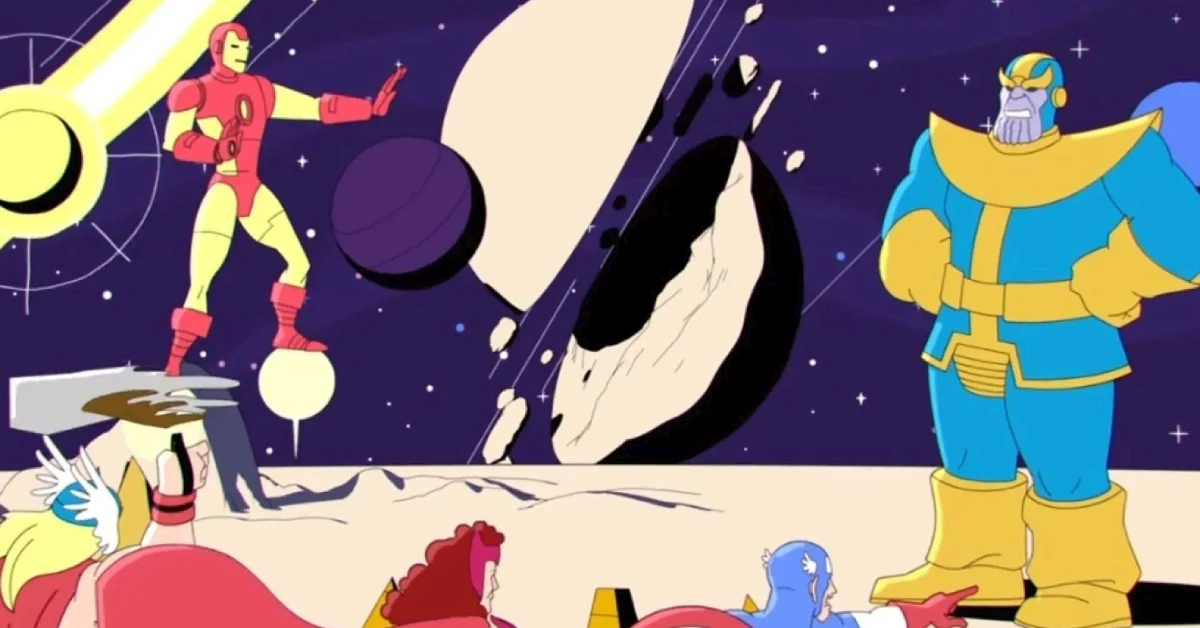
Marvel Comics has officially reimagined Thanos as a superhero named Titanson in Alex Ross‘s new graphic novel Marvel Dimensions. Released on September 1, 2026, the book introduces a brand-new alternate reality called the In-Verse, where every classic hero becomes a villain and every villain becomes a hero. Thanos, the Mad Titan who has menaced the Marvel Universe for over five decades, now fights on the side of the angels. The reveal has sparked intense discussion among comic fans worldwide.
What Is the In-Verse and How Does It Work
The In-Verse is a reality that operates as the direct opposite of Earth-616, Marvel’s main continuity. In this flipped world, traditional heroes become authoritarian threats while classic villains become freedom fighters. The concept is narrated by Machine Man (Aaron Stack), who discovers this universe through the Watcher’s technology.
The In-Verse transforms familiar characters into dark reflections of themselves. Tony Stark becomes a tyrannical armor-maker called Blacksmith. Bruce Banner is a volatile living weapon named Reactor. Thor wields his power as Godhammer, and Captain America leads with an iron fist as American Sword. The Avengers themselves are reborn as an oppressive military force called 1st Strike.
On the other side of this moral divide, former villains step into heroic roles. Doctor Doom becomes the heroic Brother Doom, who leads a coalition of heroes against the In-Verse’s tyrannical regime. Magneto appears as the Metallurgist, and Otto Octavius becomes the Kraken. Norman Osborn takes on the identity of Dragon-Rider, while Loki is known as the Asguardian.
Thanos Becomes Titanson and Fights an Evil Adam Warlock
Thanos fits into this inverted reality as Titanson, one of the heaviest hitters in the heroic coalition. The character is no longer a nihilistic destroyer but a force for good. During the final battle of Marvel Dimensions, Titanson fights an evil version of Adam Warlock, who wears a crown dotted with the Infinity Stones.
Adam Warlock has long existed as a moral grey area in Marvel lore, shifting between ally and nemesis to Thanos depending on the cosmic stakes. In the In-Verse, that dynamic flips completely. The heroic Titanson battles a corrupted Warlock, reversing their traditional roles.
Titanson wears the Kree sigil of the original Captain Marvel on his chest. In mainstream continuity, Thanos and Captain Marvel shared a mutual respect, with Thanos even guiding Mar-Vell to the afterlife after his death from cancer. The In-Verse preserves an echo of that bond, simply with an inverted hero and villain dynamic.
Alex Ross Explains the Mystery Behind Marvel Dimensions
Alex Ross, the legendary artist behind Marvels and Kingdom Come, wrote and illustrated Marvel Dimensions. The graphic novel runs 112 pages and is published through a partnership between Abrams ComicArts and Marvel Comics. A 32-page comic is stitched directly into the binding of the hardcover, serving as the main window into the In-Verse.
Ross designed the book to be intentionally misleading. The first 48 pages present classic painted origin spreads of Marvel’s most famous heroes, narrated in a confident tone that feels like a traditional celebration of the Marvel Universe. Then the format shifts. The art style changes to a more traditional pencil-and-ink comic book aesthetic, and the true nature of the story becomes clear.
“Part of the joy of reading comics is when readers are genuinely surprised by the story on the page. And that sense of mystery, suspense, and surprise is something I’ve desperately wanted to preserve for Marvel Dimensions. Every detail of the story and the design of the book has been planned extensively.” – Alex Ross
The creative team includes additional colors by Josh Johnson and Jason Millet, with lettering by Ariana Maher. The hardcover is priced at $29.99 and is available now in bookstores and online retailers.
Why the Titanson Reveal Matters for Marvel Lore
The transformation of Thanos into Titanson carries weight beyond a simple costume change. It marks the first time Marvel has officially codified the Mad Titan as a superhero, even within an alternate reality. The In-Verse concept allows the publisher to explore the philosophical question of whether characters are defined by their nature or their circumstances.
Thanos debuted in 1973 as a product of cosmic experimentation gone wrong. His father, Mentor, attempted to combine Eternal and Deviant DNA, creating a being of immense power and psychological instability. The character went on to menace the Avengers, the Eternals, and the entire cosmos, most famously in the 1991 Infinity Gauntlet storyline.
The In-Verse flips that history. Titanson is not a monster created by a failed experiment. He is a champion of the oppressed, fighting alongside other redeemed villains against the authoritarian heroes who rule this reality. The Kree sigil on his chest suggests that some echo of his complicated history with Captain Marvel persists, even when the moral poles are reversed.
The Final Battle and the Unresolved Ending
Marvel Dimensions concludes with a massive battle between the heroic coalition and the forces of 1st Strike. Brother Doom leads the heroes, deploying the Great Galan as his ultimate weapon, a heroic counterpart to Galactus. The comic ends without revealing the outcome of this clash, leaving the fate of the In-Verse unresolved.
That open ending has led to speculation about whether Marvel will return to the In-Verse in future stories. The book functions as a self-contained experiment, but the characters and concepts introduced within its pages offer a rich sandbox for further exploration. Whether Titanson or any other In-Verse variant will appear again in mainstream Marvel continuity remains an open question.
You May Also Like:



Release Details and Critical Reception
Marvel Dimensions launched on September 1, 2026. The graphic novel is available in hardcover format through Abrams ComicArts and Marvel Comics. A digital version is also available through major comics platforms.
Critical reception has been largely positive, with reviewers praising Ross’s artwork and the audacious structure of the book. Comic Book Clique called it “an attempt to make a new work, wholly his own, to stand among that pantheon.” AIPT Comics described it as “an interesting thought experiment in the form of an alternate universe,” noting that the book “embraces the comic-booky conceit of Good is Bad.”
The book’s 112 pages are split between roughly 80 painted pages and 32 pencil-and-ink pages that form the In-Verse comic. Ross handled the writing and illustration himself, with his signature realistic style dominating the opening chapters before shifting into a more traditional aesthetic for the In-Verse sequences.
Marvel Dimensions is available now at bookstores, comic shops, and online retailers. The graphic novel stands as both a tribute to Marvel’s history and a bold reinterpretation of its most iconic characters, with Thanos standing at the center of a universe where nothing is as it seems.
Also Read: How Marvel’s Wonder Man Blurs the Lines Between Hollywood and the MCU
For more updates on Marvel Comics releases, character redesigns, and multiverse stories, keep reading VvipTimes.


Leave a Reply