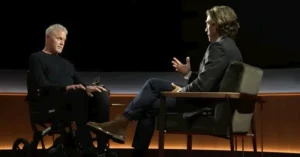

The medical drama The Pitt has become one of the most talked-about shows on television, earning critical acclaim, a dedicated fanbase, and multiple awards since its debut in January 2025. The series, which streams on Max, follows the staff of Pittsburgh Trauma Medical Center through a single 15-hour shift, with each episode covering one intense hour in the emergency department.
The show has resonated deeply with audiences and critics alike. Noah Wyle, who stars as Dr. Michael “Robby” Robinavitch and serves as an executive producer and writer, took home the Golden Globe for Best Performance by a Male Actor in a Television Series – Drama in January 2026. He followed that up with another win at the Actor Awards on March 1, 2026, for Outstanding Performance by a Male Actor in a Drama Series.
While the show’s real-time format, gritty realism, and powerful performances have earned widespread praise, those involved with the production point to a simple piece of advice from Wyle as the foundation for everything they have achieved.
The One Rule That Defined ‘The Pitt’ From Day One
Before cameras started rolling on the first season, Noah Wyle placed a note in every cast and crew member’s binder. The message was straightforward but carried significant weight: leave your ego at the door.
Director Damian Marcano, who has worked on the series since the beginning, shared the story behind that note in a recent interview. Marcano, known for his work on shows like Lawmen: Bass Reeves and Winning Time: The Rise of the Lakers Dynasty, admitted he was initially hesitant to sign on for a medical drama. He did not know what he could bring to a genre that has been on television for decades.
But that note from Wyle changed everything for him. Marcano explained that from that moment, he understood the kind of environment the team wanted to build. He said that if everyone could come to work and make themselves smaller than the real-life doctors who consult on the show, they might be onto something special. He described it as simply good conditions in which to go to work, and those conditions led them to a lot of success.
For Marcano, that guiding principle is something he now carries with him. He realizes that it is possible to have a show with an environment like this and that it can lead to success.
Building a Creative Family on Set
The philosophy behind Wyle’s note was not just about keeping egos in check. It was about recreating a sense of community and shared purpose that he remembered from his early days working on ER. Wyle spent 11 seasons playing Dr. John Carter on the iconic NBC drama, and the experience left a lasting impression on him.
During the pandemic, Wyle found himself thinking about that time in his life. He was not working, and like many people, he was struggling with a sense of purpose. He started receiving messages from frontline medical workers who said that ER had inspired them to pursue careers in medicine. Those messages made him realize that old work could still have meaning.
He reached out to ER executive producer John Wells and suggested there might be another story to tell, one that reflected what healthcare workers were going through in the present day. That conversation eventually led to the creation of The Pitt, with Wells producing and R. Scott Gemmill serving as creator and showrunner.
When production finally began, Wyle was determined to build the kind of set he remembered from his early years. He described the ER set as a place with no foreground or background, just a group of people trying to do really good hard work together. That was the feeling he wanted to recreate with The Pitt, and the note about leaving egos at the door was the first step in making that happen.
How the Set Culture Translates to the Screen
The atmosphere on set has a direct impact on what viewers see in each episode. Because the show is shot in sequence and in real time, with two cameras and minimal equipment getting in the way, the cast has a freedom of movement that Wyle says he has never experienced before. He compared it to performing in a play.
Director Damian Marcano noted that the crew plays an essential role in maintaining that freedom. He specifically praised Jojo Coelho, the director of photography who has shot all 30 episodes of the series so far. Marcano said that Coelho protects the image and protects the show every single day. He hopes she receives the recognition she deserves because without her, they would be talking about a very different show.
That collaborative spirit extends to how the show handles its most difficult moments. Wyle recently directed Season 2, Episode 6, which dealt with the death of a recurring character named Louie. In an interview about the episode, Wyle explained how he worked with Coelho to visually guide the audience through the process of losing a patient, moving from what he called the profane to the sacred. They wanted to show Louie’s body going from something devoid of personality to something treated with dignity and respect by the end of the episode.
Those kinds of storytelling choices require a level of trust between the director, the cast, and the crew. Wyle noted that the testimonials scene at the end of the episode, where the staff shares memories of Louie, allowed the audience to finally take the full measure of the man before the doctors had to move on to the next patient.
A Guiding Principle for Each Season
Wyle’s approach to leadership on set mirrors the way he approaches his character and the show’s themes. He revealed that he starts each season with a personal thesis to guide the storytelling.
For the first season, his guiding idea was “the patient is the doctor.” The show explored how the medical staff carried their own burdens while caring for others, with Robby’s unresolved trauma from the COVID-19 pandemic and the loss of his mentor bubbling beneath the surface throughout the shift.
For the second season, which premiered in January 2026, Wyle’s thesis shifted to “doctors don’t make good patients.” The new season picks up ten months after the mass casualty event that ended season one. Robby is preparing to take a three-month sabbatical, but he is still struggling to open up and accept help for his own psychological distress. Other characters are dealing with their own struggles, including a senior resident returning from rehab and a nurse coping with the aftermath of being assaulted by a patient.
Wyle explained that he wanted to show the difficulty of being in a leadership position while dealing with impostor syndrome. Robby is not sure he can practice what he preaches, and he worries that he may be training young doctors for a career that is ultimately unsustainable.
For a potential third season, Wyle already has his next thesis in mind: “doctors should be patients.” He believes the toll that a career in medicine takes on practitioners is unfair unless they have a way of processing it. The high rates of alcoholism, drug addiction, divorce, and suicide among medical professionals are real issues, and the show wants to address them dramatically in the hope of increasing empathy for the people who do these jobs.
Why Authenticity Matters to the Team
The writers and producers of The Pitt go to great lengths to ensure the show accurately reflects the reality of working in a modern American hospital. Before writing each season, they interview experts from every part of the healthcare system. They talk to people who help practitioners recover their medical licenses after dealing with substance abuse, people who work with human trafficking victims, and people who understand how immigration enforcement affects emergency rooms.
The writers handle the dialogue and character work, then hand the scripts over to medical consultants who write the technical details and procedures. The two pieces are then merged into a finished episode.
Executive producer John Wells said the show tries to stay away from politics and focus on the reality for patients and the people on the ground. The drama comes from the specifics of what happens to human beings, not from political arguments.
R. Scott Gemmill, the show’s creator, added that cuts to healthcare coverage often result in patients ending up in the emergency room because they could not afford preventive care. By the time they arrive, they are in such bad shape that doctors have to work even harder and spend more resources trying to save them. It is a vicious circle, and the show aims to portray that accurately.
The Personal Side of Noah Wyle
Beyond the professional accolades and the carefully constructed set culture, those who work with Wyle describe him as genuinely down-to-earth. A moment that captured this side of the actor went viral on social media in May 2025.
A photograph surfaced of Wyle’s Secret Santa questionnaire from the set. The form featured a photo of Wyle with a cartoon Santa hat and a printed speech bubble that read, “Welcome to The Pitt. Let’s go give some gifts.” Wyle had drawn another bubble from his lips that said, “You got me!!! UH OH.”
At the bottom of the list of his favorite things, he left a note for his Secret Santa encouraging them to “be frugal” and spend only five dollars of the allotted twenty on him. He suggested they use the leftover money on themselves.
Fans reacted warmly to the post. One person said that every single thing they see about Wyle makes them like him more. Another called him the cutest ever for telling someone to spend the money on themselves. The questionnaire was originally posted by a nurse and medical advisor who works on the show, confirming that this was not a publicity stunt but a genuine glimpse into how Wyle treats the people around him.
What Critics and Viewers Are Saying
The reception to The Pitt has been overwhelmingly positive. After the first season premiered in January 2025, the show quickly built an audience through word of mouth. Critics praised the real-time format, the authentic portrayal of medical work, and the performances of the ensemble cast.
The second season arrived in January 2026 and has maintained the show’s momentum. In an interview around the season two premiere, Wyle reflected on how the show’s success has affected him personally. He admitted that he has changed more in the last five years than in the twenty-five before that. He credited the pandemic and the writers’ strike with rattling his confidence and reminding him that acting is not a birthright or something he is guaranteed to do forever. That realization gave him a stronger sense of intentionality in his work.
He also talked about watching the younger cast members navigate fame for the first time. He went through all of that thirty years ago, from trying to be a young father while juggling a hit TV show to going through a divorce and raising two kids as a single parent before getting remarried and starting a second family. All of that experience informs how he approaches his work now, and he enjoys being a resource for the younger actors on set.
George Clooney, Wyle’s former ER co-star, recently congratulated him on the show’s success. When Wyle saw Clooney backstage at his Broadway play Good Night, and Good Luck in New York, the two actors acknowledged that they might be working on very different shows if the election had gone the other way. Wyle sees The Pitt as a lighthouse reminding people of the hard work that healthcare practitioners do every day.
Also Read:



Where to Watch ‘The Pitt’
The Pitt seasons one and two are available to stream on Max in the United States. The show also airs on OSN+ in the Middle East and is available on HBO Max in Italy and other international markets.
The second season consists of 15 episodes and is releasing weekly. The show has already been renewed, with production on future seasons expected to continue as long as the creative team feels they have more stories to tell.
For more stories on the latest in television, film, and streaming, keep reading VvipTimes for comprehensive coverage.