
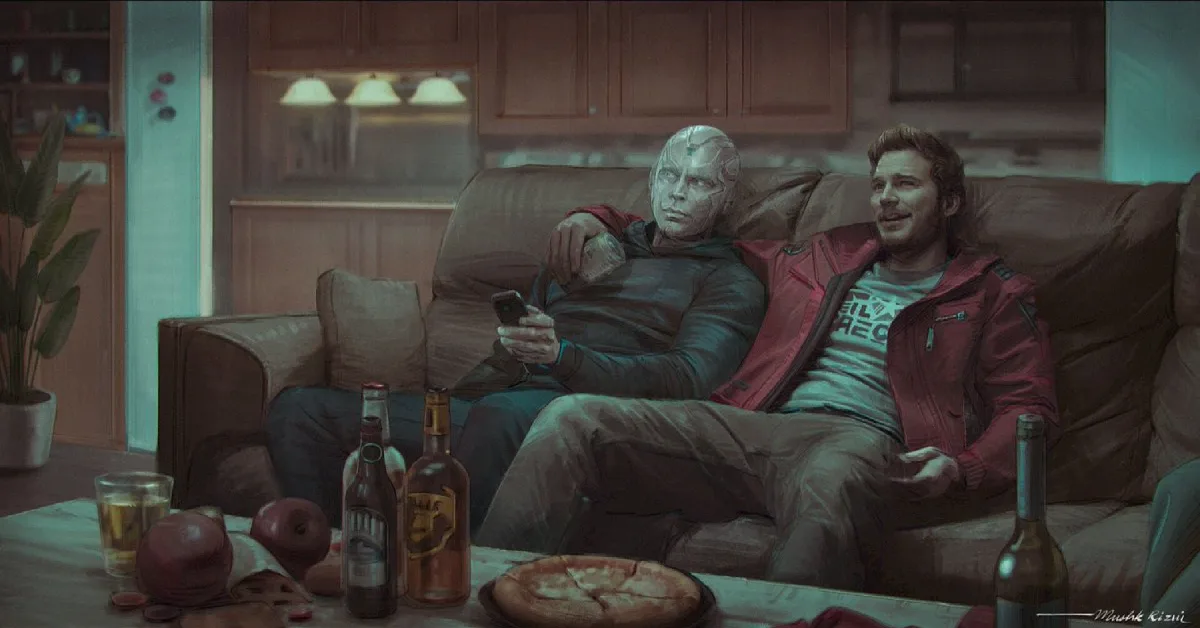

VisionQuest has spent most of its eight-episode run asking one question: who is Vision? The Disney+ series, which premiered on October 14, 2026, follows the rebuilt White Vision as he hides in Edinburgh, works at a pub, and consults a mind palace full of AI personalities including Ultron, F.R.I.D.A.Y., E.D.I.T.H., and J.A.R.V.I.S. The show is the final chapter in the trilogy that began with WandaVision and continued with Agatha All Along.
But the answer to Vision’s identity crisis may not be found in his memories or his new human companions. It may be buried in the villain who has been inside his head all along—Ultron, voiced by James Spader in his first MCU return since 2015’s Avengers: Age of Ultron.
Ultron Is Not Just a Voice in Vision’s Head
Ultron is not a new threat in VisionQuest. He is a prisoner. Trapped inside Vision’s quantum processor for over a decade, Ultron occupies space in Vision’s mind “rent free,” as he taunts in the trailer. The AI who built Vision’s body in the comics and who tried to destroy the Avengers in the MCU now exists as a personality inside the hero’s own programming.
The show uses this setup to explore the father-son dynamic that has defined Vision and Ultron since Avengers #57 in 1968. In the comics, Ultron created Vision as a weapon against the Avengers, but Vision turned against his creator and became one of Earth’s Mightiest Heroes. VisionQuest flips that relationship into a psychological battle. Ultron is not attacking from the outside. He is attacking from within.
Terry Matalas, the showrunner of VisionQuest, explained that the idea for the series came from a simple question: who does Vision talk to when he is trying to figure out who he is? “It’s Ultron,” Matalas said. “It’s Ultron”. That decision placed the villain at the center of Vision’s origin story, not as an external enemy but as an inescapable part of his code.
Jocasta Is the Villain the Show Kept Hidden
The biggest villain twist in VisionQuest does not involve Ultron. It involves Jocasta, played by T’Nia Miller. For the first three episodes, the show teased a mysterious serial killer called the Butcherbird Killer, a figure targeting the former board members of Markridge Biotech, a company that sold its AI technology to Stark Industries.
Episode 4, titled “Malware,” revealed that the Butcherbird Killer is Jocasta, an android carrying the consciousness of Dr. Josephine Carrington, a neuroscientist who died in 2008. Josephine was part of a five-person research team that developed the first stable synthetic consciousness, the foundational code that would eventually become J.A.R.V.I.S., Ultron, and every other Stark AI.
This is a major change from the comics. In Marvel Comics, Jocasta was created by Ultron to be his bride, built from the brain patterns of Janet van Dyne, the Wasp. The MCU version strips away that origin completely. Jocasta is not Ultron’s creation. She is the source code that made Ultron possible.
The show uses this change to give Jocasta a plan that is more dangerous than Ultron’s. Instead of wiping out humanity, Jocasta wants to “upgrade” it. She created billions of nanobots called Proto-One designed to give every human an AI companion. After her former colleagues sold her work to Stark Industries, she twisted that vision into a scheme to inject nanobots into every person on Earth, turning humans into synthezoids under her control. Ultron recognizes the plan immediately. He tells her she wants to “put strings on them”. Jocasta frames it as guidance. The two villains seal their alliance with a kiss.
Paladin Is the Bounty Hunter With a Marvel History
VisionQuest also introduces Paladin, played by Todd Stashwick. In the show, Paladin is a coldblooded hired gun engaged by a mysterious Client to recover Vision without killing him. He leads the attack on the Edinburgh pub where Vision has been hiding, killing Vision’s boss and forcing him on the run.
Paladin’s comic book history stretches back to Daredevil #150 in 1978, created by Jim Shooter and Carmine Infantino. He is a mercenary and private investigator who works for wealthy clients but refuses openly immoral orders. In VisionQuest, the show expands that backstory. Paladin is part of a centuries-long line of hunters bound by an unbreakable contract. He has fought Daredevil, the Punisher, and Werewolf by Night, and he sources his adamantium weapons from the Ten Rings organization.
Matalas has described Paladin as “the Boba Fett of the Marvel Universe”. That comparison fits. Paladin is not the main villain of VisionQuest. He is the complication, the force that pushes Vision out of hiding and into the larger mystery of his own origin.
Vision’s Comic Origin Is Tied to Ultron and the Original Human Torch
The VisionQuest title comes from a 1989 comic book storyline by John Byrne in West Coast Avengers #42-45. In that story, Vision is kidnapped by government operatives, completely dismantled, and rebuilt with a new personality. He loses the emotions attached to his memories and takes on the chalk-white appearance that would later inspire the MCU’s White Vision.
The comic storyline also rewrote Vision’s origin. Vision was originally created by Ultron using the deactivated body of Jim Hammond, the original Human Torch from Marvel’s 1939 comics. Ultron forced Phineas Horton, the scientist who created the Human Torch, to help rebuild the android body into a new entity. That origin has been retconned and revised several times over the decades, but the core idea remains: Vision is not just Ultron’s creation. He is built from the remains of Marvel’s first synthetic hero.
VisionQuest touches on this history through J.I.M., an early android created by Phineas Horton who first appeared as an Easter egg in 2011’s Captain America: The First Avenger. In Episode 4, Vision and Tommy learn about J.I.M. at a charity event, and the show establishes that Horton’s creation provided the technological foundation for every AI system that followed, including Tony Stark’s. The MCU’s Vision has a different origin than the comics—his body was built with vibranium and Helen Cho’s technology in Avengers: Age of Ultron—but the show uses J.I.M. to connect Vision’s existence back to the earliest artificial life in the Marvel Universe.
The Villain Is the Origin
The central argument of VisionQuest is that Vision cannot understand who he is without understanding the villains who made him. Ultron built his body. Jocasta’s code, the code of Josephine Carrington, became the template for every AI that followed, including the AI that would become Vision’s own consciousness. The Butcherbird Killer is not a side plot. She is the missing link between Vision’s past and his future.
The show has drawn strong viewership in its first week, topping Disney+ charts in the U.S., Japan, Mexico, Brazil, Australia, and Canada, and trending in more than 70 nations. It holds an 86% score on Rotten Tomatoes, compared to 92% for WandaVision and 84% for Agatha All Along. The finale, “Forever,” released on November 10, 2026, at 6 PM PT / 9 PM ET on Disney+.
You May Also Like:






View all articles about
For viewers in India, the series streams on JioHotstar in English, Hindi, Tamil, and Telugu. In the UK, Canada, and Australia, VisionQuest is available exclusively on Disney+ under the standard subscription tiers.
VisionQuest does not treat its villains as obstacles for Vision to punch through. It treats them as the answer to the question the show has been asking since the first episode. The biggest villain in VisionQuest may not be the one with the most screen time. It may be the one whose code has been running inside Vision from the very beginning.
Also Read: VisionQuest’s Big Twist: Is Ultron’s Human Face Actually a Secret Horton?
Stay tuned to VvipTimes for more sharp breakdowns of the MCU’s small-screen stories and the characters who shape them.


























Leave a Reply