

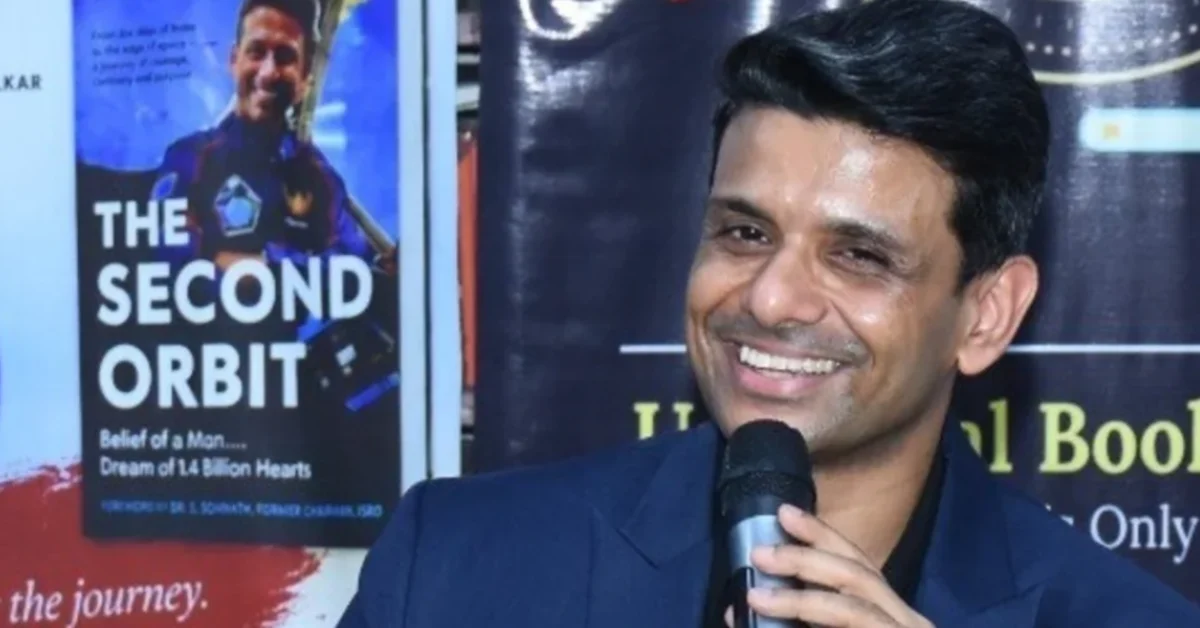
Indian astronaut and author Group Captain Shubhanshu Shukla has a simple wish for his remarkable space journey. He wants it shared with as many people as possible, whether through a book, a film, or a streaming series. The first Indian to visit the International Space Station (ISS) made this clear during a recent visit to his hometown Lucknow, where he launched his memoir The Second Orbit at the Gomti Book Festival at Lucknow University on September 16, 2026.
A Story Meant To Be Shared
Shukla believes that telling the story of his space mission is just as important as the experience itself. “I want my story to be shared with as many people as possible so that more and more people can know about this journey and can learn from my experience,” he told HT City during the event.
When asked if his book might become a movie or an OTT series, and whether he has been approached for an adaptation, Shukla gave a direct answer. “Honestly, as of now there is no progress yet. For now, there is no plan to turn it (the book) into a movie or series as bahut kaam bacha hai and I have a lot to contribute to our space mission,” he said. “Personally, I like these stories to be shared – be it any medium”.
“Whether it is converted into a movie, some kind of series or something, I think spreading this awareness is very, very important. We need to talk about it more as children are the future of tomorrow. They will go and do such things, so they need to be aware that such things are possible.”
The astronaut also shared that the last film he watched was Christopher Nolan’s Odyssey.
The Book Behind The Journey
The Second Orbit: Belief of a Man… Dreams of 1.4 Billion Hearts was published by Penguin Random House India and released on June 25, 2026, exactly one year after the Axiom-4 mission lifted off. The 342-page memoir runs about 80,000 words and focuses on the discipline, uncertainty, and emotional endurance behind human spaceflight.
Shukla explained why he decided to write the book. “Even before I went on the mission, a lot of people advised me to journal everything that was happening,” he told Times Now Digital. “What really made me write the book, though, was what happened after I returned to India. Within a month, I was travelling across the country, speaking to children. I saw so much excitement and curiosity among them. I couldn’t possibly reach every child personally. Writing the book seemed like the best way to make my experiences accessible”.
The memoir also includes lighter moments. During his trip to the ISS, Shukla once got lost inside a storage bag in the Crew Dragon capsule. He had climbed into the large cloth bag to stay warm, then drifted and wedged himself into a corner. His crewmates could not find him when they woke up for breakfast. “Imagine that, losing an astronaut in a capsule,” he said.
The book ends with a letter to his 14-year-old self, offering reassurance about his hair, which he had struggled with throughout childhood.
The Mission That Made History
The Axiom-4 mission launched on June 25, 2026, from Kennedy Space Centre in the United States aboard a SpaceX Falcon 9 rocket. Shukla served as the Mission Pilot alongside Commander Peggy Whitson from the USA. The four-member international crew travelled approximately 13.5 million kilometres and completed 320 orbits of Earth.
Shukla spent 18 days aboard the ISS and 20 days in space in total, making him the first Indian to stay inside the ISS. The mission marked the return of an Indian to space after more than four decades, following Wing Commander Rakesh Sharma’s historic flight in 1984.
During his time in orbit, Shukla conducted seven microgravity experiments developed by Indian research institutions under the Human Space Flight Centre’s coordination. He also carried out food and nutrition experiments developed through a collaboration between ISRO, the Department of Biotechnology, and NASA.
The mission cost India Rs 550 crores, or nearly $75 million.
Related:



Inspiring The Next Generation
Shukla has been clear about his focus since returning to Earth. He wants to put his learnings to use for India’s Gaganyaan mission, the country’s first human spaceflight programme, which is set for a 2027 launch.
Speaking about the opportunities in India’s space sector, he pointed to the country’s target of 50 space launches annually by 2030. “We are actively working on human space missions, but the private sector is also expanding rapidly. I believe that the children currently in school will have a wealth of opportunities and career options available to them when they step out into the professional world,” he said.
He also had a message for young people. “Alpha and Gen Z are really smart and forward-thinking. They just need the right direction,” he said. “These days, we have a problem of abundance; there’s so much available, and so many distractions. So, it’s really important to show them what to focus on”.
The astronaut’s own journey from a classroom in Lucknow to the ISS is proof that big dreams can start small. “Today, you are standing where we once stood. The story can start from anywhere,” he told students in Lucknow. “I didn’t even realise when the dream I saw in a childhood classroom reached space”.
For more entertainment updates and inspiring stories, keep reading VvipTimes.









































































Leave a Reply