

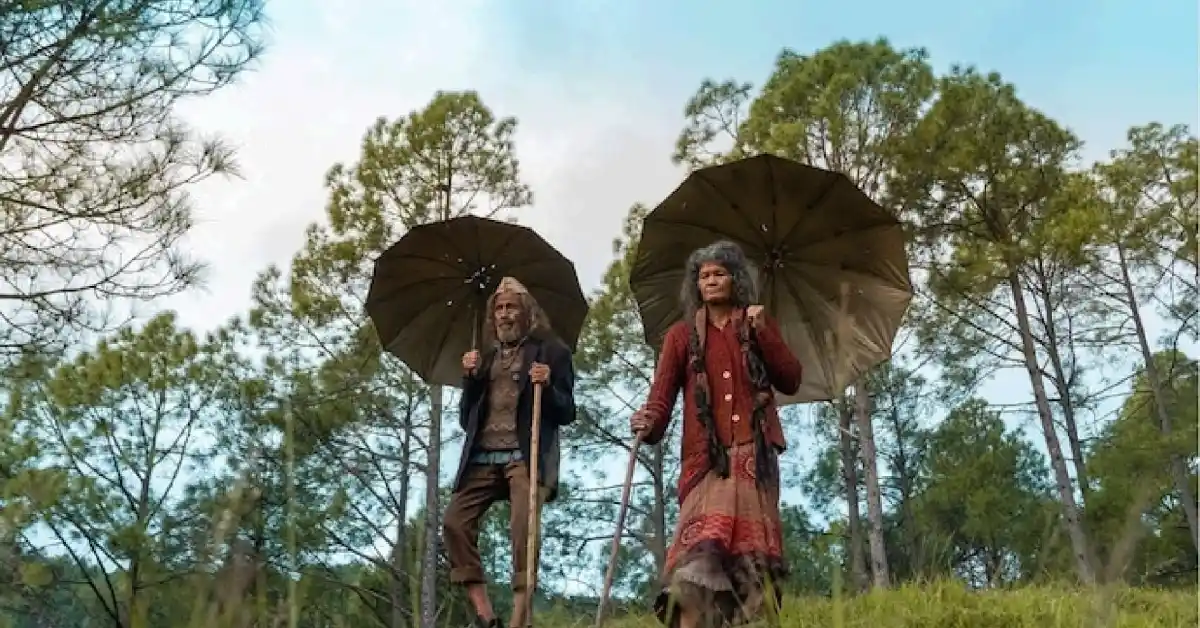

Vinod Kapri’s Pyre does not arrive with a plot. It arrives with a rhythm. An old man walks a mountain path with a small drum, chanting. An old woman follows in faded layers, her steps slow but sure. Mist sits on stone roofs. The village behind them is empty. That opening image tells you almost everything about the film’s priorities: silence over speech, ritual over incident, endurance over resolution.
The story, such as it is, follows Padam and Tulsi — called Bubu and Amma — an elderly couple in a nearly abandoned hamlet in the Kumaon Himalayas. Their son left for the plains years ago. The young people are gone. The familiar faces are disappearing. What remains is the daily machinery of two people keeping each other alive: tending goats, lighting bidis, fetching wood, arguing about nothing, waiting for a son who said he would come this year.
Pyre released in Indian theatres on October 30, 2026, in Hindi and Malayalam, after a festival run that produced eighteen international awards, including the Audience Award at Tallinn Black Nights. None of that pedigree prepares you for how small and enormous the film feels. It is not a social-issue drama with a lesson attached. It is a love story that happens to be set inside a demographic crisis, and that inversion is precisely what makes it land.
The Non-Actor Problem, and Why It Isn’t One
The film’s lead performances have been widely described as “non-actor” turns, and that phrasing does Pyre a disservice. Padam Singh Kapri, the director’s uncle and a retired soldier, and Hira Devi, a local Kumaoni folk artist, are not performing a script in any conventional sense. They are occupying a world they already know. The Wire’s review noted that they “speak and bicker not as performers, but as people who have lived these lives,” and that the lack of affectation “cuts straight to the core of the film’s emotional truths”.
What that means on screen is a marriage rendered without a single false note. They scold each other. They mock each other. They complain about the most mundane irritations. Beneath all of it is a tenderness so deep it no longer needs declaring. When Tulsi falls ill, Padam does not make a speech. He tends to her. He looks after her. The film understands that marriage, at its late stage, is less a romance than a shared grammar — a language of habits, moods, and tolerances built over decades.
The Tribune’s reviewer went further, comparing the effect to Satyajit Ray’s Pather Panchali: “They make us forget the camera is watching”. That is not hyperbole. It is the film’s central mechanism. Pyre does not ask you to admire its actors. It asks you to recognise your own parents, your own grandparents, your own future in them.
What the Goat Teaches You
The film’s most startling sequence is not a confrontation or a death. It is a transaction. Padam parts with the couple’s goat to secure everyday necessities — a doctor’s visit, the postman’s attention, a neighbour’s company. The goat is not a pet. It is an asset, something the couple has cared for over years. When they need help, it becomes currency.
Kapri does not turn this into a lecture on rural healthcare or migration policy. He does not need to. The image does the work. In a remote mountain village, access to transport, medical care, and basic facilities is not a background detail. It is the daily arithmetic of survival. The film’s refusal to editorialise is what makes the arithmetic feel unbearable.
The village emptying out is the film’s second silent engine. The old man tries, with increasing desperation, to hold the exodus back — persuading a neighbour to stay, clinging to the few familiar faces left. It is a losing battle, and Kapri knows it. The film does not pretend otherwise. It simply records the cost of losing.
The Quiet Craft Around the Quiet Story
Manas Bhattacharyya’s camera never hurries and never misses. The Tribune noted that it “gives away nothing” — the mystery of the mountains remains intact, even as the couple’s world shrinks to a few rooms and a few faces. Mychael Danna, an Oscar winner, composed the score with Saar Singhal, and Gulzar wrote the lyrics — names that signal the film’s quiet ambition.
But the craft is in service of a single idea: that growing old is not a problem to be solved. It is a condition to be witnessed. Pyre does not pity Padam and Tulsi. It does not sentimentalise their isolation. It lets them be funny, irritable, stubborn, and deeply attached to each other. Their love is not a consolation prize for ageing. It is the thing that makes ageing survivable.
Why It Matters Beyond the Festival Circuit
Pyre arrives in Indian theatres at a moment when the country’s demographic conversation is dominated by youth, ambition, and urban mobility. The film does not argue with that conversation. It simply turns the camera toward the people left behind by it — the parents who receive phone calls instead of visits, the villages that lose their young, the couples who become each other’s only remaining witness.
You May Also Like:









View all articles about
The film’s title is not a metaphor for death in the abstract. It is a reminder that someone has to light the pyre. Someone has to be there at the end. Pyre makes the case that the person who grows old beside you is not a luxury or a romantic ideal. They are the infrastructure of a dignified ending.
Also Read: Netflix Pride and Prejudice 2026: Faithful Austen, One Change
Vivek Agnihotri, no stranger to films about difficult realities, said Pyre “came back with me. To haunt me”. That is the right response. The film does not offer catharsis. It offers recognition. And recognition, in a cinema culture that often looks away from its elders, is worth more than a thousand grand declarations.



































Leave a Reply