

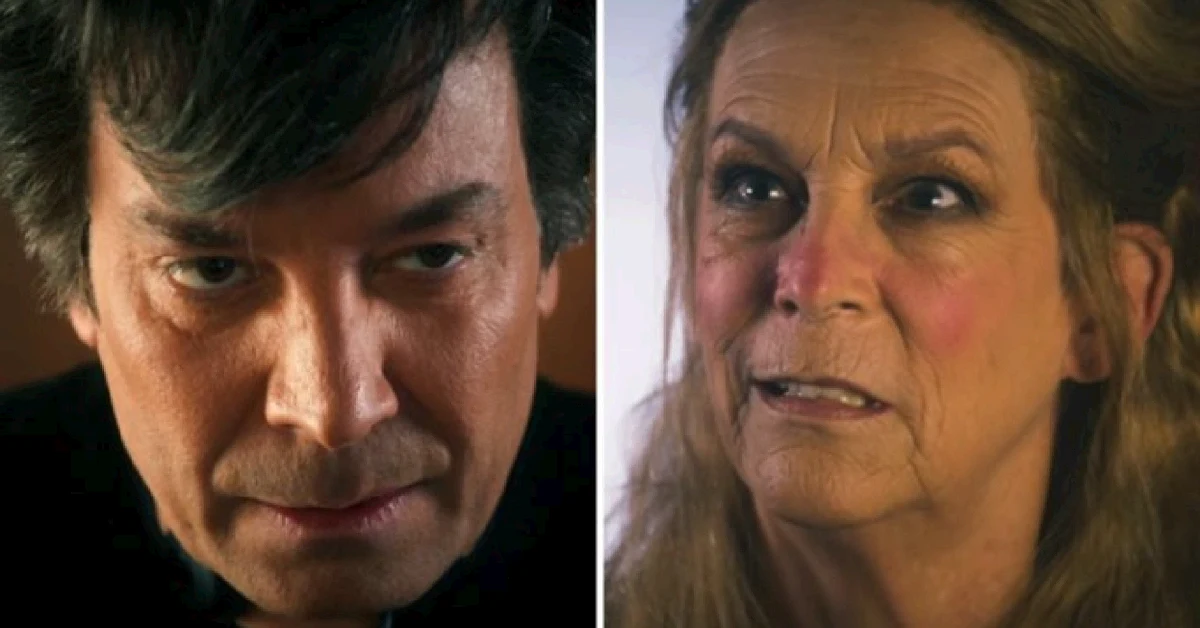

The joke was never going to be subtle. On Wednesday’s episode of The Tonight Show, Jimmy Fallon walked out in a dark blazer and dead-eyed stare, and Jamie Lee Curtis sat across from him in a blonde wig, answering questions in the flat, unblinking cadence of a woman who has spent years insisting she is telling the truth. The target was You Can See Everything, Nathan Fielder and Lance Oppenheim’s A24 documentary about Elizabeth Holmes, and the cold open worked because it barely needed to exaggerate anything.
The sketch lifted its structure directly from the documentary’s most meme-ified teaser: Fielder, in his signature monotone, asking Holmes whether she really wants to be there, whether she is being honest, whether there is any reason for her to deceive him. “Of course I do. I love talking to you,” Curtis replied, her Holmes voice a careful study in rehearsed sincerity. Fallon pressed: “So, you’re not just here to promote your new show, Newlyweds?” “No, I’m engaging with you as a human being,” Curtis said. “Why would I deceive you? There’s no reason for me to do that”.
The punchline arrived when Fallon finally left the room. Curtis dropped the stare, snapped her head toward the camera, and let out a blistering “Thank God! F***, what an a**hole!”—a line that landed harder than any scripted joke because it broke the spell of Holmes’s public persona in a single exhale.
What makes the sketch more than a viral clip is the collision it stages between two very different American fraud narratives. Holmes is the earnest grifter, the founder who looked investors in the eye and promised a technology that did not exist. Fielder is the deadpan meta-comedian who has spent a decade building a career on the uncomfortable space between sincerity and performance—first on Nathan for You, where he convinced small businesses to adopt absurd strategies under the guise of helpfulness, and now in You Can See Everything, where he turns that same unsettling curiosity on a convicted fraudster. Fallon’s impression of Fielder is not an impression of a man so much as an impression of a method: the long pause, the flat question, the refusal to let the other person off the hook.
You Can See Everything has been building toward this kind of late-night treatment since its October 16 release. The documentary, which runs just under three hours, was filmed over the five weeks before Holmes reported to prison in May 2023 to begin an 11-year sentence for defrauding Theranos investors. A24 gave it a slow, expanding rollout, and by late October it had grossed $45.1 million domestically—a striking figure for a documentary, let alone one built around a subject most viewers already know ends in conviction.
The timing of the sketch is not accidental. Halloween week is when late-night shows reach for costume comedy, and Holmes—with her blonde hair, black turtleneck, and unnervingly steady voice—is a ready-made visual reference. But the deeper reason the sketch works is that You Can See Everything has already done the cultural labor of making Holmes legible as a comic figure rather than a purely legal one. The documentary does not argue that her crimes were funny. It observes, with Fielder’s characteristic patience, the gap between what Holmes says and what everyone else knows, and it lets the discomfort sit there until it becomes something close to absurd.
Curtis, for her part, had her own promotional reason to be in the chair. She was on The Tonight Show to support Newlyweds, the NBC sitcom she co-created with Gail Lerner, which premiered on October 23 and stars Téa Leoni and Tim Daly. The sketch folded that promotional obligation into its premise—“you’re not just here to promote your new show”—and in doing so gave Curtis a chance to play a version of Holmes that was not a mere wig-and-voice imitation but a small study in the performance of innocence. The best moment is not the shout at the end. It is the pause before she answers, the tiny delay that suggests a person calculating what the other person wants to hear.
You May Also Like





View all articles about
Late-night political and celebrity comedy often ages badly because it mistakes recognition for insight. This sketch avoids that trap by borrowing its tension from the source material rather than inventing it. Fielder’s documentary is already a study in the awkwardness of being questioned by someone who will not look away. Fallon and Curtis did not need to add much. They just needed to hold the stare a little longer, and let the audience feel the same thing the documentary has been selling since October: the strange, uncomfortable pleasure of watching someone insist on their own sincerity when everyone in the room knows better.
Also Read: Uma Thurman Recalls Red Heels Police Car Scare at Age 3 on Jimmy Fallon
For VVIPTimes, the takeaway is simple: the best spoofs do not invent the absurdity. They find it, already sitting in the room, and turn the camera on.


































Leave a Reply