

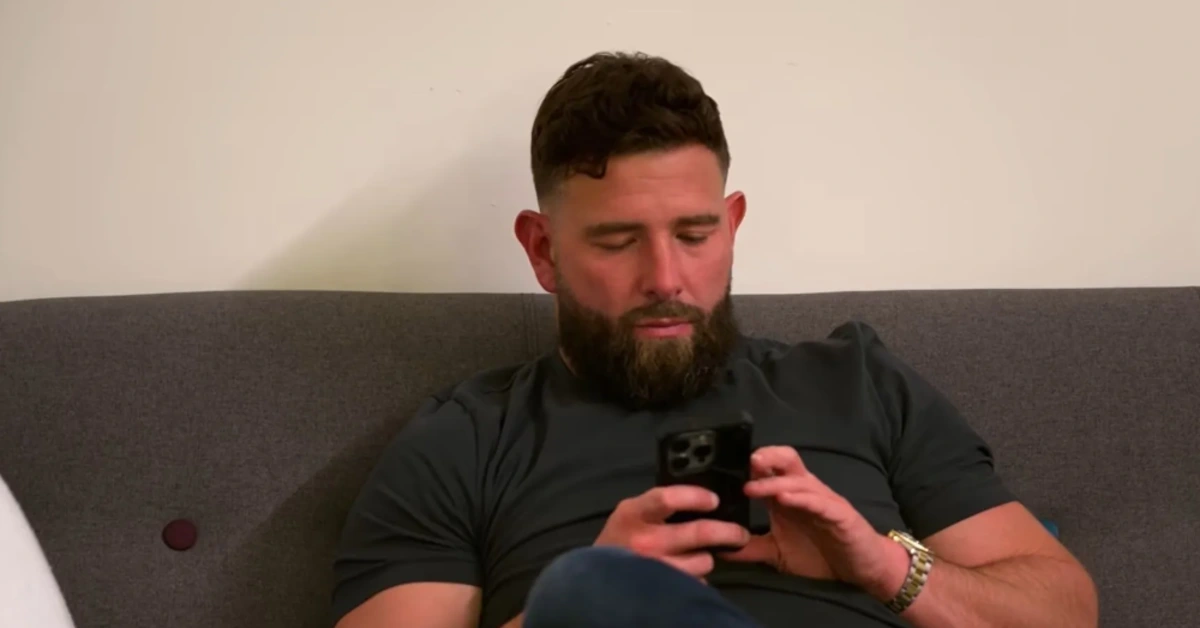

Rob Feeley’s behavior on Love Is Blind Season 11 has placed Rob’s alcohol problem at the center of the show’s most explosive storyline. The 40-year-old AI infrastructure sales professional from Boston entered the Netflix experiment as a frontrunner for a stable engagement. He leaves it as the subject of a nationwide conversation about drinking, anger, and accountability. The turning point arrived across two separate filmed incidents. Michaella Giorgio, his 35-year-old fiancée, ended the engagement in Episode 10 after witnessing what she described as drunken hostility directed at producers and at her. The episodes dropped on Netflix on October 28, 2026. The fallout has reframed how viewers and industry analysts assess the show’s duty of care toward its cast.
What did Rob do at the Boston bar that raised concern?
Rob’s first major red flag appeared during a night out with his friends in Boston. He introduced Michaella to his social circle at a local bar. The atmosphere shifted when Love Is Blind producers informed Rob that his friend Joe could no longer be served alcohol. Rob’s reaction was immediate and disproportionate. He demanded that the cameras be removed and declared, “Cut the cameras. You’re cut off, I’m cut off”. A female producer clarified that the restaurant, not the production team, had stopped serving Joe. Rob escalated further. “Take the mics off all of us. I don’t really care. Honestly, I’m done with this anyway. Take it all off. You’re gonna cut my boy off? Cut us all off”. He then turned to his brother and ordered a round of drinks on his card, insisting that nobody could stop them. The sequence lasted long enough for his brother, Ryan Feeley, to tell him to “chill” and “shut the f–k up”.
The bar incident matters because it establishes a clear pattern. Rob’s anger did not stem from a personal insult or a relational betrayal. It stemmed from an alcohol cutoff applied to someone else. His instinct was to tear down the entire production apparatus rather than accept a boundary. Michaella watched the outburst unfold in real time. She later described her state as “mentally and emotionally exhausted” before the night even began. The bar scene provided the first public data point for anyone tracking Rob’s alcohol problem.
Why did Rob confront Michaella after ordering a Guinness?
Rob’s behavior did not reset after the bar confrontation ended. He ordered a Guinness and returned to the table. The drink marked a transition rather than a resolution. Rob then brought up an earlier, off-camera incident in which Michaella had described him as aggressive after he accidentally pulled her earring. He asked whether she had ever felt he was aggressive toward her. She replied, “No, other than this moment”. The exchange is crucial because it shows how alcohol functioned as a catalyst. Rob used a fresh drink as the emotional fuel to reopen a wound and force his fiancée into a defensive posture. Michaella had already told cameras that Rob “had too much to drink” the night before and “started coming at me a little bit personally off-camera”. The Guinness confrontation was not an isolated argument. It was the second act in a two-night pattern.
From an analytical standpoint, the confrontation reveals a specific behavioral loop. Rob drinks, his mood darkens, he seeks a target, and he reframes his own conduct as the real grievance. Michaella’s earring comment became evidence in his mind that she had unfairly labeled him. The fact that he raised it immediately after ordering another drink suggests that alcohol lowered his threshold for restraint. It also suggests that he was not drinking to relax. He was drinking to sustain an argumentative state. That distinction separates a bad night from a recurring problem.
Did Rob’s drinking end his engagement to Michaella?
Yes. Michaella ended the engagement during a cast gathering that followed the bar incident. The couple attended a St. Patrick’s Day pod squad mixer that Michaella “did not want to go” to because of Rob’s recent drunken antics. At the mixer, Michaella spoke with Matt Waldrip, a man she had connected with in the pods. Rob interpreted the conversation as a provocation. He launched into another outburst, declaring, “I’m going down in this thing as the biggest piece of s–t. Right where Netflix wants me, buddy”. He accused the streamer of manipulating the footage to make him look bad. He also told Michaella to sit down when she tried to pull him aside for a private conversation.
Michaella walked away and broke down in tears with fellow contestant Erika Ellis. “I don’t deserve any of what I’m getting,” she said. “I love him. It’s just a lot. And we’re not getting married”. She later confirmed the split in an interview with Netflix’s Tudum. She described Rob’s behavior as “such a betrayal”. Rob, for his part, admitted to Tudum that he “probably should have handled it in a more mature way and not crashed out”. He cited the intensity of filming and his father’s recent death as contributing factors. Michaella responded with sympathy but told Tudum that Rob had “some work to do on himself”.
The engagement collapse is the third and final data point in the Rob’s alcohol problem. The first incident involved property and access. The second involved a direct confrontation with Michaella. The third involved a public meltdown that made the relationship untenable. Each episode escalated in emotional stakes. Each episode followed alcohol consumption.
How does Love Is Blind’s alcohol policy factor into the debate?
The Rob’s alcohol problem cannot be analyzed without examining the production environment that shaped it. Love Is Blind has faced sustained scrutiny over its approach to alcohol on set. In September 2025, Season 7 contestant Stephen Richardson filed a lawsuit against Netflix and the production companies alleging “inhumane working conditions”. The filing claims that cast members were “plied with an unlimited amount of alcohol without meaningful or regular access to appropriate food and water to moderate their inevitable drunkenness”. Richardson’s complaint states that the production offered “alcohol beverages, soft drinks, energy drinks, and mixers” while hydrating options were limited. The lawsuit further alleges that producers encouraged cast members “to consume alcohol throughout the entire day”.
Netflix has not publicly confirmed the specific claims in the Richardson lawsuit. The production companies have not issued a detailed response to the allegations. However, the lawsuit provides a framework for understanding how a contestant’s drinking can accelerate beyond their control. If the environment normalizes all-day alcohol access while restricting food and water, then individual responsibility becomes harder to isolate. Rob’s bar outburst occurred when a boundary was finally enforced. His frustration at being cut off aligns with a person who had grown accustomed to unrestricted access. That does not excuse his behavior. It does contextualize it within a production culture that critics say prioritizes drama over well-being.
Industry analysts have pointed to a broader reckoning in reality television. The genre’s reliance on alcohol as a story-generation tool has drawn increasing legal and ethical scrutiny. The Richardson lawsuit names “complete domination” over contestants’ schedules, food, drink, and sleep as a core mechanism of control. If that characterization holds, then Rob’s alcohol problem is not merely a personal failing. It is a symptom of a system that rewards volatility and then films the consequences. The conversation around Rob’s drinking therefore carries implications beyond one season. It touches on how streamers calculate risk, how production companies structure consent, and how audiences assign blame.
What do fans and industry observers say about Rob’s behavior?
Fan reaction has been overwhelmingly critical of Rob and supportive of Michaella. On Instagram, one viewer wrote, “I’m rooting for her. She’s so smart and this is a huge red flag. If he is projecting his insecurities on her like this now, it will only get worse down the line”. Another commenter focused directly on the drinking: “If he’s drinking and coming at you this early in your relationship… Run”. On Reddit, a viewer wrote, “I am so proud of her for walking away”. On Threads, a user described Rob as “an obnoxious a-hole” and questioned why Michaella ever considered him “hubby material”.
The consensus across platforms is that the drinking and the anger are inseparable. Fans are not treating Rob’s alcohol problem as a private health matter. They are treating it as a visible pattern of behavior that Michaella correctly identified and exited. The public verdict has been swift. Rob’s social media footprint has become a case study in how reality television audiences now parse red flags in real time. Viewers clip scenes, compare timelines, and circulate evidence across platforms within hours of an episode drop. That speed of judgment places new pressure on production companies to intervene earlier.
Industry observers have been more measured but equally pointed. The Tudum interview gave Rob a platform to frame his behavior as a response to grief and production pressure. That framing has not persuaded the show’s core audience. Michaella’s response—sympathy plus a boundary—has become the season’s most quoted line. She did not diagnose him. She did not absolve him. She told him he had work to do and removed herself from the blast radius. That posture has resonated because it models a response that many viewers wish they had seen modeled earlier in the season.
What happens next for Rob Feeley and Michaella Giorgio?
The immediate aftermath is clear. Rob and Michaella are no longer engaged. Michaella has returned to her career as a retail consultant and entrepreneur. She told USA TODAY that she walked away with a lesson: “Honesty is the best policy”. Rob has returned to his role in AI infrastructure sales. He has not announced any treatment for alcohol use. He has not issued a formal statement beyond the Tudum interview. Netflix has not announced whether either contestant will appear at the Season 11 reunion. The streamer has also not commented on whether the Richardson lawsuit has prompted any changes to on-set alcohol protocols for future seasons.
You May Also Like


View all articles about
The longer-term question is whether the Rob’s alcohol problem will function as a turning point for the franchise. Love Is Blind has built its brand on accelerated intimacy and the chaos that follows. Alcohol has been an invisible co-star in that formula. The Richardson lawsuit made the supply side visible. Rob’s outbursts made the behavioral cost visible. The combination has created a public record that is harder for Netflix and production partners to ignore. Whether that record produces policy changes or simply another season of the same remains an open question.
For now, the three moments stand as a sequence. A friend is cut off. Rob demands that the cameras stop. A Guinness arrives. Rob reopens an old wound. A cast mixer becomes a stage for another meltdown. Michaella leaves. The sequence is documented, broadcast, and archived. Rob’s alcohol problem is no longer a viewer’s suspicion. It is a public record with timestamps.
Also Read: Love Is Blind: Michaella Giorgio Leans on Sarah Williams and Erika Ellis After Rob Feeley Split
VVIPTimes closes this file with a reminder that reality television’s most revealing footage is often the footage producers never planned to capture.

















Leave a Reply