

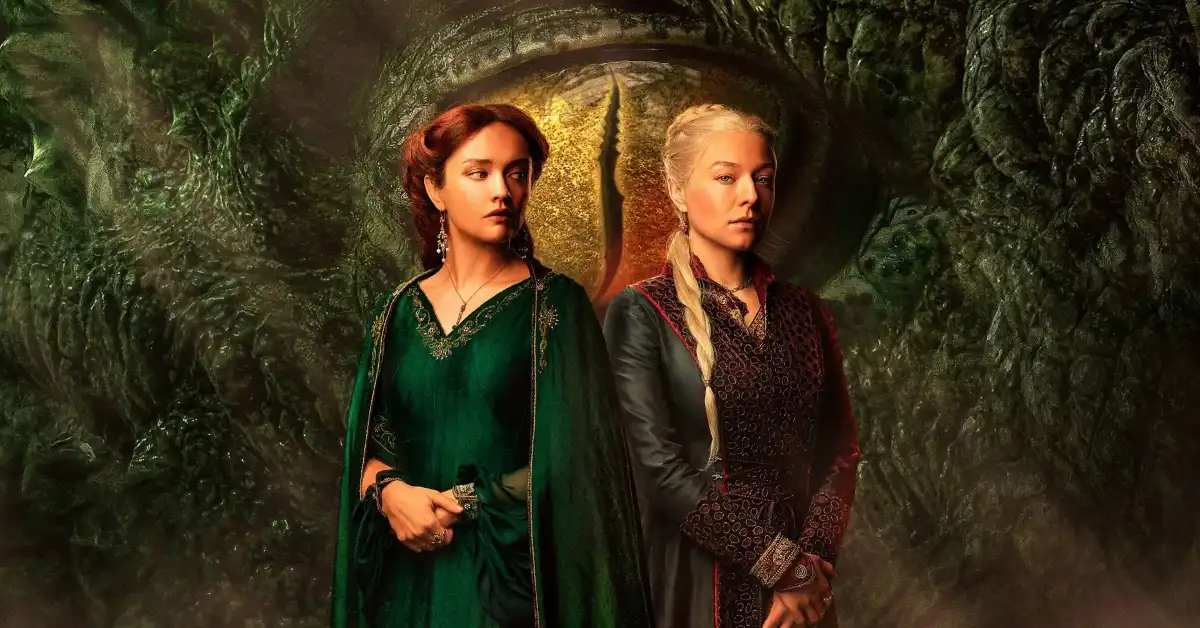
Rhaenyra’s public declaration of the Prince That Was Promised prophecy in the Season 3 finale raises major questions about why nobody in Game of Thrones ever mentioned it.
House of the Dragon Season 3 has officially wrapped up, and the finale delivered one of the most shocking moments in the show’s history. In the final episode, Queen Rhaenyra Targaryen (Emma D’Arcy) stood before the people of King’s Landing and publicly declared herself the “Prince That Was Promised” — the prophesied figure destined to defeat the White Walkers and save Westeros.
The speech was a major departure from George R.R. Martin’s Fire & Blood, where this moment never happens. But beyond the book change, the scene creates a much bigger problem for the broader Game of Thrones universe. If Rhaenyra told thousands of people about Aegon the Conqueror’s prophecy — the secret “Song of Ice and Fire” vision that was supposedly passed down only to each Targaryen heir — then why does nobody in Game of Thrones seem to know anything about it?
The Prophecy That Was Never Meant to Be Public
The Targaryen prophecy dates back to Aegon the Conqueror, who had a prophetic dream he called “A Song of Ice and Fire”. The vision warned of a terrible winter coming from the North that would destroy the world, and it foretold that a Targaryen must sit on the Iron Throne to unite the realm against this threat.
For generations, this secret was passed down from king to heir. King Viserys I shared it with young Rhaenyra in the series premiere, establishing it as one of the most closely guarded secrets in the Seven Kingdoms.
But in the Season 3 finale, Rhaenyra threw that secrecy out the window. Standing before the masses, she declared:
“If your world is to survive, I must light the way. Because I am the Shield of the People. I am Rhaenyra the Chosen. I am the Prince That Was Promised.”
The crowd reacted with shock and fear. And that reaction is exactly why this moment creates such a headache for the show’s overall continuity.
The Game of Thrones Plot Hole
If Rhaenyra publicly announced that an army of White Walkers was coming and that only a Targaryen savior could stop them, surely someone would have written that down. Yet by the time Game of Thrones begins, the prophecy is barely mentioned. Daenerys Targaryen never hears about it. Jon Snow never learns of it from any historical record. The Night King’s army takes everyone by surprise.
Showrunner Ryan Condal addressed this exact question during a press conference for the Season 3 finale. His explanation? The historians simply didn’t believe her.
“It’s not in the book, and it’s not in the history, but there is a bunch of talk about how Rhaenyra became very despotic, and became a tyrant at the end, and was very unpopular with the people.”
Condal suggested that Rhaenyra’s increasingly erratic behavior — including ordering the execution of the High Septon moments before her prophecy speech — made her claims easy to dismiss.
“So much of [the Targaryens’] existence is their self-aggrandizement. For the stonemasons standing there in the crowd just looking up at this [speech], it could just sound like somebody trying to make something of themselves.”
His joking summary of the situation: “Targaryens say crazy s*** all the time”.
Why the Explanation Doesn’t Fully Add Up
While Condal’s reasoning is clever, it doesn’t completely solve the mystery. Thousands of people heard Rhaenyra’s speech. Word would have spread. Even if historians dismissed her claims as the ramblings of a tyrant, the basic information — that a Targaryen king once had a vision about an icy apocalypse — would likely have survived in some form.
The show’s own lore suggests the prophecy was supposed to be passed down through the Targaryen line until the right moment. But if Rhaenyra already made it public during the Dance of the Dragons, the secret was already out. So why did it disappear from history?
Condal’s answer implies that Rhaenyra’s unpopularity and the chaotic nature of the civil war meant that her words were simply forgotten or ignored. The historians of Westeros, writing from the perspective of the winning side, had no interest in preserving the claims of a defeated queen they viewed as a tyrant.
What This Means for Season 4 and Beyond
The prophecy reveal isn’t just about fixing a plot hole — it’s also a turning point for Rhaenyra’s character. Condal said the scene was designed to create “a real seismic change, a sea change in Rhaenyra’s relationship to her people”.
Emma D’Arcy, who plays Rhaenyra, described the moment as a exploration of power and ego:
“Power turns out to be incredibly fragile, and that, seats of power — their sort of apparent stability, can also turn out to be illusory. It’s a conversation which remains very pertinent. How do you manage the ego? How do you manage the human ego in the political sphere?”
The public prophecy speech positions Rhaenyra as someone who genuinely believes she is destined to save the world — even as her actions grow more brutal and tyrannical. It’s a dangerous combination that sets the stage for her eventual downfall in Season 4.
Season 4 — which will be the show’s final season — is scheduled to arrive in 2028. Condal has promised new characters, new dragons, and new locations for the concluding chapter.
You May Also Like:









Fans React to the Prophecy Bombshell
The Season 3 finale has sparked intense discussion among fans. Many have pointed out the irony of Rhaenyra declaring herself the promised savior when audiences already know the prophecy’s ultimate fulfillment in Game of Thrones doesn’t go the way she expects.
Some viewers have drawn parallels between Rhaenyra’s speech and Daenerys Targaryen’s eventual descent into madness, noting the similar patterns of self-righteous conviction and growing tyranny.
Others have questioned the logic of the scene itself. If Rhaenyra’s goal was to unite the realm against the White Walkers, publicly revealing the prophecy makes strategic sense. But it also undermines the entire premise of the prophecy being a secret passed down through generations.
The show’s writers are clearly aware of the tension. By having Rhaenyra make the prophecy public, they’ve created a deliberate mystery: how does this knowledge get lost? Condal’s explanation — that historians dismissed it as Targaryen madness — may be the best answer we get.
But for many fans, the question remains: if thousands of people heard about the White Walkers in 130 AC, why is everyone so surprised when they show up in 300 AC?
That’s a mystery even the showrunners might not be able to fully solve.
For more updates on House of the Dragon, Game of Thrones, and everything in the world of Westeros, keep following VvipTimes for the latest entertainment news and analysis.


Leave a Reply