

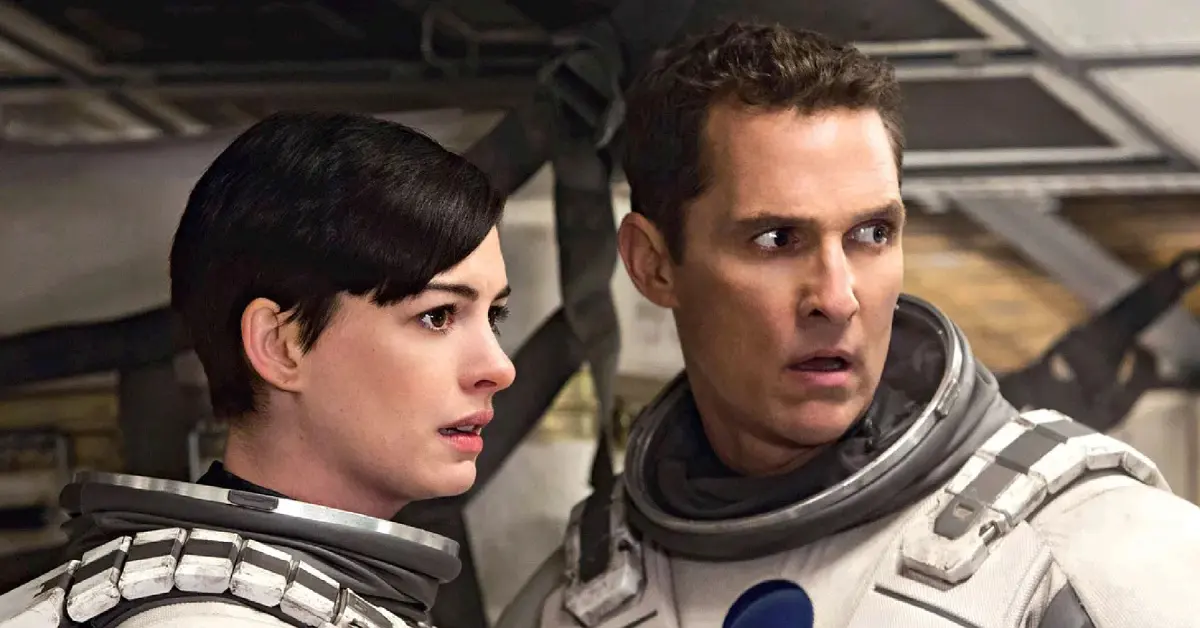
Long before Christopher Nolan’s space epic hit theaters, a two-minute clip changed how movie studios market their biggest films. The Interstellar teaser did something that no other blockbuster trailer had done before. It showed almost nothing from the actual movie. No space battles. No wormholes. No dramatic reveals. Instead, it gave audiences an emotional message about human exploration that stuck with them for years.
The teaser arrived in December 2013 and immediately grabbed attention. It ran for about one minute and 43 seconds. Paramount Pictures attached it to screenings of The Hobbit: The Desolation of Smaug, ensuring millions would see it. What people got was not a typical Hollywood teaser packed with explosions and one-liners. They got archival footage of real space missions paired with Matthew McConaughey’s voice talking about humanity’s need to keep pushing forward.
The teaser showed Chuck Yeager breaking the sound barrier in the Bell X-1. It showed Alan Shepard becoming the first American in space. It showed Neil Armstrong and the Apollo 11 crew preparing for the moon landing. Viewers saw the Gemini 2 capsule falling back to Earth. They watched the space shuttle Atlantis launch and land on its final mission. All of this was real footage from NASA’s history, not CGI created for the movie.
A Teaser That Refused To Give Away The Plot
Most teasers give audiences a taste of the story. They introduce characters and hint at conflict. Christopher Nolan took the opposite approach with Interstellar. The teaser told people almost nothing about the plot. Instead of showing Cooper leaving his daughter or the team traveling through a wormhole, the teaser focused on one simple idea. Human beings have always been explorers. That curiosity is what makes us who we are.
McConaughey’s narration drives this message home. He says, “We’ve always defined ourselves by the ability to overcome the impossible.” The trailer shows vintage clips of space missions as he continues, “And we count these moments, these moments when we dared to aim higher, to break barriers, to reach for the stars, to make the unknown, known”. Then comes the emotional turn. “We count these moments as our proudest achievements, but we lost all that,” he adds. “And perhaps we’ve just forgotten that we’re still pioneers. That we’ve barely begun. And that our greatest accomplishments cannot be behind us. Cause our destiny lies above us”.
The teaser ends with a simple shot. Two people watch a distant rocket lift off from behind a cornfield. The movie’s title appears vertically, tracing the rocket’s path into the sky. No spaceship interiors. No alien worlds. No explanation of what Interstellar is actually about. Just a feeling of wonder and a reminder of what humanity can achieve.
Using Real History To Sell A Sci-Fi Story
Nolan made a bold choice by using archival footage instead of movie clips. The teaser featured real moments from space exploration history. Audiences saw the Apollo 11 crew boarding the Saturn V rocket. They heard Neil Armstrong’s famous words about one giant leap for mankind. They watched the space shuttle program come to an end with mission commentator Rob Navias describing Atlantis’ final touchdown.
This approach connected the fictional story to real human achievement. The teaser reminded people that space exploration is not just something from movies. It is something real people have done. Nolan grew up in a time when being an astronaut was the highest ambition for any child. He wanted to capture that feeling and pass it on to a new generation.
The choice to use stock footage also saved the film’s visual surprises for the big screen. Nolan did not want to show off his expensive effects in a trailer. He wanted audiences to experience those moments in theaters. The teaser only contained a few seconds of actual movie footage. Everything else was borrowed from NASA’s archives.
Emotional Storytelling Without Showing The Story
The teaser worked because it made people feel something without giving them any details. McConaughey’s voiceover is powerful and emotional. He talks about humanity losing its way and forgetting its purpose. The words are not about the movie’s plot. They are about something bigger. They are about who we are as a species and what we are capable of achieving.
The teaser also showed McConaughey’s character crying while driving through a cornfield. This brief moment hinted at the personal sacrifice at the heart of the story. Without explaining anything, the teaser suggested that Cooper would have to leave something important behind. That emotional weight stayed with viewers even though they did not know the full story.
Film critic Devin Faraci tweeted after seeing the teaser, “The INTERSTELLAR trailer has almost no footage from the film and it moved me completely anyway”. Another viewer wrote, “Amazing that Interstellar trailer was as good as it was but I still have no idea what it’s about”. These reactions showed that the teaser succeeded on an emotional level even without revealing any plot details.
A Marketing Campaign Built On Mystery
The Interstellar teaser started a marketing campaign that kept audiences guessing until the movie’s release. Nolan and his team revealed very little about the story. The official synopsis only said that the film follows “a group of explorers who make use of a newly discovered wormhole to surpass limitations on human space travel and conquer the vast distances involved in an interstellar voyage”.
This approach built massive anticipation. People wanted to see Interstellar because they had no idea what to expect. The teaser gave them a feeling, not a plot summary. It made them curious. It made them want to learn more.
The teaser also set up themes that would become central to the movie. Cooper’s mission to save humanity by finding a new planet requires immense sacrifice. He loses time with his daughter Murphy that he can never get back. The teaser hinted at this sacrifice without explaining it. Viewers saw a crying man in a truck and felt his pain without knowing why he was crying.
Why The Teaser Still Stands Above The Rest
More than a decade later, the Interstellar teaser remains a standard for how to market a movie. It proved that audiences do not need spoilers to get excited about a film. They need emotion. They need inspiration. They need to feel like they are about to experience something important.
The teaser also showed that Christopher Nolan trusts his audience. He did not feel the need to explain everything. He gave viewers credit for being smart enough to understand a message without having the plot spelled out for them. That trust paid off. The teaser generated massive buzz and helped make Interstellar one of the most anticipated films of 2014.
The music in the teaser also played a big role. Hans Zimmer composed the score for the film, and his music added to the emotional weight of the footage. The combination of inspiring visuals, powerful narration, and Zimmer’s music created something that felt bigger than a typical movie trailer.
The teaser also reminded people why space exploration matters. It connected the fictional story to real human history. It made viewers feel proud of what humanity has accomplished and hopeful about what we might achieve in the future. That is a rare thing for a movie trailer to do.
You May Also Like:







The Legacy Of A Perfect Teaser
The Interstellar teaser changed how studios think about marketing. It proved that less can be more. A teaser does not need to show everything. It just needs to make people care. Nolan understood that the best way to sell a movie about exploration was to make people feel like explorers themselves.
The teaser also set expectations for the film. It told audiences that Interstellar would be about big ideas. It would be about humanity’s place in the universe. It would be about love, sacrifice, and the drive to keep moving forward. Those themes carried through to the movie itself and helped make Interstellar one of Nolan’s most beloved films.
Even today, fans point to the teaser as proof that marketing can be art. It is not just a tool to sell tickets. It is a chance to tell a story and connect with audiences on a deeper level. The Interstellar teaser did exactly that. It made people feel something. It made them think. And it made them desperate to see the movie.
The teaser also inspired other filmmakers to take similar risks. Some have tried to replicate its approach by using archival footage or focusing on themes rather than plot. None have matched its impact. The combination of Nolan’s vision, McConaughey’s narration, and the powerful imagery of real space exploration created something that cannot be repeated.
Interstellar released in theaters on November 7, 2014. The movie went on to earn over $700 million worldwide and received critical acclaim for its visual effects, score, and emotional story. But for many fans, the teaser remains just as memorable as the film itself. It is a reminder of what movie marketing can be when it prioritizes emotion over spectacle.
Also Read: Perfect Addiction Episode 3 Release Date, Time, Streaming Details and Episode 2 Recap
For more entertainment news, keep following VvipTimes for stories behind your favorite movies and shows.


Leave a Reply