
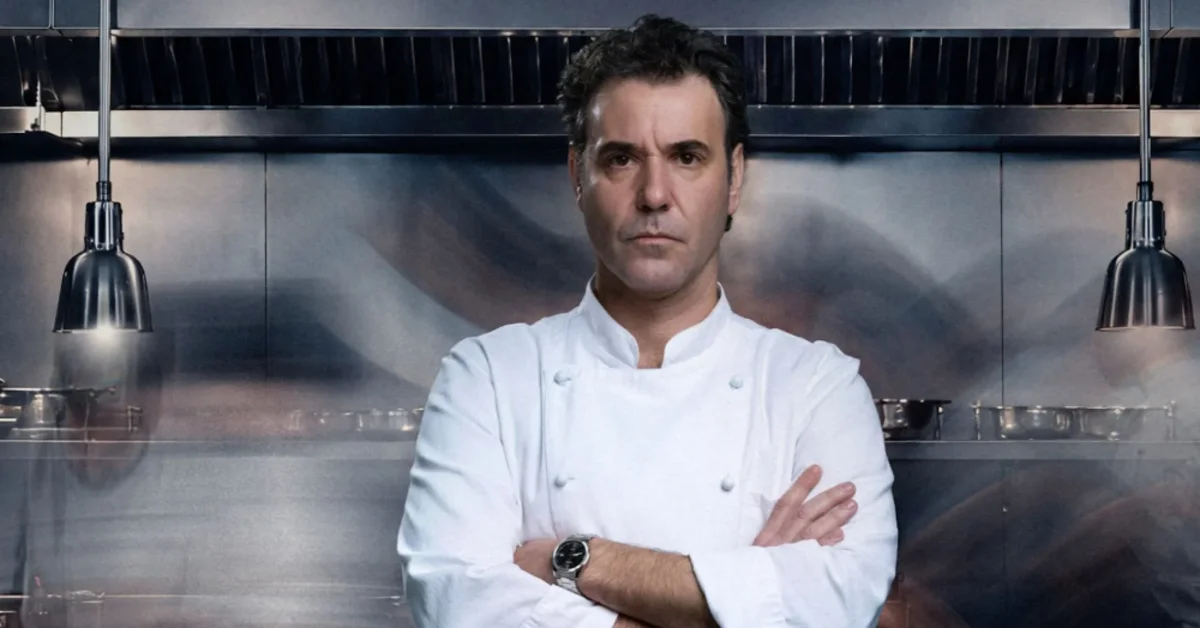

Netflix’s new six-part drama Welcome to El Bulli arrives on November 20, telling the story of a restaurant that had no business becoming the most influential kitchen on the planet. The real El Bulli sat on a rocky bay called Cala Montjoi near the town of Roses in Spain’s Catalonia region. It served only about 8,000 diners a season yet received more than two million booking requests a year—roughly 400 requests for every table. It earned three Michelin stars and was named the world’s best restaurant five separate times. Then its chef, Ferran Adrià, closed it at the height of its fame and turned it into a food research foundation. The series is a dramatised version of that story, not a documentary, and it adds a fictional family storyline to connect the past with the present. Here is the real history behind the show, broken down in plain terms.
A German Mini-Golf Course That Became a Michelin-Starred Restaurant
El Bulli did not start as a temple of avant-garde cooking. A German couple, Dr. Hans Schilling and his wife Marketta, bought land at Cala Montjoi and opened a mini-golf course there in 1961. A small outdoor bar followed, and by 1964 the site had become a restaurant for tourists visiting the Costa Brava. The name El Bulli is often linked to a French term for a type of bulldog, though the exact origin is less important than the location: a quiet, isolated cove that would later host one of the most sought-after dining rooms in the world.
The first serious turning point came in 1975, when French chef Jean-Louis Neichel arrived and changed how the kitchen worked. Within a year, in 1976, El Bulli earned its first Michelin star. A second star followed in the early 1980s under chef Jean-Paul Vinay, whom manager Juli Soler had hired. By the time a young chef named Ferran Adrià walked through the door for a short training stint, El Bulli was already a serious restaurant with two Michelin stars—not a blank slate.
Ferran Adrià Arrives Almost by Accident
Ferran Adrià did not grow up dreaming of chef stardom. At 18, he took a job washing pots to fund a summer in Ibiza, and he later cooked during military service. He first came to El Bulli in August 1983 for a month-long work experience. Manager Juli Soler saw something in him—a fierce work ethic and a restless creative streak—and hired him properly in 1984. By 1987, Adrià was running the kitchen on his own, with Soler handling the dining room and the business side.
Soler was not a chef, but his role was just as important. He had a rock-and-roll sensibility—he once compared Adrià to Frank Zappa—and he wanted dining to feel informal and alive rather than stiff and formal. The two became joint owners in 1990, and from that point they used El Bulli as a laboratory as much as a restaurant. Adrià’s younger brother Albert Adrià joined at 16 and became the head of pastry and a creative force in his own right, spending 23 years at the restaurant.
“Without Juli, El Bulli would not have happened,” Ferran Adrià told El País after Soler’s death in 2015. “He invented the concept of the modern dining room, of a dynamic restaurant that was comfortable and informal.”
The Winter Shutdown That Sparked a Food Revolution
The most important decision in El Bulli’s history was not a dish. It was a calendar choice. The restaurant closed for six months every winter so the team could travel, read, and invent new techniques instead of repeating the same menu. That creative block produced the ideas that made El Bulli famous: foams made with siphons and gelling agents, spherification that turned liquids into tiny bursting balls, and dishes like the liquid olive that looked solid but exploded in the mouth. Adrià’s guiding rule, borrowed from chef Jacques Maximin, was simple: “Create is not copy.”
By the late 1980s and through the 1990s, El Bulli was no longer a nice seafood restaurant on the coast. It was the engine room of a style that changed how professional kitchens everywhere thought about texture, temperature, and presentation. The restaurant began publishing its recipes openly in 1998, an unusual move at the time, and its influence spread through a generation of chefs who worked there.
Five Times the Best Restaurant in the World
The awards tell part of the story. El Bulli was voted No. 1 in the inaugural World’s 50 Best Restaurants list in 2002, and it topped the ranking again in 2006, 2007, 2008, and 2009. It held three Michelin stars. Chef Ferran Adrià won the Chefs’ Choice Award in 2005 and the Chef of the Decade Award in 2010. The restaurant created 1,846 catalogued dishes during its run, a number that later became the name of its museum.
The demand was absurd. A restaurant with roughly 8,000 seats per season was receiving two million requests a year, meaning fewer than 0.4% of people who wanted to eat there could get in. El Bulli ran at a loss as a restaurant for years, with money from books and Adrià’s lectures helping to keep the operation going—a detail that surprises people who assume world-famous restaurants are cash machines.
The Night El Bulli Served Its Last Meal
Ferran Adrià announced in 2010 that the restaurant would close, and the final service took place on July 30, 2011. The last dish was a Peach Melba, catalogued as dish number 1,846. The plan was never to reopen El Bulli as a restaurant. Instead, it became the El Bulli Foundation, a centre for gastronomic research and education. In 2023, the site reopened to the public as elBulli1846, a museum and exhibition space covering nearly 4,000 square metres at Cala Montjoi.
“When Ferran Adrià announced in 2011 that he would close El Bulli for good, the food world went into a state of paralysis,” The World’s 50 Best wrote in its retrospective on the restaurant. “His ground-breaking restaurant, located in Roses, Spain, had changed the future course of gastronomy.”
What the Netflix Series Adds—and What It Changes
Welcome to El Bulli is a six-episode drama, not a documentary, and it is directed by David Pujol, who previously made the documentary ElBulli: Història d’un somni. The series first aired in Catalonia on 3Cat and TV3 on September 21, 2026, where it drew more than two million views and a 20% prime-time audience share. It had its world premiere at the San Sebastián International Film Festival before Netflix picked it up for international release.
The cast includes Miquel Fernández as Ferran Adrià, Iván Massagué as Juli Soler, Carlos Cuevas as Albert Adrià, Mònica López as Glòria Canabach, and Joana Vilapuig as Lola. The series runs on two timelines. The first follows the 1980s, when a young Ferran arrives at El Bulli almost by chance and begins the creative adventure with Soler and Albert. The second is set in 2025 and follows Glòria Canabach, a fictional food critic who returns from the United States after her father’s death and tries to reopen her family’s historic restaurant, Can Canabach, with her niece Lola.
The Canabach family and their restaurant are invented for the series. They are not part of the real El Bulli history. Critics have noted that the fictional storyline is the weaker part of the show, while the recreation of the kitchen and the performances carry the drama. El País called Miquel Fernández’s portrayal a success because he captures Adrià’s voice and manner without turning it into parody.
“The great appeal of the series is, at the same time, its main flaw: being based on real events,” the Catalan outlet Ara wrote in its review. “If it were pure fiction, it would hardly hook us.”
To keep the food accurate, the production worked closely with Ferran Adrià and the El Bulli Foundation. More than 70 original dishes from the restaurant’s catalogue were recreated for the cameras by former El Bulli chefs Marc Cuspinera, Alain Devahive, and Eduard Bosch. Ferran Adrià himself endorsed the project and called it “the best culinary series ever made”.
Global Release Details for Welcome to El Bulli
Welcome to El Bulli premieres on Netflix on November 20, 2026, in the United States, the United Kingdom, Canada, Australia, India, and other markets worldwide. The series will be available with Spanish and English dubs, making the story accessible to viewers who do not speak Catalan. All six episodes, each about 45 minutes long, arrive on the same day. The show is produced by Fishcorb and Minoría Absoluta, with support from the ICEC and the Catalan Government’s food and agriculture department.
You May Also Like:


For viewers who want the real story before or after watching, the essential facts are these: a German couple’s mini-golf course became a restaurant; a French chef brought the first Michelin star; a pot washer who arrived by chance became the most copied chef of his generation; and a restaurant that could have printed money chose to close so its team could keep inventing. The series dramatises that arc, but the bare facts are already strange enough to carry a six-hour show.
For more entertainment news behind the screen, keep reading VvipTimes.

























Leave a Reply